The myth of the rational voter is a great book by Bryan Caplan about how democracies make predictable errors because people are biased against certain beliefs. The video below gives a good synopsis of his arguments
The belief that people having incorrect beliefs will not be a problem is called "The miracle of aggregation" where people don't know much all disagree with each other and those small number of people who do know something are the ones who are left after all the noise is cancelled out. But because these beliefs are not randomly wrong but biased to one side this cancelling out doesn't happen.
He talks about the economic areas of being anti market, making work for the unemployed, anti foreigners and that people are too pessimistic and how general opinion on these issues disagrees with that of economists. You could argue that the people are right and economists wrong on these issues but generally people who are experts in a field tend to know more about it. If you disagree I am available for entirely unqualified and haphazard brain surgery if you want to put your brain where your mouth is.
But what about non economic questions? Are there scientific questions people get wrong that might result in voting based on a mistaken view of how the word works. There is a poll about scientific question that takes place across many countries called the National Science Foundation, Science and Engineering Indicators which asks what it thinks are basic science questions everyone should know the answer to.
If many people get the wrong answer about these questions, and the question is important from a policy point of view then this poll will show an area the voter is likely to be irrational about and we will get bad policy in that area.
· The center of the Earth is very hot. (True) 78.0% of Americans in 2006 got this right.
A politiician who did not believe this might have a hard problem supporting geothermal heating. But geothermal is not that big a source of energy so it would mess things up very badly.
· All radioactivity is man-made (False) 73.0% got this right.
Without realising this you might overestimate the risk man made radioactivity is going to cause. I am willing to bet the 27% of people who didn't know this might be less in favour of nuclear power stations. But I really don't know if more nuclear power is a good policy. Lovelock and Brand say it is. Unless I can prove the connection between holding the belief that all radioactivity is man made and being anti nuclear power it is a stretch to claim this false belief harms us.
· It is the father’s gene that decides whether the baby is a boy or a girl (True) 62.0% got this right
Many parents want male children and without realising this then women could get blamed as the female kids are their fault. I'm not sure what political policies would change if you did get this wrong though. Sex selective abortion seems wrong whether you understand the y chromosome or not.
If more people understood the sperms role in sex selection more sperm sorting techniques could be used. This might result in lower numbers of children in those who want to 'balance out' their families.
· Lasers work by focusing sound waves (False) 42.0%
'over 25% of the GDP of developed countries is directly based on quantum physics' someone who got this wrong would have very wrng views about something fairly fundamental to the modern economy.
· Electrons are smaller than atoms (True) 45.0%
Similar issue with understanding one of the main sources of income in a modern economy. Could someone who got this wrong really hope to decide between investing research money in on scientific field or another?
To be fair I might get this question incorrect. Electrons do not really have a size. As wikipedia says "the electron has no known substructure.[2][72] Hence, it is defined or assumed to be a point particle with a point charge and no spatial extent". This question is a bit like asking is a car smaller than hope. The question doesnt really make sense.
· Antibiotics kill viruses as well as bacteria (False) 54.0%
This one is really important. Overuse of antibiotics is making them less effective. Megan Mcardle has a great piece on the problem here.
Some people give antibiotics credit with increasing our life expectancy by about 8 years and no one thinks they have had a tiny role in our large life expectancy increase during the 20th century.
Getting antibiotics policy wrong is a really big issue and one the public get wrong. You don't hear politicians on the "If you vote for me you wont get penicillen for your earache" platform. This is an important issue probably up there with the economic ones Caplan describes in his book.
I have heard Michael Graham on Irish radio saying he doesnt care about politicians opinion on evolution because it will not effect how well they govern. The case of antibiotic resistance shows how important it might be to have politicians who accept evolution as it is in progress in this case limiting the power of one of our most important healthcare tools. I get the feeling many of these questions are actually about aligning yourself with literal interpretation of the bible rather than science knowledge.
This is one area public health campaigns are trying to explain
· The universe began with a huge explosion (True) 40.0%
This is another question I might get wrong. Calvin and Hobbes described the big bang as the 'Horrendous Space Kablooie' which might be more accurate than calling it an explosion.
I can't see this issue having a big effect on policy though. The "if i am elected I will combat the inflation of the universe" party probably won't change much.
· The continents have been moving their location for millions of years and will continue to move in the future (True) 77.0%
You might have a pretty weird view of earthquakes if you didn't believe this but again I can think of no specific policy issue you are likely to get wrong
· Human beings as we know them today, developed from earlier species of animals (True) 50.0%
What policy would someone who did not believe this get wrong? Some medical ones about the usefullness and ethics of animal testing maybe. There must be more then that though. If you can think of any specific policy people who don't know the right answer voting on would cause harm please add it in the comments.
This is a question the majority is not right on. So if there is a policy question that this deals with it could be one where those that know the correct answer are drowned out.
Not to go all Karl Popper on this but I could also argue about which of these are true/false and which are the current best theories. I think most cosmologists would put a higher probability on the big bang theory being overtaken then the heliocentric solar system one. Also there would be a higher certainty on all these theories than any of the economic ones IMHO. But that does not mean I couldn't argue with the phrasing.
Does the Earth go around the Sun or does the Sun go around the Earth? (Earth around Sun) 71.0% got this right.
I'm not sure you can say the earth goes round the sun. It move in a eliptical orbit with the sun at one foci. If a politician actually believed the sun went round the earth would it specifically result in any bad policies? As opposed to general worry about his intellect? Not any I can think of.
If you know of any other polls of the public belief about scientific questions please post them. Based on this one survey (results for other countries here) On antibiotic control policy the public is likely to support the wrong policy.
Other than economics and science are there other areas the public is probably supporting policies the vast majority of experts in the area disagree with? Public Health and Criminology experts probably disagree with policies politicians run on and people vote for. I would like to see any polls that would show this.
Showing posts with label review. Show all posts
Showing posts with label review. Show all posts
Tuesday, April 10, 2012

Wednesday, February 08, 2012
The Serious Business of Children's Books
There is a bit of a literary fight today about a new book of a children's story written by James Joyce
'Joyce children's story published in Dublin to dismay in Zürich'
The book looks lovely. The issue reminds me of a bugbear I have where famous authors of adult literature's children's books are consigned to the trash heap of history.
For example I cannot find a new copy of
The Little Steamroller by Graham Greene
Virginia Woolf, The Widow and the Parrot
The Bed Book By Sylvia Plath
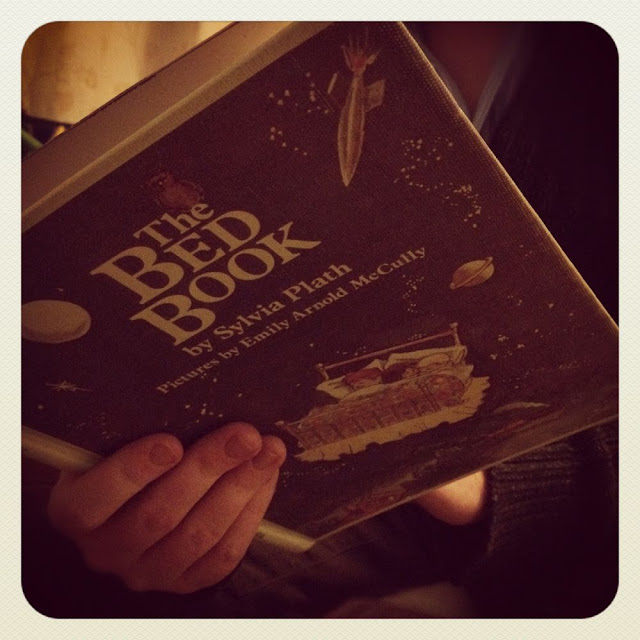
I love the Bed Book. The picture is of me reading it to my daughter. Yet many Plath fans do not even know of its existence.
Why is it that these books are not well known or in print? Could it be we do not like our serious authors to show their playful and family loving side? It could be there is no demand to pay for publishing these books. That Joyce's story needed to go out of copyright to get printed is evidence against this though.
A friend pointed out this great blog We Too Were Children 'a Compendium of Children’s Books by Twentieth Century “Adult” Authors Currently Out of Print'. Do you know of any more slightly hidden childrens books by 'serious' authors? Kafka's tale of the plucky mouse who rescues the circus or some such.
'Joyce children's story published in Dublin to dismay in Zürich'
In a statement, the foundation said it “was left completely in the dark” about the Dublin publication and that “it never permitted, tolerated, condoned or connived in this publication, and it rigidly dissociates itself from it”.
It was “dismayed to learn that a copy of the letter to young Stephen Joyce of 1936 must have been used for its publication in book form. The foundation was never approached or informed, it was never asked for permission” and it had only just learned of the publication.
The book looks lovely. The issue reminds me of a bugbear I have where famous authors of adult literature's children's books are consigned to the trash heap of history.
For example I cannot find a new copy of
The Little Steamroller by Graham Greene
Virginia Woolf, The Widow and the Parrot
The Bed Book By Sylvia Plath
I love the Bed Book. The picture is of me reading it to my daughter. Yet many Plath fans do not even know of its existence.
Why is it that these books are not well known or in print? Could it be we do not like our serious authors to show their playful and family loving side? It could be there is no demand to pay for publishing these books. That Joyce's story needed to go out of copyright to get printed is evidence against this though.
A friend pointed out this great blog We Too Were Children 'a Compendium of Children’s Books by Twentieth Century “Adult” Authors Currently Out of Print'. Do you know of any more slightly hidden childrens books by 'serious' authors? Kafka's tale of the plucky mouse who rescues the circus or some such.
Wednesday, January 11, 2012
The Irish Religious Copying that Saved Civilisation

Sweden Formally Recognizes File-Sharing as a Religion
The Church of Kopimism, whose principal tenent is the right to file-share, has been formally recognized as a religious organization in Sweden...
“For the Church of Kopimism, information is holy and copying is a sacrament,” it said in a statement.
This is a pretty good troll but more weirdly there is a history of religious copying in Ireland. One that we may have to thank for western civilisation.
How the Irish Saved Civilisation (on amazon for $8) ultimately argues that it was the Irish love of copying books that saved much of classical literature and combined with their spreading these copies as they set up new monasteries allowed an ember of literacy to be saved until the renaissance reignited it. During the dark ages after the Roman empire fell Irish monasteries with their book copying scriptoriums were one of the few bastions of literacy left in Europe.
This book is full of good anecdotes. For example that for her near contemporaries St Brigid's most famous miracle was performing an abortion.
"Brigid makes the fetus of a nun (whose womb had "through youthful desire of pleasure, .. swelled with child") magically disappear ("without the coming of birth, and without pain")"
I think the book places too much emphasis on St. Patrick and how he converted the Irish to Christianity. I always got the impression St Patrick was sort of a Arthur Guinness character. Used after his death by a giant corporation to try and sell their product to the locals. They both even have a celebration day. The Beer Nut has a great post "Interlude" that goes into the political machinations that went into the creation of the St. Patrick story.
It was a turf war: plain and simple. The independents had all been swallowed by the Big Three who were now each using the political influence they'd garnered along the way to try and crush the other two. The prize was total national dominance of the market, and a hefty slice of the action abroad where the product had been zealously pitched to a receptive customer base, building up a lucrative following among locals and ex-pats alike.
The thrust of the books argument about how the copying Irish rescued the western cannon comes from Columcille. He had a major brain erection for copying any books he came across.

On one occasion when he was at the monastery of Moville he came across Finian's book of the Psalms. Colum Cille decided to copy it secretly. He did, and when he was brought before King Diarmait who was to decide who was the rightful owner of it, Diarmait made his famous decision: “To every cow its calf and to every book its copy”. This might be regarded as the first copyright case in history! Later fighting broke out about the decision. After a battle for it Colum Cille got it back and it has since been known as the 'Cathach' or Battle Book. Colum Cille went into exile as penance and landed in the island of Iona in 563 and there he established his famous monastery
From here "he made one hundred fifty monks the cutoff number for the Iona community, and after they exceeded that, twelve and one monks would set off to establish another foundation in a new setting". These new monasteries would take copies of books with them and produce new analysis and in doing so spread literacy back into Europe. For example "More than half of all our biblical commentaries between 650 ad 850 were written by Irishmen".
I think its fascinating that Colum Cille's 150 monastery size number from the sixth century is the same as Dunbar's number. "Dunbar's number is suggested to be a theoretical cognitive limit to the number of people with whom one can maintain stable social relationships. ... No precise value has been proposed for Dunbar's number. It has been proposed to lie between 100 and 230, with a commonly used value of 150". Colum Cille was obeying modern social network theory in his monastery rules.
Ultimately I think the dark ages are a rorschach test, we know so little about them that the flimsy evidence can be used to argue any point you want to make. For example 'How the Irish saved civilization? By blogging it.' is a blogpost that argues the point that what the book proves is that blogging and such intellectual mashups are what preserved the culture.
While on the subject of dark ages Irish Monasteries "The secret of Kells" is a great film on this era
How the Irish Saved Civilisation is an interesting quick read. I was not convinced that literacy and the classics would not have survived the dark ages without Ireland. But I do think the lesson that we should copy and distribute our really important information around if we want it to be preserved when the barbarians break through the gates is an important one. It is easy to laugh at the Swedish Kopimism party but remember that an Irish monk who was willing to ignore the courts, go to war, murder and got banished from his country to copy things may have saved civilisation.
*The Taoiseach mentions the effect of these monks in his speeches 'In the sixth century our monks 'colonised the minds of Europe', rescuing the continent from the Dark Ages.' but he doesn't mention they were banished partly due to copyright restrictions.
Wednesday, December 28, 2011
Most Popular Posts of the Year
Thanks to everyone who read and commented this year. The most popular posts this year were
Search Engine Deoptimization 16,000 Pageviews. Many people seem to dislike Ryanair and weird legal rules.
Eurovision Voting Fraud 5,500 Pageviews. A rather glib post from 2010 about human rights abuse that got popular when Azerbaijan won the Eurovision.
My favorite posts were
The Dead Zoo Dodo Get Anto the Dodo back to the public. Anto has set up a twitter account
The Kilbrittain Whale. This tourist attraction is brilliantly unhinged.
Search Engine Deoptimization 16,000 Pageviews. Many people seem to dislike Ryanair and weird legal rules.
Eurovision Voting Fraud 5,500 Pageviews. A rather glib post from 2010 about human rights abuse that got popular when Azerbaijan won the Eurovision.
My favorite posts were
The Dead Zoo Dodo Get Anto the Dodo back to the public. Anto has set up a twitter account
The Kilbrittain Whale. This tourist attraction is brilliantly unhinged.
Wednesday, December 21, 2011
My favorite books read in 2011
Books really are kind of magic aren't they? Here is the ones I read this year that changed the way I think and turned me into a different person at the end. All for ten euro and a few hours of my time.
My favorite book was Moonwalking with Einstein. Without memory what would we be? This is a great diverse book on a really interesting topic.
Don't sleep, there are snakes. There is so much in this book from Language to God to child rearing to self sufficiency. It is just fascinating to read about people who see the world completely different to us.
The rational optimist nearly everything is getting better. This book left profoundly optimistic about the future. This is the book I have tried most to persuade my friends to read most this year.
Selfish reasons to have more kids. This book goes through the evidence that once your not an awful parent (one who would be refused an adoption for example) you really don't make much difference to your kids. It is actually a profoundly optimistic argument as this means you don't need to spend your time doing things you dislike to shape your childs path as by the time they are 18 they will end up where they would have anyway. It uses evidence from identical twin adoption studies to show how little parents need to worry about religion, education and all the other things they break their hearts worrying about.
The Great Stagnation By Tyler Cowen. We should have dinner in a pill, Optimus Prime, hover boards and lasers that turn dolls into women by now. Why don't we and what can we do about it?

Next year I plan to read mainly fiction. This year In cold blood by Capote was the one piece of fiction I read that I am sure will stay with me. Everyone says it is great and everyone ain't wrong.
Close but not in my very favorite books were fever by Shah, Adapt by Hardford, What technology wants by Kevin Kelly, Red Plenty by Francis Spufford, Gutenberg, race against the machine, good omens, the unbearable lightness of being, How the irish save civilisation and Launching The Innovation Renaissance by Alex Tabarrok, popular crime by Bill James
My favorite book was Moonwalking with Einstein. Without memory what would we be? This is a great diverse book on a really interesting topic.
Don't sleep, there are snakes. There is so much in this book from Language to God to child rearing to self sufficiency. It is just fascinating to read about people who see the world completely different to us.
The rational optimist nearly everything is getting better. This book left profoundly optimistic about the future. This is the book I have tried most to persuade my friends to read most this year.
Selfish reasons to have more kids. This book goes through the evidence that once your not an awful parent (one who would be refused an adoption for example) you really don't make much difference to your kids. It is actually a profoundly optimistic argument as this means you don't need to spend your time doing things you dislike to shape your childs path as by the time they are 18 they will end up where they would have anyway. It uses evidence from identical twin adoption studies to show how little parents need to worry about religion, education and all the other things they break their hearts worrying about.
The Great Stagnation By Tyler Cowen. We should have dinner in a pill, Optimus Prime, hover boards and lasers that turn dolls into women by now. Why don't we and what can we do about it?

Next year I plan to read mainly fiction. This year In cold blood by Capote was the one piece of fiction I read that I am sure will stay with me. Everyone says it is great and everyone ain't wrong.
Close but not in my very favorite books were fever by Shah, Adapt by Hardford, What technology wants by Kevin Kelly, Red Plenty by Francis Spufford, Gutenberg, race against the machine, good omens, the unbearable lightness of being, How the irish save civilisation and Launching The Innovation Renaissance by Alex Tabarrok, popular crime by Bill James
Monday, November 28, 2011
Technology of the Year
Loads of brilliant technologies went mainstream this year. Some new technologies were created but I don't know enough about any of them to make claims for their future. I'm going to describe what I think these old but newly well known technologies mean in reference to the world when my new daughter is 18 in 2030.
Learning by reading
Watson came along from IBM and answered quiz questions really well. Siri did something similar with peoples requests.
This might not seem like a big deal. Not many of us make a living answering quiz questions. But how many of us have jobs that involve finding the right page based on some search and parsing out the right bit of text? A surprising amount of medicine, lawyering, general office power point monkeying involves this. What happens when a cockroach knows everything? Watson is the answer to that as that is about the actual intelligence level it has. What happens when in 2030 the cockroach is a thousand times smarter? I have no idea.
Depressingly most of these systems seem to be owned by big companies like apple, Google and IBM. Most of the data used and the tools that analyse it are open source. It will be a really cool project when someone makes an opensource wikipedia based answering bot.
"if, in like manner, the shuttle would weave and the plectrum touch the lyre without a hand to guide them, chief workmen would not want servants, nor masters slaves." Aristotle wrote in Politics which says that smarter machines will free us from servitude. So far this has been the case but will that continue?.
Driverless cars
Will my daughter ever drive for non fun reasons? People will always drive the same way people still ride horses. Just now they do it for fun rather than transport. Two trends are making it less likely that my daughter will ever have a drivers licence. The increasing sophistication of driverless cars and our decreasing acceptance of the idiocy of youth.
If Ferris Bueller had a day off now, would he spend it on Facebook? Because cars are relatively more expensive and relatively less exciting teenagers are less inclined to drive now. Facebook and youtube provide entertainment for free so you are less inclined to work thousands of hours so you can afford a mildly entertaining car. Cars are now only mildly entertaining as safety nazis have turned them all into a homogenous look that cannot even be modded easily. If you cannot put a spoiler and underlights on your Clio your just not going to look cool as a 17 year old.
Combined with cars being less attractive to teenagers there is increasing control placed over them. New drink drive limits for learners have been imposed here. I have heard talk of curfews for young drivers. We are less inclined to accept the god given right to load a car with 7 of their mates and wrap it around a tree at 4 in the morning. In 2030 well have so many constraints on teenagers to prevent them killing themselves as to remove much of the attraction from driving.
The technology element of this is the driverless car
Hanson wrote
Cowen said
These technologies will come in gradually drive train technology, lane assist, parking assist, crash avoidance are all present in next years s-class Mercedes. Probably legal hangups will delay driverless cars. If I was to guess it will be the old that get them pushed through. The old are increasing in numbers and will continue to vote. The baby boomers won't accept the loss of independence that goes with not being able to drive currently. Legal changes to allow driverless cars could be a vote winner. I'm willing to bet that by 2030 a combination of our scardy-cat nature about risk, the grey vote and improved technology will mean that my daughter may never have to drive.
Solar Power

The exponential improvement in solar power became news this year.
This article started a great big argument about why solar is not replacing fracking and such. Including why environmentalists are still worried about co2. What will happen in 2030? I dont think we'll be using enough less energy to prevent climate change that way. I think well still be using fossil fuels to fly planes. New electricity generation methods take decades to become part of the grid, but I am still optimistic about solar.
Education
Education has not changed much in a long time. This is partly due to Baumol's cost disease where a teacher now can only teach the same number of kids as one in 1900. Since that time manufacturing jobs can produce vastly more than they used to. But education is one of those human centric industries that has not changed much.
Since videos came out it has been possible to watch lectures at home. Just giving kids computers does not improve education. If you look at the list here of the best educational strategies Tutorial instruction, Reinforcement, Corrective feedback, Cues and explanation are now part of online educational programs.
Stanford this year ran three computer courses where anyone can sign up for free, get homework graded by computer and do exams at the end. This is a graduate level course in one of the worlds best universities for free. The Khan academy has been around for a while but this year it moved from just a list of videos to include problems. The site is now using machine learning and gamification techniques to improve these problems and thus student learning. They are also using statistical tests to improve the website layout and which version of a explanation gets used. These computer assisted techniques are even being used by humans to get better at Jeopardy as the video below describes.
Interestingly the same guys who got learning by reading and driverless cars to their current state are also important in these changes to education Sebastian Thrun, Andrew Ng and Peter Norvig.
This year technologies became mainstream that finally turn computers into the amazing educational tools they have always promised to be.
Comparison
How did these areas change from when I was born till I was 18?
Cars became safer and drink driving became mildly uncool. The main change here was removing lead from petrol though. The recent drop in crime and increase in IQ may be largely due to removal of leaded petrol. I think driverless cars are important but not as important as this.
Power generation changed a bit, Chernobyl made nuclear uncool but it was probably never economical anyway.
Education did not change much. I did example questions from the year I was born to practice for the leaving cert. Corporal punishment still existed in my time but mainly for nostalgia rather than because they got true joy battering children. I was born after the education system demilitarized. I predict education will change more in my daughters childhood than mine.
Computers did not really visibly exist for people when I was born. By the time I was 18 it was obvious they were going to change the world even if they had not fully done that yet. I think the change from no computers to some was bigger than useful computers to really useful ones that I predict will happen.
Here is the prediction in 2030 for the technologies that became public this year. Many of the cars will be driverless. The world will get a most of its new generational electrical capacity from solar. Education has already changed massively this year just people have not realised it yet. We will each have an assistant that knows everything. I don't know how that will effect employment, my guess is she will end up working in a job that does not exist at the moment.
Learning by reading
Watson came along from IBM and answered quiz questions really well. Siri did something similar with peoples requests.
This might not seem like a big deal. Not many of us make a living answering quiz questions. But how many of us have jobs that involve finding the right page based on some search and parsing out the right bit of text? A surprising amount of medicine, lawyering, general office power point monkeying involves this. What happens when a cockroach knows everything? Watson is the answer to that as that is about the actual intelligence level it has. What happens when in 2030 the cockroach is a thousand times smarter? I have no idea.
Depressingly most of these systems seem to be owned by big companies like apple, Google and IBM. Most of the data used and the tools that analyse it are open source. It will be a really cool project when someone makes an opensource wikipedia based answering bot.
"if, in like manner, the shuttle would weave and the plectrum touch the lyre without a hand to guide them, chief workmen would not want servants, nor masters slaves." Aristotle wrote in Politics which says that smarter machines will free us from servitude. So far this has been the case but will that continue?.
Driverless cars
Will my daughter ever drive for non fun reasons? People will always drive the same way people still ride horses. Just now they do it for fun rather than transport. Two trends are making it less likely that my daughter will ever have a drivers licence. The increasing sophistication of driverless cars and our decreasing acceptance of the idiocy of youth.
If Ferris Bueller had a day off now, would he spend it on Facebook? Because cars are relatively more expensive and relatively less exciting teenagers are less inclined to drive now. Facebook and youtube provide entertainment for free so you are less inclined to work thousands of hours so you can afford a mildly entertaining car. Cars are now only mildly entertaining as safety nazis have turned them all into a homogenous look that cannot even be modded easily. If you cannot put a spoiler and underlights on your Clio your just not going to look cool as a 17 year old.
Combined with cars being less attractive to teenagers there is increasing control placed over them. New drink drive limits for learners have been imposed here. I have heard talk of curfews for young drivers. We are less inclined to accept the god given right to load a car with 7 of their mates and wrap it around a tree at 4 in the morning. In 2030 well have so many constraints on teenagers to prevent them killing themselves as to remove much of the attraction from driving.
The technology element of this is the driverless car
Hanson wrote
So a huge upcoming policy question is: when will what big cities manage to coordinate to change road law to achieve these huge auto-auto economic gains? Thirty years from now we may look back and lament that big city politics was so broken that no big cities could manage it. Or perhaps history will celebrate how the first big city to do it dramatically increased its importance on the world scene
Cowen said
The typical American spends an average of roughly 100 hours a year in traffic; imagine using that time in better ways — by working or just having fun. The irksome burden of commuting might be lessened considerably. Furthermore, computer-driven cars could allow for tighter packing of vehicles on the road, which would speed traffic times and allow a given road or city to handle more cars
These technologies will come in gradually drive train technology, lane assist, parking assist, crash avoidance are all present in next years s-class Mercedes. Probably legal hangups will delay driverless cars. If I was to guess it will be the old that get them pushed through. The old are increasing in numbers and will continue to vote. The baby boomers won't accept the loss of independence that goes with not being able to drive currently. Legal changes to allow driverless cars could be a vote winner. I'm willing to bet that by 2030 a combination of our scardy-cat nature about risk, the grey vote and improved technology will mean that my daughter may never have to drive.
Solar Power

The exponential improvement in solar power became news this year.
Averaged over 30 years, the trend is for an annual 7 percent reduction in the dollars per watt of solar photovoltaic cells...10 years later, in 2030, solar electricity is likely to cost half what coal electricity does today
This article started a great big argument about why solar is not replacing fracking and such. Including why environmentalists are still worried about co2. What will happen in 2030? I dont think we'll be using enough less energy to prevent climate change that way. I think well still be using fossil fuels to fly planes. New electricity generation methods take decades to become part of the grid, but I am still optimistic about solar.
Education
Education has not changed much in a long time. This is partly due to Baumol's cost disease where a teacher now can only teach the same number of kids as one in 1900. Since that time manufacturing jobs can produce vastly more than they used to. But education is one of those human centric industries that has not changed much.
Since videos came out it has been possible to watch lectures at home. Just giving kids computers does not improve education. If you look at the list here of the best educational strategies Tutorial instruction, Reinforcement, Corrective feedback, Cues and explanation are now part of online educational programs.
Stanford this year ran three computer courses where anyone can sign up for free, get homework graded by computer and do exams at the end. This is a graduate level course in one of the worlds best universities for free. The Khan academy has been around for a while but this year it moved from just a list of videos to include problems. The site is now using machine learning and gamification techniques to improve these problems and thus student learning. They are also using statistical tests to improve the website layout and which version of a explanation gets used. These computer assisted techniques are even being used by humans to get better at Jeopardy as the video below describes.
Interestingly the same guys who got learning by reading and driverless cars to their current state are also important in these changes to education Sebastian Thrun, Andrew Ng and Peter Norvig.
This year technologies became mainstream that finally turn computers into the amazing educational tools they have always promised to be.
Comparison
How did these areas change from when I was born till I was 18?
Cars became safer and drink driving became mildly uncool. The main change here was removing lead from petrol though. The recent drop in crime and increase in IQ may be largely due to removal of leaded petrol. I think driverless cars are important but not as important as this.
Power generation changed a bit, Chernobyl made nuclear uncool but it was probably never economical anyway.
Education did not change much. I did example questions from the year I was born to practice for the leaving cert. Corporal punishment still existed in my time but mainly for nostalgia rather than because they got true joy battering children. I was born after the education system demilitarized. I predict education will change more in my daughters childhood than mine.
Computers did not really visibly exist for people when I was born. By the time I was 18 it was obvious they were going to change the world even if they had not fully done that yet. I think the change from no computers to some was bigger than useful computers to really useful ones that I predict will happen.
Here is the prediction in 2030 for the technologies that became public this year. Many of the cars will be driverless. The world will get a most of its new generational electrical capacity from solar. Education has already changed massively this year just people have not realised it yet. We will each have an assistant that knows everything. I don't know how that will effect employment, my guess is she will end up working in a job that does not exist at the moment.
Monday, May 30, 2011
Palaces of memory
Remembering is a creative process. We tend to think rote memorisation as a dull boring task. However instead we should think of it as "Moonwalking with Einstein". A big challenge to think of the oddest 'most memorable' images you can associate with what you are trying to remember.
The book 'Moonwalking with Einstein' deals with one journalists travels around the world of memory competitions. These competitions have all sorts of weird and wonderful rounds. Remembering binary number, packs of cards, poetry, random word list, matching faces to names and historic dates. It is a very entertaining book, dealing with the history of knowledge, savants, the weird world of self help marketing and the importance of living adventurously.

Many of these competition events seem pretty abstract. Some memory based skill that had some sort of humane self improvement aspect and maybe even some vague practical use would be good to learn though. But if there was one of these skills that would be cool to have I would like to practice the methods described in the book. I read a book, Inside the black room by Jack Allen Vernon, about sensory deprivation experiments in a Californian university. The author describes an Arab immigrant who unusually asked to be put back into sensory deprivation room as he wanted to train himself incase he was ever forced into a similar situation as torture.
Brian Keenan's 'an evil cradling' has vivid, gripping and terrifying descriptions of the madness that stalked him as he was held hostage in isolation in the Lebanon. For example he writes "that the human mind can travel into those dark regions and return exhausted but intact is more a miracle than that word can ever convey". One of the boys own adventure stories I read as a child had the description of an RAF POWs time in the cooler and the physical and mental regime he went through to ease the hardship. One of the parts I remember was that he remembered all the poetry he had learned at school. These tales of how to deal with sensory deprivation have really stayed with me. Maybe if the memory skills in this book could help in such a situation that would seem useful.
One of the expert mnemonists in the book Ed suggests memorising poetry and prose is useful for such a situation of sensory deprivation. "My philosophy of life is that a heroic person should be able to withstand about ten years in solitary confinement without getting terribly annoyed' he said 'an hour of memorization yields ten solid minutes of spoken poetry, and those ten minutes have enough content to keep you busy for a full day.'
I will give myself a challenge to get good at poetry memorisation in a month. The competition seems to be to '15 minute memorization time, 20 minute written recall' for poetry. I will try memorise a poem tomorrow. And again in a month and see if memory training improves poetry memorisation.
As an aside the author mentions the interesting possibility of using "neutropic 'cognitive steroids,'" but never goes into details about how these might aid a memory sports competitor. This is slightly odd given he wrote an article in 2005 (viewable here) about his experience taking one of these drugs. He said 'gym rats have steroids, and overachievers have Adderall. ' it would have been interesting to hear what effect these drugs had on his memory abilities but this book never brooches the subject in a personal way.
The book 'Moonwalking with Einstein' deals with one journalists travels around the world of memory competitions. These competitions have all sorts of weird and wonderful rounds. Remembering binary number, packs of cards, poetry, random word list, matching faces to names and historic dates. It is a very entertaining book, dealing with the history of knowledge, savants, the weird world of self help marketing and the importance of living adventurously.

Many of these competition events seem pretty abstract. Some memory based skill that had some sort of humane self improvement aspect and maybe even some vague practical use would be good to learn though. But if there was one of these skills that would be cool to have I would like to practice the methods described in the book. I read a book, Inside the black room by Jack Allen Vernon, about sensory deprivation experiments in a Californian university. The author describes an Arab immigrant who unusually asked to be put back into sensory deprivation room as he wanted to train himself incase he was ever forced into a similar situation as torture.
Brian Keenan's 'an evil cradling' has vivid, gripping and terrifying descriptions of the madness that stalked him as he was held hostage in isolation in the Lebanon. For example he writes "that the human mind can travel into those dark regions and return exhausted but intact is more a miracle than that word can ever convey". One of the boys own adventure stories I read as a child had the description of an RAF POWs time in the cooler and the physical and mental regime he went through to ease the hardship. One of the parts I remember was that he remembered all the poetry he had learned at school. These tales of how to deal with sensory deprivation have really stayed with me. Maybe if the memory skills in this book could help in such a situation that would seem useful.
One of the expert mnemonists in the book Ed suggests memorising poetry and prose is useful for such a situation of sensory deprivation. "My philosophy of life is that a heroic person should be able to withstand about ten years in solitary confinement without getting terribly annoyed' he said 'an hour of memorization yields ten solid minutes of spoken poetry, and those ten minutes have enough content to keep you busy for a full day.'
I will give myself a challenge to get good at poetry memorisation in a month. The competition seems to be to '15 minute memorization time, 20 minute written recall' for poetry. I will try memorise a poem tomorrow. And again in a month and see if memory training improves poetry memorisation.
As an aside the author mentions the interesting possibility of using "neutropic 'cognitive steroids,'" but never goes into details about how these might aid a memory sports competitor. This is slightly odd given he wrote an article in 2005 (viewable here) about his experience taking one of these drugs. He said 'gym rats have steroids, and overachievers have Adderall. ' it would have been interesting to hear what effect these drugs had on his memory abilities but this book never brooches the subject in a personal way.
Sunday, February 14, 2010
The Perplexus Rocks

The perplexus is a 3-d maze where the aim is to move a ball around a series of obstacles. Makezine last issue had a great story on it here. The article described the journey from a school project through decades of effort to a toy and even a giant art piece.
There is an interview here with the creator Michael McGinnis. Usually my wife finds puzzles and games really boring but I have to keep fighting her to get a go on the perplexus. There is a page here on the history of the design. It shows some of the dedication and inventiveness that you can feel went into the puzzle when you play it.

It is not perfect, there are annoying etchings on the top that sometimes hinder viewing. It is slightly off spherical which is not what the designer wanted. It is made out of plastic like all toys. I presume trying to get this level of precision in wood would be nearly impossible. Still this is the best designed toy since the rubik's cube. Similar to the rubik's cube it is mainly aimed at children but not just for them.
This is really pretentious but the puzzle is like moving meditation. I cannot play this without feeling like part of zen and the art of motorcycle maintenance. You never get products anymore that have such obvious dedication built into them. Every step feels like some sort of Japanese mindfullness exercise. Basically the perplexus rocks. I got bought mine in the UK from here. The shipment to Ireland was really quick. You can get it from America here

Sunday, January 18, 2009
Sex, science and profits: Kealey
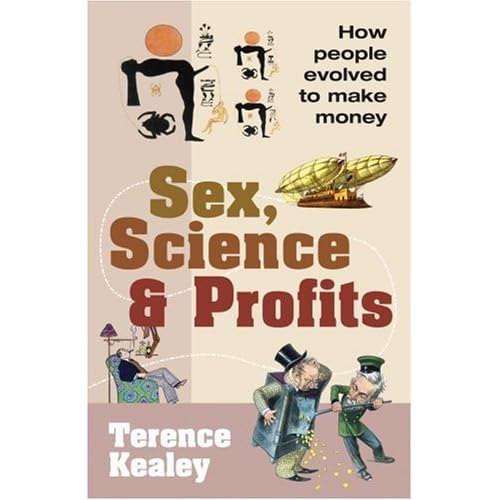
This book asks whether governments should fund science. It starts with a review of the history of technological advancement. This section is like a cross between an economic history of the western world and guns germs and steal. The books title seems to be tying to trade in on the popularity of Guns and Germs which might cause people to dismiss it as pop history and miss its important arguments about current science funding.
The second section is an analyse of the industrial revolution and shows how its discoveries stemmed not from government funded pure scientists providing insights that were then used by industrialists but from tradesmen making gradual improvements to the machines they used every day. These new machines then provided evidence for the theoreticians to build up scientific theories from.
The third section looks at how contemporary science is done and examines if government funding of science increases or decreases the rate of progress (and economic growth). It includes a convincing chapter on why patents serve to harm the public.
This is an entertaining well crafted book that lays out a compelling argument for free market (rather than state subsidised) science. The book seems to have been widely ignored outside libertarian circles where he is preaching to the converted.
One thing the book does not explore is the use of other methods to incentivize science. The use of betting markets and prizes are two ways that are probably underused.
Friday, January 09, 2009
Enough by John Naish

We have too much food, information, stuff, and the constant quest for more is costing us our physical and mental and even planetary well being.
The good of this book is that it is correct and entertaining. The bad is
1. This bit of the brain lights up which means.... Something like this is said every few paragraphs which as the author himself points out "is like standing outside a football ground, trying to interpret the action in the game by listening to the roars of the crowd". Brain scanning is not that accurate and basing your argument on extremely scant data like this is unwise.
2. In the stone age we did X so now we do X to much in the modern world. Evolutionary just so stories. These pop up in popular culture all the time and become accepted knowledge without any evidence. We don't really know how we lived in the stone age. Looking at Bonobo society early man may have been vastly different to how we imagine it today. So the old cliche (not from the book)
Men are better at maths because they had to have spatial abilities to chase antelope. Except when you look at it that's not the reason. People thinking men are better at maths seems to be most of the cause of them being better.
This book is full of these non falsifiable fairy tales which again is not a good foundation for an argument
3. No index
4. We cannot have more stuff unless we consume more. This is taken as an axiom but it is wrong. Ephemeralization is the process where people use technological advances to continuously do more with less.
The book is right that we need to be satisfied with enough and serves as a good motivator as to how to do this personally.
Similar but better books are Collapse by Jared Diamond on what causes societies to fail and Critical Path by Buckminster Fuller on how we can provide the needs of society and move away from over consumption.
Friday, May 25, 2007
Fight Like Apes
Whelans 24/05/2007
After having “Lend me your face” stuck in my head for the last week I decided to go see this band in case they were half as good as that tune.
The band consists of
Some beardy man who dances round like a monkey with a miniature symbol.
A scatological singer with the temperament of a spoiled three year old.
The worlds tallest bass player, but he is under investigation for use of performance enhancing afro.
An oddly normal drummer who might be on an exchange program from Kraftwork.
The songs sound like demented nursery ryhmes all bounce and menace. Which is a very good thing as hearing another sensitive singer songwriter just might send me postal. Top notch live band this, they jump around the stage, playing the piano with their heads eating the microphones and they have fans who do a dance that is like hares fighting. Do you know how many bands get their own dance? These things are rationed carefully.
So go see this band and if you live far away buy the ep tie people to chairs and make them listen to it. You can tickle them a bit to but not so much they wee themselves.
After having “Lend me your face” stuck in my head for the last week I decided to go see this band in case they were half as good as that tune.
The band consists of
Some beardy man who dances round like a monkey with a miniature symbol.
A scatological singer with the temperament of a spoiled three year old.
The worlds tallest bass player, but he is under investigation for use of performance enhancing afro.
An oddly normal drummer who might be on an exchange program from Kraftwork.
The songs sound like demented nursery ryhmes all bounce and menace. Which is a very good thing as hearing another sensitive singer songwriter just might send me postal. Top notch live band this, they jump around the stage, playing the piano with their heads eating the microphones and they have fans who do a dance that is like hares fighting. Do you know how many bands get their own dance? These things are rationed carefully.
So go see this band and if you live far away buy the ep tie people to chairs and make them listen to it. You can tickle them a bit to but not so much they wee themselves.
Wednesday, March 14, 2007
Neon Bible: Arcade Fire
This is one of the great albums. Great in that it sums up the time. "On the beach" and "After the goldrush" by Neil Young are Zeitgeist albums. Catch 22 and American Psycho define a moment in a similar way.
If you believe like John Lennon that music should be like journalism this is a great album. Music is not some perfect Platonic world,it and only makes sense when it puts the world around you in context.
Neon Bible will turn out to be the album of the year, it sums up this moment perfectly. Modest Mouse's "We were dead before the ship even sank" is a better album but it is not the one that we need right now.
The album sounds foreboding and imminent. Imminent in the sense of a being trapped in a world where you cannot affect the forces aligned against you. The Onion described it as peopled by characters in an Ayn Rand novel. People who realise what has been holding them back and rebel against it. I think Brazil or Thx1138 might be more apt, Rand's characters escape from their prison but this album just tells us that we have to try.
If you believe like John Lennon that music should be like journalism this is a great album. Music is not some perfect Platonic world,it and only makes sense when it puts the world around you in context.
Neon Bible will turn out to be the album of the year, it sums up this moment perfectly. Modest Mouse's "We were dead before the ship even sank" is a better album but it is not the one that we need right now.
The album sounds foreboding and imminent. Imminent in the sense of a being trapped in a world where you cannot affect the forces aligned against you. The Onion described it as peopled by characters in an Ayn Rand novel. People who realise what has been holding them back and rebel against it. I think Brazil or Thx1138 might be more apt, Rand's characters escape from their prison but this album just tells us that we have to try.
Wednesday, January 17, 2007
Black beetle voodoo lounge Jan 15th 2007
The band seemed to genuinely enjoy themselves which makes a change from the deliberately grumpy careerists that you see a lot. They play driven repetitive rock like QOTSA which means they are, like Jesus, at their best when angry
The playing is pretty simple which is a good thing as it results in a cleaner sound then with Veto. Veto are a band whom black beetle have cannibalized for members. The future of this band probably depends on the singer. As his voice relaxed during the gig and became louder in the mix the whole sound and feel of the band improved.
One stand out track, mainly because all the audience bounced along was "stink bomb" which sounds like a cross between the Stunning’s "half past two" and Simon and Garfunkel’s "feeling groovy". None of these songs are actually called that.
The band seemed to play this as a joke which is good as it improved the mood but bad in that there is nothing to be ashamed of in writing good tunes.
The band seemed to genuinely enjoy themselves which makes a change from the deliberately grumpy careerists that you see a lot. They play driven repetitive rock like QOTSA which means they are, like Jesus, at their best when angry
The playing is pretty simple which is a good thing as it results in a cleaner sound then with Veto. Veto are a band whom black beetle have cannibalized for members. The future of this band probably depends on the singer. As his voice relaxed during the gig and became louder in the mix the whole sound and feel of the band improved.
One stand out track, mainly because all the audience bounced along was "stink bomb" which sounds like a cross between the Stunning’s "half past two" and Simon and Garfunkel’s "feeling groovy". None of these songs are actually called that.
The band seemed to play this as a joke which is good as it improved the mood but bad in that there is nothing to be ashamed of in writing good tunes.
Monday, December 11, 2006
The scale of music is wrong. Everything is notched up to 11 and it ends up sounding like porridge hitting at a wall. You photograph a mushroom and it is interesting because the scale is within our perception yet somehow otherworldly.
This is where music has to go, the small scaling to the big.

SCALE
I have been listening to Steven Reich because it scales. It is the the micro made macro it is wheels within wheels. That and you do not read about his time in the Priory in the NME.
This is where music has to go, the small scaling to the big.

SCALE
I have been listening to Steven Reich because it scales. It is the the micro made macro it is wheels within wheels. That and you do not read about his time in the Priory in the NME.
Friday, November 10, 2006
Biscuit Taxonomy Explained
It has been a cause of insomnia for weeks but finally the tree of biscuit taxonomy makes sense again. See the platypus of the biscuit family is the
Anyway after many sleepless nights the issue has been resolved. It is a tax dodge.
“Yes the VAT man wanted it to be a biscuit. That way it would fall by virtue of its chocolate coat into a category of products liable to VAT at the standard rate, i.e. luxury biscuits. As a cake however it is zero rated for VAT, no matter how luxuriant, much to the VAT man’s continuing annoyance. In fact Wifey and I once had a chat with ex Tory Minister John Knott who brought in VAT when the Conservative Government of the time took
http://www.nicecupofteaandasitdown.com/jaffajudgement/
http://blogs.warwick.ac.uk/hollycruise/entry/jaffa_cakes_and/
Wednesday, October 18, 2006

The most disappointing album of the year
I got “At War with the Mystics” that day it came out. After listening to it solidly for a week I found it intensely irritating and decided to give it up and come back to it after a few months. Same thing happened again then.
It is not disappointing because thy tried experimental stuff and it did not work, tightrope walkers need to occasionally fall off otherwise it is not impressive. I can forgive and even expect a few dodgy songs on a flaming lips album, It tells me I am not just listening to elevator music if I do have negative reactions occasionally.
I finally figured out the reason this album makes me nauseous [1] There is no difference between the loud bits and the quiet bits they are all incredibly loud. So the call and response of the “yeah yeah yeah song” becomes a constant sonic assault. When the foot is taken off the gas slightly like on “Goin On” you can hear how good the songs are. The wall of sound on The W.A.N.D sounds great because the contrast between loud and quiet has not been destroyed as it never existed.
When the whirrs and squeks are as loud as the tune they take away from it. Like Stalinistic architecture where no one item can be the main theme in case that style is labelled bourgsouise[2] and gets you sent off to the gulag. Everything becomes over decorated, everything becomes important so nothing is.
This album is disappointing because the songs are so good. Underneath the Pollock like random blasts of sound is a subtle gem drowned out.
[1]http://www.austin360.com/music/content/music/stories/xl/2006/09/28cover.html.
[2]http://en.wikipedia.org/wiki/Image:Msu-main-seabhcan.JPG
Subscribe to:
Posts (Atom)