Showing posts with label Long Now. Show all posts

Wednesday, January 11, 2012

The Irish Religious Copying that Saved Civilisation


Sweden Formally Recognizes File-Sharing as a Religion
The Church of Kopimism, whose principal tenent is the right to file-share, has been formally recognized as a religious organization in Sweden...
“For the Church of Kopimism, information is holy and copying is a sacrament,” it said in a statement.

This is a pretty good troll but more weirdly there is a history of religious copying in Ireland. One that we may have to thank for western civilisation.

How the Irish Saved Civilisation (on amazon for $8) ultimately argues that it was the Irish love of copying books that saved much of classical literature and combined with their spreading these copies as they set up new monasteries allowed an ember of literacy to be saved until the renaissance reignited it. During the dark ages after the Roman empire fell Irish monasteries with their book copying scriptoriums were one of the few bastions of literacy left in Europe.

This book is full of good anecdotes. For example that for her near contemporaries St Brigid's most famous miracle was performing an abortion.
"Brigid makes the fetus of a nun (whose womb had "through youthful desire of pleasure, .. swelled with child") magically disappear ("without the coming of birth, and without pain")"

I think the book places too much emphasis on St. Patrick and how he converted the Irish to Christianity. I always got the impression St Patrick was sort of a Arthur Guinness character. Used after his death by a giant corporation to try and sell their product to the locals. They both even have a celebration day. The Beer Nut has a great post "Interlude" that goes into the political machinations that went into the creation of the St. Patrick story.
It was a turf war: plain and simple. The independents had all been swallowed by the Big Three who were now each using the political influence they'd garnered along the way to try and crush the other two. The prize was total national dominance of the market, and a hefty slice of the action abroad where the product had been zealously pitched to a receptive customer base, building up a lucrative following among locals and ex-pats alike.


The thrust of the books argument about how the copying Irish rescued the western cannon comes from Columcille. He had a major brain erection for copying any books he came across.


On one occasion when he was at the monastery of Moville he came across Finian's book of the Psalms. Colum Cille decided to copy it secretly. He did, and when he was brought before King Diarmait who was to decide who was the rightful owner of it, Diarmait made his famous decision: “To every cow its calf and to every book its copy”. This might be regarded as the first copyright case in history! Later fighting broke out about the decision. After a battle for it Colum Cille got it back and it has since been known as the 'Cathach' or Battle Book. Colum Cille went into exile as penance and landed in the island of Iona in 563 and there he established his famous monastery


From here "he made one hundred fifty monks the cutoff number for the Iona community, and after they exceeded that, twelve and one monks would set off to establish another foundation in a new setting". These new monasteries would take copies of books with them and produce new analysis and in doing so spread literacy back into Europe. For example "More than half of all our biblical commentaries between 650 ad 850 were written by Irishmen".

I think its fascinating that Colum Cille's 150 monastery size number from the sixth century is the same as Dunbar's number. "Dunbar's number is suggested to be a theoretical cognitive limit to the number of people with whom one can maintain stable social relationships. ... No precise value has been proposed for Dunbar's number. It has been proposed to lie between 100 and 230, with a commonly used value of 150". Colum Cille was obeying modern social network theory in his monastery rules.

Ultimately I think the dark ages are a rorschach test, we know so little about them that the flimsy evidence can be used to argue any point you want to make. For example 'How the Irish saved civilization? By blogging it.' is a blogpost that argues the point that what the book proves is that blogging and such intellectual mashups are what preserved the culture.

While on the subject of dark ages Irish Monasteries "The secret of Kells" is a great film on this era

How the Irish Saved Civilisation is an interesting quick read. I was not convinced that literacy and the classics would not have survived the dark ages without Ireland. But I do think the lesson that we should copy and distribute our really important information around if we want it to be preserved when the barbarians break through the gates is an important one. It is easy to laugh at the Swedish Kopimism party but remember that an Irish monk who was willing to ignore the courts, go to war, murder and got banished from his country to copy things may have saved civilisation.


*The Taoiseach mentions the effect of these monks in his speeches 'In the sixth century our monks 'colonised the minds of Europe', rescuing the continent from the Dark Ages.' but he doesn't mention they were banished partly due to copyright restrictions.

Friday, January 16, 2009

Cheer up things could be worse

Chicken Licken has nothing on the news these days. Everyone is talking about "perfect storms of bad economic data" and "the worst possible recession imaginable", stuff like that. This recession is bad(pdf), much worse then most people currently believe. It is at the point where those hoarding gold are overly optimistic, they should be hoarding rice.

However you have to be really lacking in imagination to think that a complete collapse of the banking system hyperinflation of fiat currency and abandonment of all social services provisions are the worst economic event you can imagine.

Here are a collection of things that are much worse.

These sorts of inevitable disasters come round anywhere from every 100 years to 50,000 years or so
1. A Flu pandemic which killed 5% of world population.
2. Canary island volcano falling into the Atlantic.
3. Yellowstone volcano exploding
4. Rapid onset new ice age

Not inevitable but fairly likely
1. Thermonuclear war.
2. Intelligent robots that try kill us all (surely this is overdue at this point)
3. Bioterrorism of some mix of aids, smallpox, anthrax and athletes foot.

So cheer up on a geological scale this is minor. Yellowstone could explode then you’d really have problems.

Friday, August 29, 2008

Neolithic Mancala

There is a game played in most of the world called Mancala. It is a “count and capture” game that involves moving stones around a board made up of holes. You can see an explanation of various forms of rules of the game here.


Ireland has some of the best preserved ancient tombs and building sin the world. This means we have some of the oldest known versions of games in the world. Boards of a game called “windmill” have been cut into the temple at Kurna, Egypt (~1440 BC). A version of this game called “Nine Man Morris” is still played. Tic Tac Toe can be considered a very basic version of it also. The earliest known depiction of this game is a bronze age cemetery in Ballinderry Ireland.

Boards of nine man morris have also been found in roman age sites.


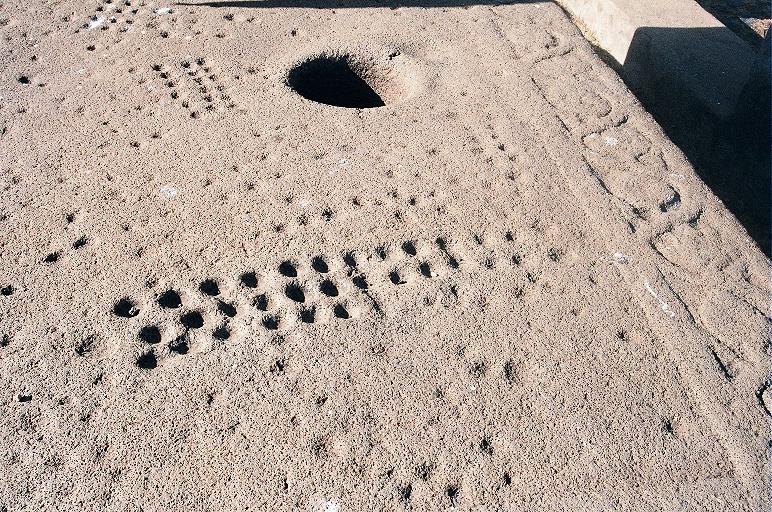
Irish 5000 years old Mancala boards should look like this. On a flat surface. Two rows of holes, probably six holes (possibly more) long with slightly larger holes at either end. Possibly you would see a few together as mancala is currently a social game and tends to be played in groups.


We tend to view megalithic carvings as having a religious purpose. It is quite possible that megaliths were gathering points and as such social games took place there. So next time your at a megalith have a look for a game board.


Tuesday, May 29, 2007

Lismullen henge

I joined the green pen brigade today when I wrote a politician an email. I sent Dick Roche the minister for the environment the text below. He has the right to remove the newly discovered Lismullen henge. I think people and particularly politicians (who have five year life cycles) do not have the cognitive architecture needed to make such decisions.

I am writing to you in relation to the planned motorway in the Tara-Skryne valley. I would however like you to consider how your decisions will look to someone at the same remove from us as we are to the creators of the original megalithic monuments.
The Long Now organisation asks people to think about how their actions will affect the long term future. To illustrate how we can affect the future they are building a clock designed to run for ten millennia. This "clock of the long now" costs millions of dollars and will serve as a tourist attraction. The megalithic sites of Ireland are a form of clock of the long now that have already operated for over five millennia.

Economists describe the daily discount rate as the amount of consumption we are willing to put off today to save for later. Cats, who have a very low daily discount rate, will gorge and starve rather then ration food over a period of time. Humans however are capable of seeing how our decisions now will affect the future. It is rare that we make a decision that we know will have consequences more then a few decades from now. You however have a decision to make about preserving Lismullen henge in the Tara-Skryne valley that you know will affect the world for millennia. I ask you to consider the geological timeframe that the consequences of any decision on this site will persist.

Wednesday, May 02, 2007

Long Term Caving Project

What are you doing for the next 10 thousand years? There is a plan to build a clock that will keep time accurately for 10k years. The main purpose of this is to get people to think long term and perhaps alter there actions accordingly. The clock is being placed in a cave because it is believed to be the most stable environment available.

Danny Hillis is building this clock. He makes some good points about the construction.
If something becomes unimportant to people, it gets scrapped for parts; if it becomes important, it turns into a symbol and must eventually be destroyed.” f something becomes unimportant to people, it gets scrapped for parts; if it becomes important, it turns into a symbol and must eventually be destroyed. The only way to survive over the long run is to be made of materials large and worthless, like Stonehenge and the Pyramids, or to become lost. The Dead Sea Scrolls managed to survive by remaining lost for a couple millennia”

Long term man made experiments have been taking place for about one hundred years. Observations of things in caves long term include.
1. Temperature readings using stalactites layer analysis.
2. Mud samples are used to tell climate in the past.
3. Natural nuclear reactors in Gabon could be used to test for changes in physical constants over time.

Could we set up an experiment in a cave now that would gather results for the next 10k years?

The choice of cave is important. It should be geologically uninteresting, no earthquakes volcanoes etc . The cave needs to be geographically isolated i.e. High above sea. Adding permanent structures to caves is a fairly bad idea. Also there is little point doing this unless people see it. So a tourist cave would be ideal given that it is fairly extensively damaged already.

So what experiment could you think of that would give out answers for 10k years? Apart form the Gedanken experiment could any of these actually be set up?
There are a few physics experiments that have been running for over a hundred years
The reason for thinking like this is not so much the egomania of “we will have giant tombs to ourselves in a few millennia” just to remind us that our actions do have long term consequences. For instance Newgrange can be regarded as a clock of the long now build six thousand years ago. The construction of the new motorway near the hill of Tara to me indicates a lack of this sort of long term thinking. Do we have the right to alter ancient still undiscovered long now tools to build a motorway for a technology that will probably be obsolete in a few decades?