Showing posts with label progress. Show all posts

Sunday, February 23, 2025

Football ball improvement is back

There is a trade off between how fast a football goes and how much control you have on it. And football designers are always trying to get a ball that goes faster and that has great control. The trade off involves seams (panels) big bumps. The texture of the ball (tiny bumps). This is a graph to tell the story of how theyre has been back and forth over time as technology tries to get us to 1 panel but also sometimes we go to far and step back.

Bray's prediction of one panel by 2022 and why 

Nature paper on football shape 

The drag crises, spin and how the 2024 football works 


I talked before about how we should be playing with 1 panel balls by 2022 here 


Code and data for this graph is here 


Monday, June 15, 2015

When did we get too much stuff?

Kevin Kelly pointed out that we have more types of things (species of technology) than even the most wealthy had in the past. "count the number of species of technology in our household. And it came up with 6,000 different species of products. I did some research and found out that the King of England, Henry VIII, had only about 7,000 items in his household. And he was the King of England, and that was the entire wealth of England at the time." Kevin Kelly

How much more stuff can we get over time? The Argos catalog seems to get bigger each year and it seemed to me an ideal way to measure the amount of stuff we get to decide we don't want.

Retromash is a great site for old Argos catalogs. I Counted the total page numbers in each years catalog. I don't have the slaves undergraduates needed to count everything in the actual catalog. Retromash don't have much after 1990 so I went to ebay and they list the number of pages. This produces this data (with links to the ebay sources). One weirdness is there seemed to have been an instore catalog and superstore (to be delivered) catalog for a few years.

I have tried to give the number of pages of the Autumn/Winter Argos catalog you get in the shop in any given year.

The graph is just a simple ggplot2 scatterplot

mydata = read.table("argos.tsv", header=TRUE)

ggplot(mydata, aes(x=Year, y=pages)) + geom_point(shape=1) + geom_smooth(method=lm, se=FALSE)

ggsave(file="argos.png")

It looks like there are nine times the number of things we can choose now from Argos as there was in 1975. To put a prediction on this, the amount of things you can buy nearby doubles ever decade.

Wednesday, March 04, 2015

Pandemics and the Internet

My last point pointed out how many people died in the flu pandemic in Ireland in 1918.

To take the example of Japan according to Gapminder 1918 had a huge drop. The other big drop is the is the second world war with all the bomb dropping and shooting that involved.

David Eagleman has an interesting point here about how the internet can help prevent and reduce epidemics.

"The internet can be our key to survival because the ability to work telepresently can inhibit microbial transmission by reducing human-to-human contact. In the face of an otherwise devastating epidemic, businesses can keep supply chains running with the maximum number of employees working from home. This can reduce host density below the tipping point required for an epidemic. If we are well prepared when an epidemic arrives, we can fluidly shift into a self-quarantined society in which microbes fail due to host scarcity."

Eagleman has a good short video on his thesis

The long term effects of a sudden switch to everyone avoiding each other for a month or two could be huge. These would include

Education: How schools help spread influenza has been studied. 'School closures during the 2009 influenza pandemic: national and local experiences'. If all the schools were closed for a few months and people would move to Khan Academy and other online education sites. After this period a switch back to a fully non online world won't happen

Telecommuting: In a similar way online telecommuting would become much more popular. After a quarantine lite period the use of online project management and other telecommuting tools would become mainstream.

Shopping: If you don't meet people in school or at work you meet them in the shops. Deliveries of shopping would be strongly encouraged in the event of a pandemic. They should probably even be sponsored. Shops would not get as popular again once everyone got used to online shopping.

Banking: No one likes queuing in the banks at the best of times. Even ATMs would become horrible grubby in a pandemic world. Everything including social welfare payments would try and avoid using the fomite that is cash.

Telemedecine: People with the influenza need to be kept away from people who are sick. People with other illnesses will have to be dealt with remotely to avoid them coming into contact with people with influenza.

Public Events: Public events parades, cinemas, bars and museums would be closed. By their nature these involve people. If public events are made cheaper to attend virtually that will reduce the need for people to meet up. By this I mean if Sky Sports is made free for a few months people will be less annoyed no fans are allowed attend the football game.

There are many people without access to the internet that would not be helped by the use of digital technologies. Hopefully the use of digital technologies will help focus more of the traditional public health effort on them.

When the next pandemic happens the internet will reduce the consequences. Many industries will also change but the main thing is to avoid the 50 to 100 million the last pandemic killed.

Sunday, November 16, 2014

The number of new drugs is declining

Why Are So Few Blockbuster Drugs Invented Today?
since 1950, the number of new drugs approved has fallen by half roughly every nine years, meaning a total decline by a factor of 80. They called this Eroom’s Law, because it resembled an inversion of Moore’s Law

Graph from In the Pipeline (more here)

Thursday, June 26, 2014

The Great Stagnation, Football Ball Edition

'Since 2002, panel numbers have roughly halved every four years: 32 in 2002, 14 in 2006 and eight in 2010. Thus, by the 2022 World Cup, players should be kicking a single-panel ball around the pitch.' claimed Ken Bray here. I will call this Brays law 'The number of panels on the World Cup football ball will half every tournament'. This is not quite as epoch defining as Moore's law but still cool I think.

This year according to projections the soccer ball in the world cup should have at most 4 panels. Instead the ball has 6. 50% more panels then you would expect if progress continued at the rate Bray predicted. The Great Stagnation is the belief that things are not improving as quickly as they used to and is used to explain why we still have homeless people but not flying cars.

The number of panels each world cup ball has is found on each balls individual Wikipedia page.

2014 the Adidas Brazuca: 'The ball has been made of six polyurethane panels'

2010 the Adidas Jabulani: 'The ball was constructed consisting of eight (down from 14 in the 2006 World Cup) thermally bonded, three-dimensional panels'

2006 the Adidas Teamgeist:'The Teamgeist ball differs from previous balls in having just 14 curved panels rather than the 32 that have been standard since 1970. Like the 32 panel Roteiro which preceded it'

Fewer panels mean the ball is smoother and should fly more true. The ball flying true involves the interaction of several variables other than the panel number though. The 2010 ball was notorious for wobbly flight for example. For this reason just reducing the number of panels at the expense of the quality of the ball is a bad idea and may explain why Bray's law has failed. Still not being able to make a ball work with fewer panels indicates a technological innovation slow down to me. The aerodynamics of soccer balls and why there is a race to fewer panels is described in Brays article 'A fly walks round a football'.

Sunday, December 18, 2011

How much would a driverless taxi cost?

This is a post where I do a back of the envelope estimate of when we'll see driverless cars, what will they do to taxi costs and what will that do to unemployment.

There are several estimates to when driverless cars will arrive. The New York time estimates 2020.
Self-Driving Cars
By 2030, Sebastian Thrun predicts, more people will use self-driving cars in their daily commute than manually driven cars.
Submitted by Sebastian Thrun, developer of Google’s self-driving car.
Our readers predict this will occur around 2020, having moved this date 1381 times.

Many similar bets of Driverless cars being regular enough in 2020 and ubiquitous in 2030 exist for example here,
By 2020 - Driverless cars are commercially-available and street-legal somewhere in the United States.
By 2027 - New driverless cars outnumber new cars requiring at least some human control, in the US market.

and here
By 2019, it has begun spreading to public roads, with significant numbers of driverless trucks appearing.

and here
In my post last week, my commentors took me to task on my prediction that cars will drive us in ten years. Some thought Americans would wise up and learn to love mass transit. They don't know Americans.

Others thought the hardware cost would even in ten years remain out of reach. Google did not build an autonomous car by creating the hardware but by harnessing and training good machine learning algorithms. No amount of hardware would have given you a car able to navigate the streets of San Francisco five years ago.


What effect will these cars have? There are all sorts of ideas about how they will alter parking and car ownership. I'm going to try do a back of the envelope here on how much Taxi fares will cost if you don't have to pay the driver.

Taxis cost about 120 cent for a kilometer

For each additional 1/6th of a kilometre or time 28 seconds)

(a) Day time 8am to 10pm €0.15
(b) Night time 10pm to 8am €0.20
(c) Sundays, Public Holidays, Christmas Eve and New Year’s Eve €0.20

Ignoring the pick up costs of about 3.40.

The AA says it costs around 25 cent per kilometer to drive a car in Ireland. About 25 pence per mile in the UK. Taxis charge 1.20 so the majority of the cost looks like the driver. You would have extra costs on top of a normal car with a commercial vehicle. But given the pick up costs a driverless taxi could be about a quarter the cost of a taxi with a driver.
The price elasticity of demand should allow an estimate of how this will alter taxi usage. This paper "Estimation of Price Elasticity for Taxi Services in Hassel" gives a PED of -2.644. Though others such as Schaller at -.22 and here of -.6 shorter term. Taxis that cost a quarter the current price with a PED of -2.6 would mean about ten times the number of taxi journeys. The long term viability of public transport should take this possibility into account. If by 2030 people will be taking ten times the number of taxi journeys would enough people be using Metro North to make it cost effective?

Transport employs nearly one hundred thousand people in Ireland. Which is about 1 in 20 people who have a job here. Or about a third of the number of unemployed. I doubt everyone who works in transport will lose their jobs overnight. But taxis provide an example of how economic effects could provide a huge incentive to move to driverless cars. So far technological progress has always eventually resulted in new jobs to replace old lost ones. The money people save getting into town for a night now could end up being spent in town and require more employment in restaurants and bars for example.

But I think it is worth considering the possibility that fairly soon we could have nearly a hundred thousand people who earn a decent wage at the moment becoming unemployed in a short period of time. Construction lost 160 thousand people in three years. Transport jobs do not pay as well as construction did. But if the construction change caused most of our current economic issues it would be unwise to ignore a large sudden future change in transport employment.

To put some skin in the game, I am predicting that in 2025 in a period of three years we will see structural unemployment of about 5% of the workforce, half of those that work in transport.

Friday, December 09, 2011

A Rose Named 20175 Does Not Smell as Sweet


Would we get more or less innovation without patents? The rose that holds patent no 20175 tells us how little we need patents. The plants have been patentable in America since 1930. 16% of Rose varieties are now patented but this increase in protection to rose growers has not increased the variety of rose varieties.

Launching The Innovation Renaissance by Alex Tabarrok is a short €2 book I read on the bus into work. It details as well as the perils of rose patents other hindrences that block wider innovation

The argument against patents is that they give too much protection to innovators. That in covering too much that is too easily thought of they actually hinder people coming up with new products. I have not seen a coherent argument that (non pharmaceutical) patents have too little protection. Tabarrok does a moderate anti patent argument forward in a clear convincing way though.

Next Tabarrok argues we should have more prizes for innovation. I have a major brain erection for kaggle and science innovation prizes in general. Tabarrok makes a clear case that prizes should be used when new ideas are needed.

Many of the faults in education are also well laid out. "the value of a permanent 25-point increase in scores ...would be 80 trillion" ..."A 25 point increase would bring the united states from about the level of mathematics education in Ireland and Spain to the level in Germany and Australia" How are we in Ireland worse at maths than Australia? Australia is mainly populated with Irish people, and the ones with an unhealthily active interest in sports at that. We have no excuse for the Aussies beating us in Maths. The education section gives several good pieces of advise for Ireland. Pay teachers based on their subject. Pay them on results not just years served. Sponsor college courses that result in more innovation that increases the standard of living more than some of the liberal arts that don't. While on the subject there is a very good blog on Irish education from the teachers side at anseo.

Immigration of high skilled immigrants is discussed next. Again like patents a reasonable achievable change is suggested rather than fully free immigration. I think Ireland should go moneyball on this. Find undervalued players in the market and buy them for our team (this would mean letting persecuted people live here, but it is an argument for another time).

The main thrust of the book is that innovation matters. Instead of a welfare state dividing a pie it might be worth thinking of an innovation state that constantly tried to make things better and increase the size of the pie. This would involve fighting entrenched interests "Few people lobby for innovation because almost by definition, innovation creates present losers and future winners and the present winners are by far the more politically powerful".

The optimistic view that we have in our power to create new and amazing things infuses this book. It is about fixes rather than showing how bad the innovation problem is as Cowen's The Great Stagnation does. None of the suggestions are on the extreme side and all are clearly explained. Because of this I think this book is likely to provide a blueprint for many improvements in the near future.

The Irish times has an interview with Tabarrok here

Wednesday, August 17, 2011

War is on its last legs

Famine is not looking too great either. Pestilence and death are down but not nearly out.

The recent riots in London had all sorts of people claiming the world had gone Mad Max and it was time to shut down facebook and make all teenagers join the army. There is a great summary of the moral panic in this article "Civil disorder and looting hits Britain, We have been here before". I think its interesting how the rioting that probably wont even be visible in the end of the year crime statistics made everyone freak out so much.

For all the talk of moral decay is the world in general a worse place than it used to be? War along with the other horsemen is a pretty good definition of how bad things are. Unless Bob Geldof finally gets that concert to end death set up. Even pestilence would seem to be a big ask to fix. What is the trend for war deaths recently?

Many people have predicted a century of appalling death tolls from war. Robert McNamara the ex US defense secretary and self confessed war criminal (at 3:10 ) for example.
Blight and McNamara project the level of warfare forward into the twenty- first century based on population growth, and suggest a “speculative” but “conservative” estimate of “at least 300 million” fatalities from war in the twenty-first century, of which perhaps 75 million would be military

So how have we done in the last decade on the predicted 3 million deaths a year?
So far they haven't even been close. In fact, the last decade has seen fewer war deaths than any decade in the past 100 years, based on data compiled by researchers Bethany Lacina and Nils Petter Gleditsch of the Peace Research Institute Oslo. Worldwide, deaths caused directly by war-related violence in the new century have averaged about 55,000 per year, just over half of what they were in the 1990s (100,000 a year), a third of what they were during the Cold War (180,000 a year from 1950 to 1989), and a hundredth of what they were in World War II.
So there has been under 2% of the expected war deaths this decade.

The Quaker economist describes the decline with "Just in the last fifty years, the progress towards peace has been startling. If this trend continues — and I am cautiously optimistic that it will — then as pressure from civil society increases and international institutions of conflict resolution mature, warfare as a regular practice may cease sometime late this century."

While talking about sending the four apocalyptic horsemen to their dotage the decline of Famine is also impressive
On the day that a famine is declared in Africa -- thanks as much to Somalia's political dysfunctionality as to a severe drought -- comes news that the world drought severity index has been falling for three decades. You can check for yourself by going here and clicking on "make time series":


There are some fairly serious disclaimers on this famine decline. The first is that agricultural productivity growth is declining at the moment
combine this with a possible loss of farm productivity when global warming kicks in and there could be problems.

While on the subject of how things are not good but significantly better than they used to be the last decade was the best one in human history.
We estimate that between 2005 and 2010, nearly half a billion people escaped extreme hardship, as the total number of the world's poor fell to 878 million people.

Nearly everything is getting better. Including life expectancy which you could take as evidence that even death is not what he was. Oddly all three of these sources give different numbers on 'major armed conflicts' but all agree the number is declining.

If two of the biggest problems mankind has faced for all of history are on the decline so rapidly they could be almost unknown within our life times I would say that is good news. And probably more important evidence of how we are progressing than a few rioters stealing runners.

Monday, August 15, 2011

We are getting better at nearly everything

How quickly are humans getting better? We tend to think technology is getting better or that humans augmented by technology are improving. New swimming records happen regularly as swim suit technology improves. This post just throws up some evidence about human progress.

The Effect of Testing for Performance Enhancing Drugs on the Progress of World Records in Weightlifting “From 1964 to 1988 the relative strength of the world record holders in those weight classes increased by 21% …The same analysis in other types of sports, where there had been some changes in training methods over the same period of time, revealed that the maximum improvement was only 9%“ So most improvement in weightlifting seems to have been from pharmacological rather than having a wider range of people to select from or improved training mechanism reasons. However what about areas of human endeavour that drug taking seems unlikely to help?

In chess taking steroids seems unlikely to help. Though future nootropics might. "We conclude that there has been little or no ‘inflation’ in ratings over time—if anything there has been deflation. This runs counter to conventional wisdom, but is predicted by population models on which rating systems have been based…The results also support a no answer to question 2. In the 1970’s there were only two players with ratings over 2700, namely Bobby Fischer and Anatoly Karpov, and there were years as late as 1981 when no one had a rating over 2700 (see [Wee00]). In the past decade there have usually been thirty or more players with such ratings."

Even musicians are getting better Virtuosos Becoming a Dime a Dozen "The overall level of technical proficiency in instrumental playing, especially on the piano, has increased steadily over time." One good explanation for this and the chess improvement is just that more people are getting to try these, people who are not as limited by nutrition and disease as they would have been int he past.


This explanation is expanded in this rather good post "Two Hour Marathon in 2045"

"But the pipeline that selects and trains runners behaves, in some ways, like the model. If a person with record-breaking potential is born in Kenya, where running is the national sport, the chances are good that he will be found, he will have opportunities to train, and he will become a world-class runner. It is not a certainty, but the chances are good.

If the same person is born in rural India, he may not have the opportunity to train; if he is in the United States, he might have options that are more appealing.

So in some sense the relevant population is not the world, but the people who are likely to become professional runners, given the talent. As long as this population is growing exponentially, world records will increase linearly.

That said, the slope of the line depends on the parameter of exponential growth. If economic development increases the fraction of people in the world who have the opportunity to become professional runners, these curves could accelerate."

Progress of things like number of children suffering malnutrition and having clean water can really result in increasing the number of great chess or piano players as well as the world running record. We are getting better at loads of things because more people are getting to try them without the poverty induced hinderances they used to have. According to this model it is not that population is increasing exponentially but at the moment population of people who have a chance at being great at something is.

If you have other explanations for why and in what human achievment is progressing I would love to hear them.

Friday, March 11, 2011

Analog Computer Museum

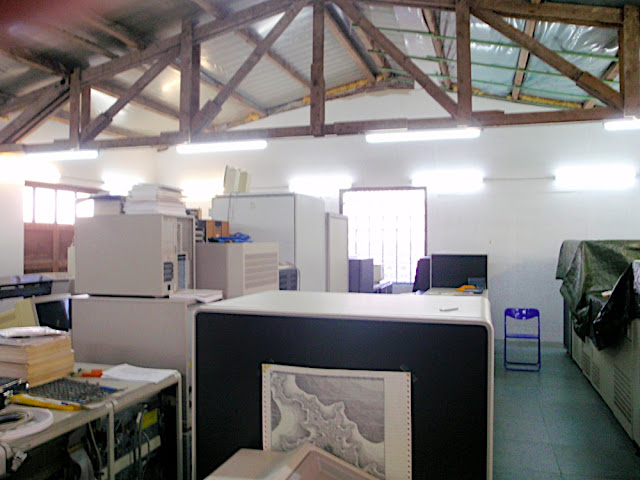
This week I was lucky enough to visit the Analog Computer Museum near Frankfurt. Bernd who owns and protects the collection I have known for years via email so I was happy out to finally get to meet him and his wife. These Analog computers carry out calculations using electronic components.


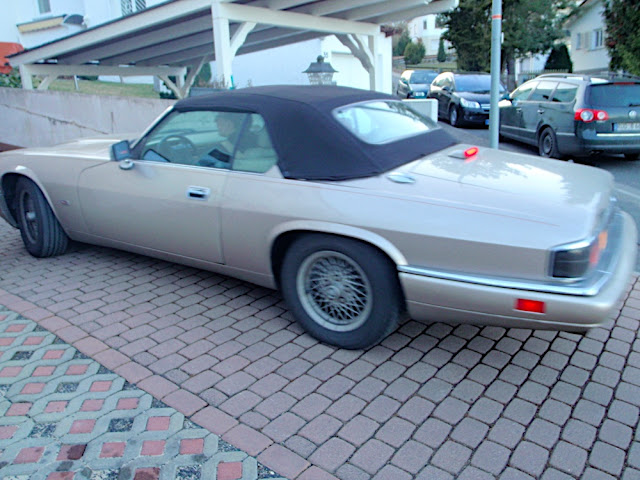
Bernd works as a software archeologist. That is he updates the systems of banks and such that are written in OS' and languages that almost no one knows anymore. If the software running your bank was written int he 60's and you want to get it running on Linux Bernd is the man to call. These languages are so obscure they make the COBOL look like the Beatles. The job seems to pay well enough as he can afford warehouses to keep his computer collection in and a collection of vintage sports cars he drives at terrifying speeds on the local autobahns.


Yes I take my wife to Computer Museums but in fairness shes a physicist and I suspect she thought this rocked as much as I did


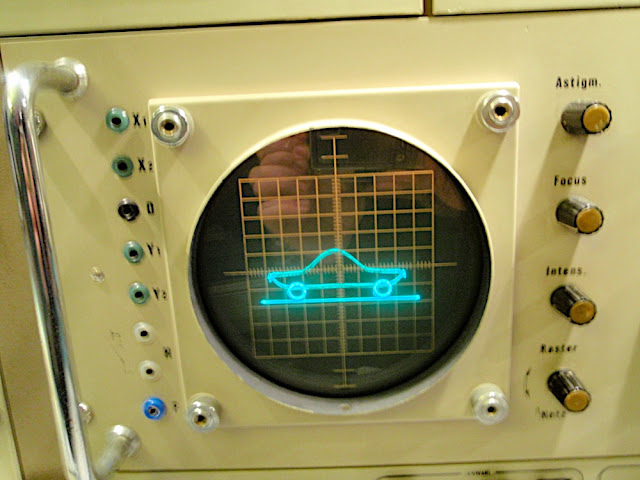
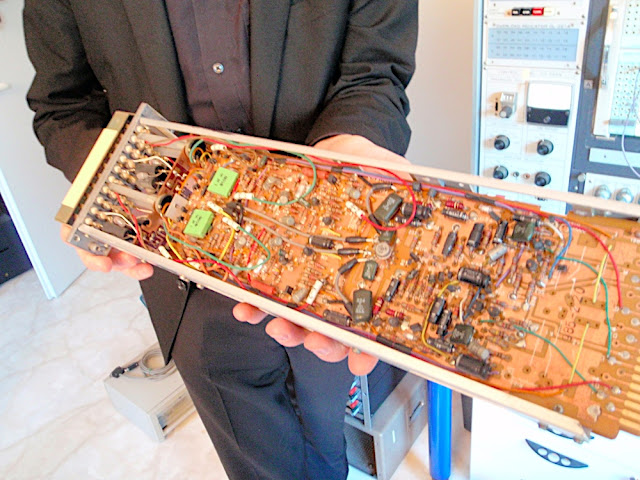
These machines are ideal for real time simulation. This Telefunken currently simulating a car was used to train nuclear powerstation operators with simulations of various 'problems'


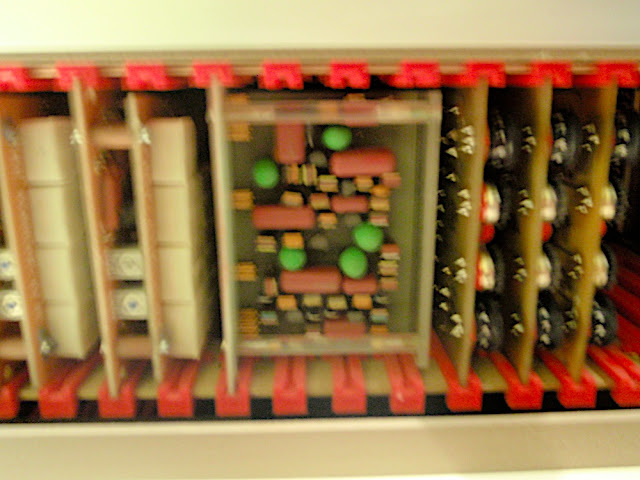
Next time you call rand() think of this board that was used to generate random numbers through electronics


Old school fractal printed out and taped to the side of a Vax. It is like chalking up a kill on the side of a WW2 fighter plane. Computing from the time where men were men and debuggers were nervous.

I cannot rationalise why these analog computers are so cool (pics here). I think its to do with getting to the bare metal of a computation. Also something of the history of these machines is amazing. Looking at the circuit boards you can imagine national characteristics they describe. The German machines based on mathematical abstractions are beautifully clean (and easy to fix apparently). The Japanese machines were a mess like their remote controls. The British machines had a distinct boffin feel to them. The machines from communist countries really seems like a scramble of clever but under resourced hacks. The American machines were big brash and heavy.


Kevin Kelly claims that a technology never dies

What happens is that most technologies become obsolete, diminish their role, but they don't disappear--more idea-based and can be resurrected more easily. Seems like a silly claim: the hand-axe, the arrowhead--they don't exist any more. And that's what I thought too... Looking on the Internet was able to find an example of whatever the challenger had given to me: brand new steam-powered valve for a steam-powered car; they're making flint axes exactly the same way, using exactly the same tools to the point they are almost indistinguishable from the original; archeological artifacts, making in huge numbers today.

But I really worry that the knowledge of many of the engineers who created these machines will be lost. One thing is that the analog museum really wants donations of machines that may be thrown out. If you see a box of the brand Dornier, TeleFunken, Gould, Aritma, BBC, Electronic Associates Inc, Solartron or even just something you think might be of interest send him an email. Even parts of these machines could be really useful to help repair the computers he has.

I do not think these machines are purely of historic interest. It is possible that in the future analog computers will be used in the real time simulations they excel in. One area I think they could be useful for is search engines. Linear algebra calculations are at the heart of modern search engines. this is described in
The $25,000,000,000∗ Eigenvector the linear algebra behind google and How Google Finds Your Needle in the Web's Haystack

These calculations do not need to be precise (the google algorithm uses random walks) which removes one of the big objections to analog computers.

George Dyson in the this years edge question 'What Scientific concept would improve everybody's cognitive toolkit?' describes a search engine based on analog computers here
Analog computing, once believed to be as extinct as the differential analyzer, has returned. Not for performing arithmetic — a task at which even a pocket calculator outperforms an analog computer — but for problems at which analog computing can do a better job not only of computing the answer, but of asking the questions and communicating the results. Who is friends with whom? For a small high school, you could construct a database to keep track of this, and update it every night to keep track of changes to the lists. If you want to answer this question, updated in real time, for 500 million people, your only hope is to build an analog computer. Sure, you may use digital components, but at a certain point the analog computing being performed by the system far exceeds the complexity of the digital code with which it is built. That's the genius that powers Facebook and its ilk. Your model of the social graph becomes the social graph, and updates itself.


Analog computer methods of calculating eigenvectors have been described decades ago (pdf here).

It is possible that the techniques of analog computers could be the future of search engines. We should make some effort to save these machines, any manuals written on them and if possible some of the knowledge of those who made and used them.

Friday, February 18, 2011

The Great Stagnation in Ireland

There is a new ebook by Tyler Cowen about how growth rates and progress in general has declined since 1973. There is a podcast here where he discusses the argument.

The book, is short you can read it in an evening, and published only in ebook format. It is a bit like an evening with your smart friend as he explains something rather than an economic treatise thats full of equations and aids insomnia. It is well worth the 4 dollars and few hours it takes to read.

Loads of commentators have examined various parts of the argument for stagnating progress. I even joined the argument here. I am going to try give a few datapoints that relate to Ireland that are part of the great stagnation argument here. Ireland has not been stagnating since 1973. In that time we moved from an improvished bachwards country to a modern well off one (and then slipped back somewhat again).
But there some areas where we are stagnating in similar ways, there are areas where we made similar mistakes to the Americans (and the rest of the OECD) and if we can expect a similar decline in growth here that means we should alter our expectations.

Stagnating medicine

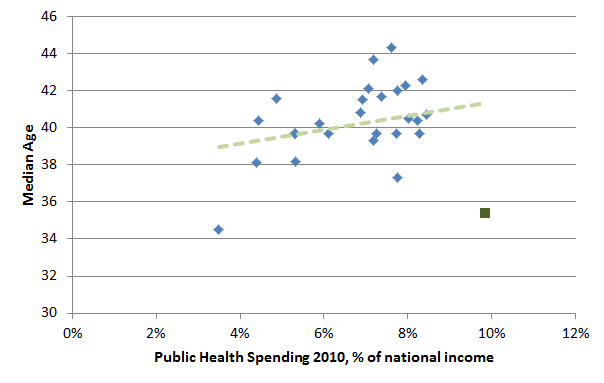
We spend too much on medicine and do not get good value for that spending. There is a piece here by Ronan Lyons where he argues convincingly that with our age profile we should be spending a third less than what we currently do on medicine


It is generally agreed that access to the health system in Ireland is bad. If we spend more than we should and people cannot get healthcare as easily as other OECD countries do it is fair to say that Irish healthcare is not improving our quality of life the way it should be

Stagnating education

'In the past decade, funding per student has been increased in real terms by 61 per cent, yet performance has decreased by 15 per cent.

This disconcerting news was reinforced before Christmas when the international ranking of the reading, mathematics and science skills of Ireland’s 15-year-olds was published. Reading skills dropped from fifth to 17th, the sharpest drop among 39 countries, with one quarter of all 15-year-olds classified as effectively illiterate. This was more politely termed in the report as “below the level of literacy needed to participate effectively in society”.'

We are spending more and getting less on education. Literacy is one of those basic measures that is hard to fake. Anyone who leaves school illiterate is a failure of our education system. In this school education area Ireland seems to have stagnating improvement.

Expecting too high growth
One of the major conclusions of the book is that Americans expected growth to continue at previous rates and this facilitated the financial crisis. People believed house prices would go up forever without wages increasing at the same rate. When people realised that they could not afford their debts and no one was going to buy them off them the house of cards collapsed.

In Michael Lewis' Vanity Fair piece makes a similar claim that Ireland expected too much growth
'An Irish businessman named Denis O’Brien sat on the board of the Bank of Ireland in 2005, when it was faced with the astonishing growth of Anglo Irish, which was about to double in size in just two years. “I remember the C.E.O. coming in and saying, ‘We’re going to grow at 30 percent a year,’” O’Brien tells me. “I said, How the fuck are you going to do that? Banking is a 5-to-7-percent-a-year growth business at best.”'

If the financial crisis in America was aided by delusions of future growth the Irish collapse was to an even greater extent.

Expecting growth to be much higher than it will be leads you to paying too much for things. For example buying empty buildings on the grounds that NAMA will make a profit on them eventually.

Other Claims
There is a very interesting section on how the internet might entertain us but does not provide many jobs. There is a similar argument to in "An Exodus Recession?" that because we can sit at home and look at youtube essentially for free the recession both does not feel as bad but is measurably worse as people do not go out and spend money on cinemas etc that employ people.
This does not relate specifically to Ireland though I do think the internet has improved our lives in ways that are hard to measure and that probably help those who like reading and arguing more than they help the average person.

Cowen also claims that increased emphasis on scientific research could again get progress moving faster again. I was watching Bronowski's the ascent of man last night from 1973, the year Cowen claims the stagnation began. Bronowski gives a warning that the next step in mankinds progress is dependent on science and that if we don't prevent scientific progress from stagnation some other civilisation will.


Expecting growth to return now

I have heard many people running for office who claim anyone who questions that we can return to the good old days of 5%+ growth of being unpatriotic. In this narrative our debts are huge but they were in the 1980's as well ans well soon have 5%+ growth that will evaporate our debts for us.

The evidence is that once countries get as rich as we are now their quick growth from playing catchup then slows. Some of us might be able to get more productive now but not nearly the increase that happened in the 90's when we went from working on farms producing vegtables and potatoes to producing Viagra and Pentiums.

We are not going to have the growth rates we had in the 90's we like the rest of the OECD have entered a period of lower growth, what Tyler Cowen calls 'the great stagnation'. Anyone who says we should plan for Ireland growing at a rate higher then the 6.7% interest rate on the ECB/IMF loan are is trying to get you to take on billions of their debt.

The great stagnation a great short book. Though its arguments apply to America the lessons of what they Japan and other countries who developed before Ireland are important for us to learn.

Wednesday, February 16, 2011

When will you be able to ask Watson?

Watson is a computer currently playing the quiz Jeopardy. You can see a video of this here


One useful question is how long this sort of supercomputer like power will take to be seen in everyday life? It has 3000 cores running and answers in less than three seconds. On one machine would take 2 hours to answer a question according to here
So how long to get a desktop computer to be able to answer at this speed? I propose that half the speed improvement in Watson like programs will be from Moore's law and half from algorithm improvements. To go from 7200 seconds to say 2 seconds will require about 13 halvings in speed. I predict this will occur in the time it take processors to improve 7 doublings in computation. You can buy your own supercomputer now on the cloud and depending on how long you are willing to wait you could get an answer to a Watson like answer for costs of around a dollar (if you had the data and software Watson uses).

One comparison here is with chess. "It has been estimated that doubling the computer speed gains approximately fifty to seventy Elo points in playing strength (Levy & Newborn 1991:192)."

If doubling in processing power happens ever two years that would imply about a 30 point increase a year. The actual improvement (in computer v computer games) is described as 'With a 40-point annual improvement due to hardware upgrades, and a 30-point annual improvement due to software upgrades'. Implying improved algorithms are responsible for half the improvement.

This argument is summed up in this explanation as to why a fairly normal computer Deep Fritz in 2002 was an improvement over the supercomputer Deep Blue in 1997 'Deep Fritz has improved considerably over Deep Blue. Despite Deep Fritz having available only about 1.3% as much brute force computation, it plays chess at about the same level because of its superior pattern-recognition-based pruning algorithm'

I claim there is an analogy to Moore's law that says something like.

Once computers get good enough at a task to have a flashy TV challenge from then on algorithms will cause half the improvement in that task

So if I am right I think Watson like computation instead of talking over 25 years to move from twelve refrigerators to something we can use everyday should take less than 10 years. I would take an even money bet that in five years there will be a service you can use from your phone that is a lot closer to Watson than to a search engine we see today.

*update A friend just made this bet with me
"20 euro bet that January 2015 there is a search engine that with a set of quiz questions from one gameshow program (the weakest link, who want to be a millionaire, university challenge) and it has to get 7/10 right". The effects of learning by reading (and autonomous cars) are examined in this rather long but brilliant blogpost

Monday, January 31, 2011

Are Kitchens Better?

There is a really interesting debate going online right now about whether the rate of improvement in America and the west in general has slowed. The debate has been started by a book by Tyler Cowen called "the great stagnation" which I have yet to read.


Above is a graph from here of how quickly different products became popular
Paul Krugman raises a similar point about how American Kitchens have not improved much from the 1950's here where he points out "By any reasonable standard, the change in how America lived between 1918 and 1957 was immensely greater than the change between 1957 and the present."

You could argue that kitchen equipment is much cheaper than they were in the 1950's. Or that rice cookers, food processors and microwaves are a great improvement. Coffee machines are probably the exception to the stagnation rule as they do seem to have improved vastly. There is also the explanation that if your home kitchen has not improved maybe the kitchen that cooks your food has.

Has the big change been that people do not use their kitchens anymore? In a 1950's kitchen could you order a pizza to be delivered? Dominos started in 1960 according to the history of pizza delivery here so you probably could. I doubt Italian, Chinese, Mexican and Indian food were regularly delivered to ordinary peoples homes though.

Has the technology and labour moved from the domestic kitchen into industrial kitchens that now do 90+% of the work in preparing many of our meals? How much of the supposed lack of improvement could be explained in terms of more processing happening outside the home?

About 44 percent of food dollars are spent outside the home – a figure that started rising sharply in the 1970s, as more women joined the work force. Full-service restaurant revenue rose 5 to 7 percent a year in the decade leading up to the Great Recession”. So do seem to be eating out more?

Houses with small numbers of people cook less. And houses have less people nowadays, due to demographics. If people eat out more (or order in). Why would they buy some brand new kitchen invention? I have seen people with kitchens filled with shiny new equipment they have never used but I think this is fairly rare.


If the dial up pizza restaurant can have a new dough maker that is more efficient it makes sense for them. I can ring them up now and get the use of their new industrial standard food technology for the minute it takes them to make my pizza. Maybe home technology stagnated and the restaurant/supermarket/Microwave dinner technology improved?

I think it is worth noting that the improvements in Irish kitchens in this time have been huge. The 1918 world Krugman describes is superior to my grandmothers life in the mid fifties rural Ireland. She did not have running water or electricity and in her lifetime between 1950 and 1980 the changes she saw were massive.

Tuesday, July 20, 2010

Science grows 2.5% annually why doesn't the economy?

What causes economic growth? Much of the world still lives in grinding poverty, figuring out a way to get them out of this is important. The best way seems to be for their economy to grow.

There are many theories as to what causes economic growth. The founder of Google claims
"Virtually all economic growth (in the world) was due to technological progress. I think as a society we're not really paying attention to that," Page said. "Science has a real marketing problem. If all the growth in world is due to science and technology and no one pays attention to you, then you have a serious marketing problem."

If technological progress causes growth there should be a link between the amount of scientific progress and the amount of growth. Here is a very interesting article about the rate of the increase in scientific knowledge.

'What I found, using this simple proxy for difficulty, in each field — biology, astronomy, chemistry — was a curve with the same basic shape. In every case, the ease of discovery went down, and in every case it was a curve called an exponential decay ...[I] discovered asteroids get 2.5 percent smaller each year. So while the ease of discovery drops off quickly as early researchers pick the low-hanging fruit, it can continue to “decay” a long time, becoming slightly harder without ever quite becoming impossible"

Say science increases in the level of knowledge by 2.5% a year.

What is the rate of economic growth? 'Since 1820, world development has been much more dynamic. Per capita income rose more than eightfold, population more than fivefold.' 190 years growth 8 fold increase is a growth rate of about 1.1% per annum. Or for two specific countries the UK from 1830 to 2008 had average real GDP 1.97%. The US 1830 to 2009 real GDP of 3.62%.

Other things cause economic growth

-Demographics more people of working age means more stuff gets made.

-Institutions. The rule of law matters. If people think anything the build will be plundered off them they wont build much.

-Governments. Some ways of running a country seem to result in more economic growth than others. Communism was never that good at creating economic growth for example.

-Taxation. At a certain point if you tax people too much they wont work anymore. If you dont tax people enough you might not be able to afford schools. Knowledge of what level of taxation is beneficial to economic growth should improve over time.

-Financial innovation. By getting capital to the people who best use it financial innovation is supposed to help economic growth. If it doesn't we should not spend money bailing out investment banks.

-Foreign aid: Aid to developing countries seems to have a mild positive effect on their economic growth rate though in specific areas it seems to have a negative effect

What else can affect economic growth and how great an effect does it have?

Friday, May 21, 2010

Craig Venter creates synthetic life form

There are stories about this everywhere. But one quote from wired sticks out

“Over the last five years the field has seen a 100-fold increase in the length of genetic material wholly constructed from raw chemicals,” said synthetic biologist Drew Endy of Stanford University. “This is over six doublings in the max length of a genome that can be constructed.”

Doubling in abilities in less than a year is amazing. Pretty much any exponential improvement like that ends up being a big deal if it carries on for a reasonable length of time. This is 1 million base pairs of synthetic DNA. A human is 3 billion base pairs. So at this growth rate that is less than 12 years. Not that you would artificially create a human or anything but it gives you some impression of how rapidly this technology could develop.

Friday, April 10, 2009

Shannon limit progress


Shannon was the guy who came up with much of the theory of digital computers but is mostly famous for creating information theory. I found out today invented the worlds first wearable computer to cheat at roullette in Vegas here. This is pretty similar to finding out Einstein invented a time machine to grift rubes in three card monte.

He also developed a motorised pogo-stick and flame throwing trumpet. A picture of Shannon using these or even just juggling on his unicycle would finally prove the internet was useful.

So how has attempts to get a code that approaches the Shannon limit progressed? "The Shannon limit or Shannon capacity of a communications channel is the theoretical maximum information transfer rate of the channel, for a particular noise level."

It is really important because it controls how much information a device can transmit. Which is important if you make phone calls or communicate with a satellite.
So in 1948 Shannon put a limit on how much information can be transferred. Mathematicians (and engineers) devise ways to encode information to make communications close to this limit. As maths progresses you would expect the codes to get closer to this limit.

I have taken this first picture from this very good article. You can see how codes improve over time


In this picture you can see new codes moving closer to 0 on the y-axis showing improvements in the coding schemes. I'm having trouble getting the world record closeness to the Shannon limit for particular dates. When I do I'll add them.
What I have so far is
Year Power Who
1977 2.1 dB Reed–Solomon code(now 1–1.5db)
1997 .27 db hamming code
2009 0.0045 dB LDPC codes

Sometimes codes have been invented before they were practical, but even then people tend not to have known how good they were.
"LDPC codes were invented by Robert Gallager in 1962! However, LDPC codes were largely forgotten until their rediscovery by David Mackay in 1998, who not only rediscovered them but used powerful modern computers (which were not available to
Gallager) to simulate their performance and thereby demonstrate their astonishing power"

The importance of this progress has been summed up by suggesting future historians will write
"Claude Shannon formulated the notion of channel capacity in 1948 A.D. Within several decades, mathematicians and engineers had devised practical ways to communicate reliably at data rates within 1 percent of the Shannon limit...."
Coding theory is one where we can see practical applied progress in mathematics over the last 60 years.

Thursday, April 09, 2009

Rubik's Progress

How quickly is maths improving? Say you look at how good your best solution to certain problems is over time. You can estimate how much improvement there is in maths over this time. Most of maths is based around proofs which are pretty hard to measure the quality of. But by looking at applied results you might get evidence to how much the pure maths knowledge has improved also.
So take the example of optimal algorithms for Rubik's cubes (most of this data taken from here).

Start 1974 until now how many face turns are needed to solve the Rubik's cube in the worst case?

52 moves 1981 using Thistlethwaite's Algorithm
42 moves 1990 Kloosterman (doc)
39 moves Mike Reid (i'm trying to get a date for this)
29 moves 1995."In 1995 Michael Reid proved that using these two groups every position can be solved in at most 29 face turns"
27 moves 2006, Silviu Radu
26 moves August 2007, Daniel Kunkle and Gene Cooperman
25 Moves Mar 2008 Tomas Rokicki
23 moves Jun 2008 Tomas Rokicki
22 moves August 2008 Tomas Rokicki

This implies 20 moves are enough using the given algorithm but it has not been proved

Now the best possible solution is at least 20 moves (known as gods algorithm). This number used to be 18 but was improved in 1995 by Michael Reid. The bounds on solutions to the Rubik's cube is improving from two sides. The ability to solve a Rubiks cube going from 52 to 22 moves does not seem earth shattering. There are probably more important maths calculations that have improved over time though. Can you think of any? As usual if you have any more information or corrections I will add them.

Wednesday, April 08, 2009

Timing Accuracy

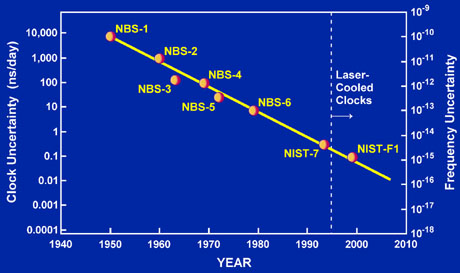
As technological improves you would expect that our ability to measure things would improve. So if we take the accuracy of measurements as a crude gauge of technological progress can we graph how quickly we are progressing?

So take time. How quickly is our ability to measure time accurately improving?

I'm going to have a look at how accurately people have been able to measure time since the start of the modern world (about the time Newton got hit by an apple) till now. I take accuracy to mean how many seconds you could count before you would be out by one on average.

1656, Dutch astronomer Christian Huygens. It had an error of less than one minute a day according to here
1721, George Graham improved the pendulum clock’s accuracy to within a second a day
1761 John Harrison, half a second a day
1889 to Siegmund Riefler's clock with a nearly free pendulum, which attained an accuracy of a hundredth of a second a day
1952 Quartz clock at accuracy of 1 in 10^8 seconds.

Modern times are graphed here

For the atomic age I got the figures from here
So that gives the data

year accuracy
1650 10E+03
1721 10E+05
1889 10E+07
1952 10E+08
1955 10E+10
1970 10E+13
1989 10E+16
2008 10E+17

One problem with this line of thought is that exponential increases tend to stop. Otherwise we would be up to our ears in Fibonacci's rabbits. The problem with this exponential reasoning is described here

There are all sorts of other things whose accuracy have improved over time. Has temperature and mass measurement accuracy increased at the same rate?