Showing posts with label Science. Show all posts

Saturday, July 04, 2026

Next Pandemic we should have Challenge Trials

Covid-19 is long enough away now that we should look at what happened and decide what we want to to next time there is a pandemic. One thing we could do is challenge trials of vaccines. This would have sped up vaccine deployment hugely and saved time and huge amounts of money.

Reading books like Vaxxers there were several vaccines ready for early testing in the first weeks of 2020. But it still took until December for the vaccine to be approved. This is because if you have tens of thousands of people in your vaccine trial but tiny amounts of the disease out there it takes a long time for enough people in the vaccinated and unvaccinated sides of the trial to get infected to be able to judge that the vaccine works. 


If instead after the initial testing on a small number of people just to make sure no reactions are common a challenge trial took place. Where after vaccination both arms of a larger phase 3 trial are deliberately infected with the virus you gather enough people in the vaccinated and unvaccinated groups to judge the effectiveness in a matter of weeks not months. 

These sorts of challenge trials are much more common now but it is the sort of thing that agreeing about now will make it much easier and more trustworthy when the challenge trial based vaccine experiments happen. 

Back of the envelope with these sorts of trials a vaccine could have been tested by the time lockdowns started to happen. Even if this was just for medical professionals initially. and rolled out to older people shortly afterward this could have avoided a huge number of issues


Friday, December 17, 2021

A Patreon for Materials

Prizes are a really good way of funding science but are not used enough. All sorts of prizes from longitude to private space have speed up technological development in their area.

Kaggle is an interesting example of current innovation incentivised using prizes. Kaggle defines a metric over a dataset and people try an build models that predict that well. This is then tested over another dataset to prove your predictions are the best. For not very much money a large number of very skilled people work on a defined problem for fun, kudos and the possibility of profit.

  1. Typical Kaggle competition lasts 3 months, offers $25,000-100,000 in prize fund and attracts around 1000 specialists

  2. At least top 10% of those specialists, ~100 persons are of prime quality, many others 'just' good.

Could a similar thing be done for discovering materials with properties we want? There are all sorts of problems that could be solved with materials with new properties. There are commercial incentives to develop many useful materials already. A more efficient solar panel or energy dense battery could have such commercial value lots of people are working on making them already. But some properties of materials are known to be useful but not commercialised yet to have huge competition or budgets trying to create them.

If we agree prizes are a useful incentive. And that we need new materials with useful properties how might a kaggle for such prizes work?

Kaggle has test datasets unknown to competitors held out to prove later which prediction model is best. For a materials version proving specific qualities in the lab would, initially, be too expensive. Relying on the scientific peer review process, of quality journals, would probably be enough initially. Occasionally issues in published materials research comes to light. But that happens in kaggle competitions too. And with prizes fairly low the incentives for shenanigans are not huge. Use a paper being published by a high quality journal as proof that a material has the defined property.


How long would the competitions be open for? The millenium prize for solving known big hard maths problems are open ended. Kaggle competitions are shorter a few month time periods. The time needed for journal papers to be approved and the difficulty of making materials means a year is probably more practical. Having a year competition timeline makes it more open to tinkerers than big grand ambitious challenges. I think 'A prize to someone who makes a wire room temperature superconductor at atmospheric pressure' is too ambitious. 'A prize to someone who publishes the warmest superconductor in a substance that can be turned into a wire by December 2022' is more practical. Competitions for improvements of a defined characteristic over a period of a year or two seem to be the best prize incentives to me.

How much would the prizes be for? Using journals keeps the cost of running the competitions low. But also means huge amounts of money cannot be involved. Also unlike kaggle a company putting up a dataset is not paying the prizes. The prizes would just be donated by people who can see that creating a product with these properties would be useful for improving our lives. As such a Patreon like model where donations are collected would probably be best. Stripe lets foundations setup as non profits set up these sorts of donations. Prizes would probably be in the 100K to -> 1 million range but initially to prove the concept would be much lower. 

What would be a good initial material quality to test this Patreoned Kaggle for materials idea on?

Sunday, November 16, 2014

The number of new drugs is declining

Why Are So Few Blockbuster Drugs Invented Today?
since 1950, the number of new drugs approved has fallen by half roughly every nine years, meaning a total decline by a factor of 80. They called this Eroom’s Law, because it resembled an inversion of Moore’s Law

Graph from In the Pipeline (more here)

Why has the worm not been emulated?


"The way the prophets of the twentieth century went to work was this. They took something or other that was certainly going on in their time and then said that it would go on more and more until something extraordinary happend." G. K. Chesterton

What if you could emulate the brain the way we emulate computer worms?

C elegans is a 1mm long worm with 302 neurons, 3 Nobel prizes and has survived a space shuttle crash. It is one of the simplest animals and has been studied in massive detail. Like the fruitfly or ecoli anything these lab animals do that you cant explain you wont be able to explain in people either.

Whole brain emulation is a prediction that we will be able to simulate the brain in enough detail to create artificial intelligence very like us.

Robin Hanson on econtalk talked about the possible results of whole brain emulation.
"This scenario, which we've called whole brain emulation--taking a whole brain and emulating it on a computer--requires three technologies. One is scanning--you have to be able to scan something in sufficient detail; have to see exactly which parts are where and what they are made of. Two, you have to have models of these cells, a model of the cell input signature and then what comes out of it as a mapping--doesn't have to be exactly right, just has to be close enough. Three, you need a really big computer. A lot of cells, a lot of interactions."
Hanson blogs about brain emulation here. There are interesting fights about whether whole brain emulation is a reasonable prediction or just "the rapture for nerds".

Many biologists seem to think computer people are completely misunderstanding how complicated biological systems are and computer sciencey whole brain Emulation types say that biologists do not understand abstractions because they deal with this complexity all the time.
'[Robin] Hanson’s fundamental mistake is to treat the brain like a human-designed system we could conceivably reverse-engineer rather than a natural system we can only simulate. We may have relatively good models for the operation of nerves, but these models are simplifications, and therefore they will differ in subtle ways from the operation of actual nerves. And these subtle micro-level inaccuracies will snowball into large-scale errors when we try to simulate an entire brain, in precisely the same way that small micro-level imperfections in weather models accumulate to make accurate long-range forecasting inaccurate.' is an example of the biologists argument against brain emulation.

'We should expect brain emulation to be feasible because brains function to process signals, and the decoupling of signal dimensions from other system dimensions is central to achieving the function of a signal processor.

"We can do trend extrapolation and say: Where are we now; if trends continue how long would it take? The computing technology has a nice solid trend; we can project that pretty confidently into the future. The problem is we don't really know how detailed we're going to need to go into these cells. The scanning technology, we have decent trends. This is a vastly smaller industry; small demand. That technology actually looks likely to be ready first. We've actually done a scanning of a whole mouse brain at a decent resolution. A thousandth smaller than a human brain. What does that mean--scanning of a brain? They slice a layer, do a two-dimensional scan of that layer at a fine resolution, go across each cell, and then they slice another layer and do the same thing again. Let me ask again, sort of naive question: If you could take a person's brain out of their head while they were still alive, are you going to be able to get access to my memories in this process? my creativity? All these things we think of as more than a physical process, but of course as you say, it's just chemicals interacting. Is it imaginable that we would be able to reconstruct my memories? To the extent we are confident that your memories and personality are encoded in these cells and where they are and how they talk to each other, so we get that right, we get it all right. That's all you are. Let me say it differently. Looking at it isn't enough. Scanning means noticing the chemical densities. There's thousands of kinds of cells in your brain, and each cell sort of behaves a bit differently. What we need is to know when a cell gets a signal from the outside, electrical or chemical signal, how does that change a cell and what kind of signal does it send out. So, we need to have a model of each of those cell types. We have, actually, models of a wide range of cell types. Doesn't seem that hard to model these cells. We just have a lot of cells to go through and not that much motivation to do it all in a rush. We have actually pretty good models of some particular cells. We have a cell on a dish, we send a signal in, model on the computer, do the same things."

Both sides here. The brain is really complicated squishy stuff and the simcity looks like a real city if you squint sides here could be right. I want a comparison of the predictions of these two theories now and not in 2040 though.

If we had Hanson's 1,2,3 met for an organism and we were not emulating it that would seem to be a problem for the theory.

One is scanning--you have to be able to scan something in sufficient detail;

The c elegans connectome was mapped in 1986
Two, you have to have models of these cells, a model of the cell input signature and then what comes out of it as a mapping--doesn't have to be exactly right, just has to be close enough. There are not many types of neurons in c elegans so we should have a fairly good model of when they will fire.


Three, you need a really big computer. A lot of cells, a lot of interactions."
How big a computer would you need to model all these cells and interactions?

In When will computer hardware match the human brain?
Hans Moravec (1997) gives some nice graphs of how much processing you get for $1000


Kurzweil gives similar figures here

This puts the amount of processing available to a C. elegans at about 1990 levels for $1000. So in 1986 that processing power would have easily been available to university researchers. Maybe that graph is optimistic but if it is out by 25 years for something as simple as c elegans that means predictions of whole brain emulation by 2050 also on the graph will be out as well.

For the last 25 years we have had the power to emulate the whole brain of C. Elegans. Why haven't we?

1. We have not actually because our neuron firing models has not been accurate enough
2. No one cares about emulation fo a worm. A lot of people care about this worm the numbers of neuroscience papers on it confirm this.
3. They are just a bit delayed. There is a thread here on less wrong about this
an open source project openworm*
4. It is hard to get output from a worm 'Our first goal is to combine the neuronal model with this physical model in order to go beyond the biophysical realism that has already been done in previous studies. The physical model will then serve as the "read out" to make sure that the neurons are doing appropriate things.' Pixar, special effects companies and computer game programmers must have fairly good worm emulation programs. If there is a big problem making an animal bodies simulation surely one of them could easily enough make a good model of a tiny bag of gunk?

'Whole Brain Emulation A Roadmap' acknowledges the gap that exists in our emulation of the animal and suggests alternatives ' While the C. elegans nervous system has been completely mapped (White, Southgate et al., 1986), we still lack detailed
electrophysiology, likely because of the difficulty of investigating the small neurons. Animals
with larger neurons may prove less restrictive for functional and scanning investigation but
may lack sizable research communities'

Why 25 years after having a good map and enough computation to run the calculation have we not emulated C Elegans? If it is the modelling of the cells
'I have talked several times to one of the chief scientists who collected the original connectome data and has been continuing to collect more electron micrographs (David Hall, in charge of www.wormatlas.org). He has said that the physiological data on neuron and synapse function in C. elegans is really limited and suggests that no one spend time simulating the worm using the existing datasets because of this. I.e. we may know the connectivity but we don't know even the sign of many synapses.'

The openworm project is really cool. and it might be a good way to get some evidence into the whole brain emulation debate now.

'The problem is we don't really know how detailed we're going to need to go into these cells. '

If Ken Hayworth is right and it is just that 'He has said that the physiological data on neuron and synapse function in C. elegans is really limited' is this because the biologists are right and step 2 the cell models will not be as easy to build as supporters of whole brain emulation claim?
These is a project here to emulate C Elegans. And a good paper here on the problem involved Dynamics of the model of the C Elegans neural network. Just in time to make me look more stupid is A Worm's Mind In A Lego Body. It is not full emulation yet but it is at lest on the path there. * An article from Popular Science on Whole Brain Emulation here that made me resurrect this post I drafted two years ago. Since then the openworm project has moved on massively.

Drones and Ecology

Drones have become wildly popular recently. They seem to be on the path of military, geeks, specific industries ->everything that successful tech seems to go through. It seems likely that large numbers of small deliveries will take place by drone in ten years time. One thing that damaged bird sized tech in the past was hawks. Jon Bentley described in 'More Programming Pearls'
The computers at the two facilities were linked by microwave, but printing the drawings at the test base would have required a printer that was very expensive at the time. The team therefore drew the pictures at the main plant, photographed them, and sent 35mm film to the test station by carrier pigeon, where it was enlarged and printed photographically. The pigeon's 45-minute flight took half the time of the car, and cost only a few dollars per day. During the 16 months of the project the pigeons transmitted several hundred rolls of film, and only two were lost (hawks inhabit the area; no classified data was carried). Because of the low price of modern printers, a current solution to the problem would probably use the microwave link.
Hawks have a habit of attacking small things we send through the skies. There is this great piece on the effect of Amazon drones on ecology. The Dark Extropian Report: The Evolution of Amazon’s “Prime Air” Drone Delivery Service
Hawks and other birds of prey taking issue with these noisy (for now) airborne intruders into their territory. Everyone was worried about people below shooting them down, but it turns out there may be another threat that can’t be so easily policed; outlaw avians....A delivery drone that takes its shape and forms that outline in the sky will not be attacked by a lesser predator, even if it’s not already wired into their genetic memory

The article suggests creating drones that look like very big hawks to discourage natural hawks from attacking them.

This effect doe not just apply to birds of prey though. Prey species hide when they see the outline of a bird of prey. And doing this increases their anxiety enough to reduce feeding and decrease numbers drastically over time. The drones that look like birds of prey will not have to prey. Just being in the sky with the right silhouette will drastically reduce the number of vermin.

According to this article

Changes to ecology have unpredictable effect on the environment. Less pigeons would seem an improvement to the urban environment but they do eat bread and other foodstuffs. If numbers are reduced enough to prevent this bad things could happen.

tldr: 1. there will be lots of drones 2. They will look like birds of prey 3. They will have a big effect on rats, pigeons and other prey species.

Wednesday, December 19, 2012

Cystic Fibrosis Improved Screening

In the first post I claimed that like Tay-Sachs in Israel Cystic Fibrosis could be drastically reduced with some relatively inexpensive genetic testing. In the second further analysis suggested that such genetic screening of the Irish population would pay for itself several times over. In this post I want to see if some form of targeted screening could be shown to be as cost effective as currently implemented screening.

Currently there is free screening for people who has relatives with CF and their partners. I assume they include second cousin as a relative. Based on this paper and some consanguinity calculations I calculate that an Irish couple with one of their second cousins has CF have about twice the chance of having a child with CF as the general population. This means you can be tested for free currently if you have about a 1 in 700 chance of having a child with cystic fibrosis whereas the general population with a 1 in 1444 chance. If a test can be focused the test so that it is twice as good as random screening that should be enough by current standards to be rolled out.

How could a non random screening be made this focused?

1. Geographic area. Some areas of the country might be more likely to have CF carriers than others. Targeting screening in these areas might make it twice as effective. The Cystic Fibrosis Registry of Ireland annual report 2010 gives numbers for Irish counties. 4 counties do not have their numbers listed but I have estimated these based on their population.

This map is based on the figures of people with CF found in the registry. This could be a biased sample or people could have moved. A better measure would be babies born with CF in each county.

Number of people with CF in each county might be useful for deciding how to allocate some treatment resources. What % of people have CF is more interesting for screening though. To work this out we first need the numbers found in each county.

The number of people with CF in the registry per ten thousand people is

I can send anyone who wants them full sized versions of these maps or the r package code I used to generate them. The code I used is below

library(RColorBrewer)
library(sp)
con <- url("http://gadm.org/data/rda/IRL_adm1.RData")
close(con)
people<-read.csv('cases.csv', sep=',', header=TRUE)
pops = cut(people$cases,breaks=c(0,2,10,20,30,40,50,70,150,300))
myPalette<-brewer.pal(9,"Purples")
spplot(gadm, "pops", col.regions=myPalette, main="Cystic Fibrosis Cases Per County",
       lwd=.4, col="black")
dev.print(file="CFIrl.jpeg", device=jpeg, width=600)
dev.off()
population<-read.csv('countypopths.csv', sep=',', header=TRUE)
pops = cut(population$population,breaks=c(0,20,40,60,70,80,100,160,400,1300))

myPalette<-brewer.pal(9,"Greens")
spplot(gadm, "pops", col.regions=myPalette, main="Population in thousands",
       lwd=.4, col="black")
dev.print(file="PopIrl.jpeg", device=jpeg, width=600)       
dev.off()

gadm$cfpop <- people$cases/(population$population/10)
cfpop = cut(gadm$cfpop,breaks=c(0,0.5,1,1.5,2,2.5,3,3.5))
gadm$cfpop <- as.factor(cfpop)

myPalette<-brewer.pal(7,"Blues")
spplot(gadm, "cfpop", col.regions=myPalette, main="CF/Population Irish Counties",
       lwd=.4, col="black")
dev.print(file="CFperPopIrl.jpeg", device=jpeg, width=600)       
dev.off() 
If this result was replicated in a more complete analysis just picking the darker counties could get you the two times amplification needed to have a test as strong as the currently paid for ones.

2. Pick certain ethnic minorities. Some groups have higher levels of CF than the average population. For example travellers have higher levels of some disorders. 'disorders, including Phenylketonuria and Cystic fibrosis, that are found in virtually all Irish communities and probably are no more common among Travellers than in the general Irish population. The second are disorders, including Galactosaemia, Glutaric Acidaemia Type I, Hurler’s Syndrome, Fanconi’s Anaemia and Type II/III Osteogenesis Imperfecta, that are found at much higher frequencies in the Traveller community than the general Irish population'. 'There is no proactive screening of the Traveller population no more than there is proactive screening of the non-traveller Irish population'. I do not think deliberate screening of one ethnic group, unless that group themselves organise it, is a good idea. Singling out one ethnic group for screening risks stigmatising its members and reminds many of the horror of eugenics.

3. Certain disorders seem to cluster with CF. 'In 1936, Guido Fanconi published a paper describing a connection between celiac disease, cystic fibrosis of the pancreas, and bronchiectasis'. Ireland also has the highest rate of celiac disease in the world (about 1 in 100). If CF and celiac disease or some other observable characteristic are also correlated in Ireland testing people with celiac disease in their family could also provide amplification of a test.

4. Screening parents undergoing IVF. HARI was the first clinic in Ireland to offer IVF and it currently receives up to 800 enquiries a year specifically about the procedure. It carries out over 1,350 cycles of IVF treatment annually and over 3,500 babies have been born as a result. The Merrion Clinic carries out up to 500 cycles of IVF per year, while last year, SIMS carried out 1,063 cycles." IVf is roughly 33% effective per cycle so this means about 1000 children are born through IVF from these three Irish clinics here each year. Screening of these parents would prevent roughly one CF case per year. Screening people who use IVF does not prevent many cases. It can be used by people who know they are CF carriers to avoid having a child with CF though.

Concerns about the privacy and security of a general genetic screening program of the Irish population should not be ignored. Cathal Garvey on twitter pointed out that this screening would require 'With explicit informed consent & ensuing destruction of samples, Just wary of prior shenanigans of HSE bloodspot program. i.e. it's already fashionable among governments to abuse screening programs to create 'law' enforcement databases. Without clear guarantees against that, must weigh the costs of mass DNA false incriminations vs. gains of ntnl screening prog!' I agree that any genetic screening program for Ireland would have to ensure privacy for the individual.

Screening the general population for carriers of serious genetic disorders would save money and suffering. If the level of savings are not sufficient for general screening focusing on certain locations or relatives of people who suffer from disorders that co-occur with CF could amplify the returns sufficiently to be as useful as current screenings.

Thursday, December 13, 2012

Gluten Levels of 73 Beers

I often hear it asked what the gluten content of various beers are. Particularly in relation to celiacs who want to avoid gluten. This post is just a direct google translate of a Swedish research paper. PDF's can be hard to search as can Swedish documents for English speaking users. I am just putting up this translation to aid people searching for this research on beer gluten levels. The appendix here is from the Swedish National Food Agency (NFA). This is from a regularly cited report "Gluteninnehåll i de öl som analyserats vid Livsmedelsverket". Gluten content in beer. SLV. 2009 which is difficult to find online. This commonly linked to location linked to but it is dead.
Gluten content of the beers analyzed at the NFA
A total of 73 analyzed beer. For 12 of these low gluten content of 50 mg gluten per liter or higher.
A further 11 beer contained between 41 and 50 mg of gluten per liter. The list is sorted alphabetically by
manufacturers.
One should be aware that the consumption of beer can lead to increased intake of gluten, even if concentrations gluten in beer
is on a par with those found in foods that are appropriate for gluten intolerance.
Consumption of 0.5-1 liters of beer can in some cases make a significant contribution to the daily intake of gluten,
as for an adult celiac disease should be below 50 mg per day gluten.
The table sometimes describes the gluten level as ep = Not detected, which means less than 10 mg per liter gluten
Manufacturer Alcohol Strength Color Names ppm gluten (Mg / l)
AB Åbro Brewery, Sweden 3.5 light Åbro Original ep
AB Åbro Brewery, Sweden 3.5 Light 18:56 ep
AB Åbro Brewery 5.2 light Andersson Beer 47
AB Åbro Brewery 5.2 light Småland 41
Arthur Guinness Son & Co., Dublin, Ireland 3.5 dark Guinness Draft 48
Arthur Guinness Son & Co., Dublin, Ireland 5 dark Guinness Extra Stout 62
Brau Union Österreich AG 2.8 light Zipfer 23
Carlsberg, Denmark 2.8 light Carlsberg Beer 15
Carlsberg, Denmark 3.5 light Carlsberg Beer 21
Carlsberg, Denmark 3.5 Dark Carnegie Porter 20
Carlsberg, Denmark 4.1 light-Saxon gluten ep
Cerveceria Modelo, Mexico 4.6 Light Corona Extra ep
Cerveceria Cuauhtemoc Moctezuma, Mexico 4.5 light Sun ep
Erdinger Weissbräu, Germany 5.3 light Erdinger Weissbier 1188
Erdinger Weissbräu, Germany 5.6 Dark Erdinger Weissbier obscure 1224
Eriksberg 5.6 dark Christmas beer 33
Falcon Breweries, Sweden 2.8 light-Falcon 28
Falcon Breweries, Sweden 3.5 between Falcon Ale 22
Falcon Breweries, Sweden 3.5 light Falcon Extra brew 24
Falcon Breweries, Sweden 3.5 light Falcon Pilz 67
Falcon Breweries, Sweden 5.2 between Bavarian Falcon 55
Falken Falkenberg 3.5 Dark Beer July 49
Grolsche Bierbrowerij, Holland 3.5 light Grolsch Premium Stock 15
Harboes Brewery, Denmark 2.2 Light The Cheerful Dane 25
Harboes Brewery, Denmark 2.8 light Dansk Pilsner premium beer 42
Harboes Brewery, Denmark 3.5 light Dansk Pilsner premium beer 34
Harboes Brewery AB Denmark 3.5 lighting Christmas beer 31
Harboes Brewery AB Denmark 7.3 light Bjørne brewer 49
Hartwall PLC, Tornio, Finland 3.5 light Lapin Kulta ep
Hartwall PLC, Tornio, Finland 5.2 light Lapin Kulta Premium stock ep
Heinecken Brouwerijen Holland Heineken Light 3.5 45
Hofbräu, Germany 6.3 light Hofbräu October-fest bier 26
Inbev UK Limited 3.5 dark Murphys Irish Strout 43
Jämtland Brewery Ltd 6.5 dark Christmas beer e.p.
Kopparberg Brewery 5.3 light Fagerhult Exports III 93
Kra'sne'Březno 4.8 dark Zlatopramen 47
Kronenbourg Strasbourg, France 5.0 light Kronenbourg 1664 97
Krönleins Brewery AB Halmstad 5.3 dark Christmas beer exports 33
Löwenbräu, Germany 6.1 light Lowenbrau October-fest bier 21
Mariestad Brewery Ltd [Spendrups] 2.8 light Mariestads 40
Mariestad Brewery Ltd [Spendrups] 3.5 light Mariestads e.p.
Mariestad Brewery Ltd 3.5 between Julebrygd 60
Pivovar Nova Paka, Czech republic 2.8 light BrouCzech ep
Pivovary Staropramen 3.5 light Staropramen 21
Pripps Sweden 2.2 light Pripps Light beer 17
Pripps Sweden 3.5 Pripps Blue Light Special Stock 32
Pripps Sweden 3.5 light Pripps Blue Pure 28
Pripps (Carlsberg) 5.0 dark Christmas beer 33
Pripps (Carlsberg) 5.2 light Pripps Blue 66
Shepherd Neame Whitstable Kent 3.5 between Bishops Finger ep
Singha Corp. Thailand 5 Light Singha Premium stock beer 17
Source Castle Brewery 3.5 Uppsala dark Christmas beer 23
Source Castle Brewery Ltd 3.5 Light White Weissbier 67
Source Castle Brewery Ltd 3.5 from Vienna ep
Source Castle Brewery Ltd 9.0 dark Imperial Stout 50
Spendrups Brewery Ltd 2.0 dark Gammeldags Moderate Drinking ep
Spendrups Brewery Ltd 2.1 light Spendrups Premium Stock 31
Spendrups Brewery Ltd 2.8 light Norrland Gold 21
Spendrups Brewery Ltd 3.5 light Norrland Gold 35
Spendrups Brewery Ltd 3.5 light Spendrups Premium Gold ep
Spendrups Brewery Ltd 3.5 light Spendrup Bright Brew 28
Spendrups Brewery Ltd 3.5 light Odin Pilsner 46
Spendrups Brewery Ltd 5.0 light Spendrups Premium Stock 53
Spendrups Brewery Ltd 5.2 dark Christmas beer 24
Spendrups Brewery Ltd 5.3 light Mariestads Exports 45
Spendrups Brewery Ltd 5.3 light Norrland Gold 38
Spendrups Brewery Ltd 5.3 dark Norrland July ep
Spendrups Brewery Ltd 5.9 light Spendrups Premium Gold 35
Spendrups Brewery Ltd 7.0 dark julbock 34
Starobrno Brewery Czech 3.5 light Starobrno Premium Stock 21
St Peters Brewery *, UK 4.2 Light St. Petersburg G-free (gluten-free) ep
Tuborg Copenhagen, Denmark 3.5 light Tuborg Beer Premium Gold 28
Zeunerts AB, Sollefteå 5.1 dark Christmas beer 37
* According to the ingredients list on the brew sorghum.
e.p. = Not detected, which means less than 10 mg per liter gluten
My favorite beer blog is by the beer nut and this links to his gluten free section.

Wednesday, December 12, 2012

Cystic Fibrosis Carrier Screening

In my last post Cystic Fibrosis Screening I described how Tay-Sachs had been nearly eradicated in Israel and America and did a rough calculation as to why it would be cost effective to run a similar program to screen for Cystic Fibrosis in Ireland.

In this post I am going to take a closer look at the figures involved to give more evidence that such a screening program is justified.

The Cystic Fibrosis approve of genetic carrier screening for those related to people with CF and their partners. Genetic Carrier Testing For Cystic Fibrosis. 'Carrier testing is limited to adults over the age of 16 where there is a family history of CF, or where a family member has been found to be a carrier of a CF mutation' says the lab that does the testing.

[in the UK] 'A disadvantage of cascade testing is that it will not identify the majority of carrier couples since more than 80% of affected infants are born in families without a prior history of the disease'. Testing relatives though useful only covers a small fraction of potential CF cases.

This screening of relatives is paid for out of public funds

"How much does the test cost? GP fees will apply for arranging the blood test but molecular genetic testing at NCMG and any genetic counselling you may have is a public service and therefore free of charge".

This means that CF Ireland and the health service are involved in and support CF carrier screening. This means some of the moral objections to public screening that might have existed are not present.

What would population wide screening cost? The cost of genetic screening has fallen amazingly fast. for example here is the cost of sequencing an entire genome compared to Moores law.

23andMe a private company has recently announced it will for $99 dollars. This test checks for over 200 genetic markers including some forms of cystic fibrosis. This is further confirmation that genetic screening is getting much cheaper fast and that its current cost is quite low at less than a tenth of the cost of a night in hospital.

The list price of sending a sample from every 16 year old to 23andMe each year would at present be $7.5 million. There are reasons you might not want a private company to do this but it gives a baseline cost. This $7.5 million is the lifetime cost of under 8 CF patients 'However, the lifetime medical cost of the care of a CF child in today’s dollars was estimated to be slightly >$1,000,000'. To be economical, at US prices, this screening would have to prevent 8 of the roughly 40 CF sufferers born a year. Other genetic disorders are also screened for this $99 cost including many of those listed here. None of these are as common as CF in Ireland but these other disorders should be included in a full cost benefit analysis of genetic screening for the Irish population.

This $100 dollar cost is slightly deceptive as once someone finds out they are a CF carrier there are several options available to them. These vary in cost. They can decide (or matchmakers can ensure) not to have children with another carrier. If they do decide to have children with another carrier they can use IVF techniques to ensure an embryo without CF is implanted. Many of the cost analysis of CF screening (like the Rowley et al paper) include the possibility of screening a fetus for CF and terminating the pregnancy if found. This option is not legal in Ireland. They can ignore their and their partners screening results and have a baby as normal with all the risks that entails.

These costs and the probabilities on each have been worked out for the US in the 1998 paper Prenatal screening for cystic fibrosis carriers: an economic evaluation. 'the marginal cost for prenatal CF carrier screening is estimated to be $8,290 per quality-adjusted life-year. This value compares favorably with that of many accepted medical services. The cost of prenatal CF carrier screening could fall to equal the averted costs of CF patient care if the cost of carrier testing were to fall to $100'. This QALY cost figure is used by health care economists to decide which treatments and screenings meet a cost benefit analysis. The wikipedia page on QALY describes the measue well. According to this paper screening in the US, where CF is about four times rarer, is cost effective for the general population at current screening prices.

The paper 'Economic evaluation of cystic fibrosis screening: A review of the literature' has further figures on the cost of screening. This paper is from 2008 and the figures it quotes can be from years before then. As an example of how much screening costs have dropped in that time 23andMe screening cost $999 in 2007 and is now $99 and screens for more genetic markers.

In the UK £30,000 per QALY is generally considered cost effective.

In Ireland what is the cost for a QALY? 'In Ireland, there is no fixed and generally agreed cost effectiveness threshold below which health care technologies would be considered by policy makers to be cost effective'. ’Pee-in-a-pot’ screening in third level institution/college settings may be considered cost effective if a cost effectiveness threshold in the region of €45,000 per QALY gained is used. This €45,000 per QALY gained seems to be a generally accepted figure.

There are more costs to screening than can be supped up in a € per QALY figure. Any screening will induce worry for example. Prostate, breast cancer and other screenings all also induce extra human costs not measurable in QALY though. These common screenings also have to meet these cost per QALY standards.

Given the US analysis at $8,290, screening costs having dropped drastically since then and the high rate of CF gene in the Irish population this implies to me full CF screening of the Irish population would be very cost effective.

Friday, December 07, 2012

Cystic Fibrosis Screening

Approximately 1 in 25 Ashkenazi Jews are carriers of Tay-Sachs disorder which is a really nasty genetic disorder that kills children who have inherited two copies of the Tay-Sachs variant of the gene from their parents by the age of four.

This disease does not effect many kids anymore though

of the 10 babies born in North America in 2003 with Tay-Sachs, not a single one was Jewish.

Figures from Israel paint a similar picture.

According to Prof. Joel Zlotogora, who heads the Health Ministry's Department of Community Genetics, just one baby was born with Tay-Sachs in Israel in 2003. Insofar as is known, not a single baby in Israel was born with Tay-Sachs last year,(2004)

Israel almost ten years ago pretty much eradicated a really nasty genetic disease. This has been done by screening people so that they know they are carriers. If they find out early in a relationship that their partner is also a carrier people tend to decide they are incompatable. IVF techniques allow testing of preimplantation embryos for certain genetic disease before implantation. Finally 'the general public in Israel is advised to carry out, at the expense of the state, genetic tests to diagnose the disease before the birth of the baby. In the event an unborn baby is diagnosed with Tay-Sachs, the pregnancy is usually terminated'.

The Cystic Fibrosis variant of the gene is carried by 1 in 19 Irish people. This is the highest rate in the world. CF is an unpleasant disease but not nearly as unpleasant as Tay-Sachs. It is however the most common genetic disorder in Ireland and one that is more common than Tay-Sachs, which screening eradicated nearly a decade ago.

75,554 children born in Ireland during 2009. Testing newborns would be unfair for reasons of consent but a genetic test for CF could be offered to adults. Genetic carrier test costs a bit over 100 euro (but the costs has been dropping exponentially for the last several years). Testing in bulk means this screening could come in at under 7 euro million a year. Much of the cost in testing involves collection and processing of samples. This means other less common genetic disorders could be screened for at little extra cost.

A bed in an Irish hospital costs €910 per day. This is semi private room and I believe CF rooms need to be more isolated than this. That is €332150 per year. For the 20 beds in the St Vincents unit that costs (roughly) 6.5 million per year. The cost of screening every 18 year old for CF is roughly that of running one ward in St Vincents for a year.

This cost benefit analysis of screening for CF of one ward ignores all the other medical costs involved in CF but worse it ignores the suffering of the 35-40 children (one in 1,461) born with the disorder every year. The termination of fetus' with CF would not be supported in Ireland. CF compared to Tay-Sachs is a mild disorder and Irish people have a different opinion on termination to Israeli's. But with voluntary screening CF cases would significantly reduce just from partner selection alone.

I think at least a cost benefit analysis and a debate on the morality of genetic screening of the general population should take place.

Tuesday, April 10, 2012

The Rational Voter On Science

The myth of the rational voter is a great book by Bryan Caplan about how democracies make predictable errors because people are biased against certain beliefs. The video below gives a good synopsis of his arguments


The belief that people having incorrect beliefs will not be a problem is called "The miracle of aggregation" where people don't know much all disagree with each other and those small number of people who do know something are the ones who are left after all the noise is cancelled out. But because these beliefs are not randomly wrong but biased to one side this cancelling out doesn't happen.

He talks about the economic areas of being anti market, making work for the unemployed, anti foreigners and that people are too pessimistic and how general opinion on these issues disagrees with that of economists. You could argue that the people are right and economists wrong on these issues but generally people who are experts in a field tend to know more about it. If you disagree I am available for entirely unqualified and haphazard brain surgery if you want to put your brain where your mouth is.

But what about non economic questions? Are there scientific questions people get wrong that might result in voting based on a mistaken view of how the word works. There is a poll about scientific question that takes place across many countries called the National Science Foundation, Science and Engineering Indicators which asks what it thinks are basic science questions everyone should know the answer to.

If many people get the wrong answer about these questions, and the question is important from a policy point of view then this poll will show an area the voter is likely to be irrational about and we will get bad policy in that area.

· The center of the Earth is very hot. (True) 78.0% of Americans in 2006 got this right.
A politiician who did not believe this might have a hard problem supporting geothermal heating. But geothermal is not that big a source of energy so it would mess things up very badly.

· All radioactivity is man-made (False) 73.0% got this right.
Without realising this you might overestimate the risk man made radioactivity is going to cause. I am willing to bet the 27% of people who didn't know this might be less in favour of nuclear power stations. But I really don't know if more nuclear power is a good policy. Lovelock and Brand say it is. Unless I can prove the connection between holding the belief that all radioactivity is man made and being anti nuclear power it is a stretch to claim this false belief harms us.

· It is the father’s gene that decides whether the baby is a boy or a girl (True) 62.0% got this right
Many parents want male children and without realising this then women could get blamed as the female kids are their fault. I'm not sure what political policies would change if you did get this wrong though. Sex selective abortion seems wrong whether you understand the y chromosome or not.

If more people understood the sperms role in sex selection more sperm sorting techniques could be used. This might result in lower numbers of children in those who want to 'balance out' their families.

· Lasers work by focusing sound waves (False) 42.0%
'over 25% of the GDP of developed countries is directly based on quantum physics' someone who got this wrong would have very wrng views about something fairly fundamental to the modern economy.

· Electrons are smaller than atoms (True) 45.0%
Similar issue with understanding one of the main sources of income in a modern economy. Could someone who got this wrong really hope to decide between investing research money in on scientific field or another?

To be fair I might get this question incorrect. Electrons do not really have a size. As wikipedia says "the electron has no known substructure.[2][72] Hence, it is defined or assumed to be a point particle with a point charge and no spatial extent". This question is a bit like asking is a car smaller than hope. The question doesnt really make sense.

· Antibiotics kill viruses as well as bacteria (False) 54.0%

This one is really important. Overuse of antibiotics is making them less effective. Megan Mcardle has a great piece on the problem here.

Some people give antibiotics credit with increasing our life expectancy by about 8 years and no one thinks they have had a tiny role in our large life expectancy increase during the 20th century.

Getting antibiotics policy wrong is a really big issue and one the public get wrong. You don't hear politicians on the "If you vote for me you wont get penicillen for your earache" platform. This is an important issue probably up there with the economic ones Caplan describes in his book.

I have heard Michael Graham on Irish radio saying he doesnt care about politicians opinion on evolution because it will not effect how well they govern. The case of antibiotic resistance shows how important it might be to have politicians who accept evolution as it is in progress in this case limiting the power of one of our most important healthcare tools. I get the feeling many of these questions are actually about aligning yourself with literal interpretation of the bible rather than science knowledge.

This is one area public health campaigns are trying to explain


· The universe began with a huge explosion (True) 40.0%
This is another question I might get wrong. Calvin and Hobbes described the big bang as the 'Horrendous Space Kablooie' which might be more accurate than calling it an explosion.

I can't see this issue having a big effect on policy though. The "if i am elected I will combat the inflation of the universe" party probably won't change much.

· The continents have been moving their location for millions of years and will continue to move in the future (True) 77.0%
You might have a pretty weird view of earthquakes if you didn't believe this but again I can think of no specific policy issue you are likely to get wrong

· Human beings as we know them today, developed from earlier species of animals (True) 50.0%
What policy would someone who did not believe this get wrong? Some medical ones about the usefullness and ethics of animal testing maybe. There must be more then that though. If you can think of any specific policy people who don't know the right answer voting on would cause harm please add it in the comments.

This is a question the majority is not right on. So if there is a policy question that this deals with it could be one where those that know the correct answer are drowned out.

Not to go all Karl Popper on this but I could also argue about which of these are true/false and which are the current best theories. I think most cosmologists would put a higher probability on the big bang theory being overtaken then the heliocentric solar system one. Also there would be a higher certainty on all these theories than any of the economic ones IMHO. But that does not mean I couldn't argue with the phrasing.

Does the Earth go around the Sun or does the Sun go around the Earth? (Earth around Sun) 71.0% got this right.
I'm not sure you can say the earth goes round the sun. It move in a eliptical orbit with the sun at one foci. If a politician actually believed the sun went round the earth would it specifically result in any bad policies? As opposed to general worry about his intellect? Not any I can think of.

If you know of any other polls of the public belief about scientific questions please post them. Based on this one survey (results for other countries here) On antibiotic control policy the public is likely to support the wrong policy.

Other than economics and science are there other areas the public is probably supporting policies the vast majority of experts in the area disagree with? Public Health and Criminology experts probably disagree with policies politicians run on and people vote for. I would like to see any polls that would show this.

Thursday, December 08, 2011

Should Science Bloggers Have a Session?

I think it would be really cool if loads of science bloggers talked about the same thing on the same day. Beer bloggers have a monthly "session"

"The Session, a.k.a. Beer Blogging Friday, is an opportunity once a month for beer bloggers from around the world to get together and write from their own unique perspective on a single topic". The beer blogging community really get around the session and seem to delight in sharing stories around one topic. Something similar for science bloggers would be cool, it might already exist but I cannot find it.

If some neglected interesting topic was blogged about once a month that could be really fun. To see the many angles bloggers can take on a subject.

Here is a suggestion World Leprosy day is January 30th.

How about we all write a blog about leprosy for that day?

Off the top of my head here are some possible angles

1. Epidemiology
How is leprosy spread
Where is it common
Can it be eradicated? An irish leprosy charity The Leprosy Mission is here

2. Microbiology
Why can't leprosy be diagnosed until you have symptoms
Why is the Leprosy bacteria so hard to culture
Why do some people take decades to develop symptoms
Why are most people genetically immune from the disease
The reviled drug Thalidamide has a role in modern leprosy treatment why

3. History
Why is leprosy one of the oldest known infectious diseases. How can you tell a mummy has leprosy
How has treatment changed through the ages
How has leprosy effected history? From the king in Braveheart to the Gospels leprosy has been important in history.
Leopardstown I have heard was a 'leper colony'. Was it and what did it look like?

4. Sociology
Why is there such a taboo against leprosy? What can we do to ease this?

5. Medicine
What are the symptoms of Leprosy and why do they occur?

6. Zoology
Armadillos can spread leprosy to humans. Other animals have also been implicated. What does it mean for the animal to carry this disease? How can infection from these animals be minimised?


Thats just a few ideas. None of which I know enough about to be able to write up. But you or someone you know might. It is a neglected disease. I have heard it small pox described as the disease that is gone but not forgotten and leprosy as the disease that is not gone but is forgotten. How about a session for science bloggers on leprosy on January 30th? If you have any ideas or comments or will commit to writing a post please comment below.

Saturday, December 03, 2011

Lithium in the water supply

There is an interesting proposal in the Irish Times
Psychiatrist calls for lithium to be added to water

A consultant psychiatrist last night called on Government to add lithium salts to the public water supply in a bid to lower the suicide rate and depression among the general population.

At a mental health forum on “Depression in Rural Ireland” in Ennistymon, Co Clare, Dr Moosajee Bhamjee said that “there is growing scientific evidence that adding trace amounts of the drug lithium to a water supply can lower rates of suicide and depression”.

I would like to see what this scientific evidence is. The studies I have seen are from Japan where the lithium is naturally occuring. And one from Texas that seems a bit dodgy
Drinking water which contains the element lithium may reduce the risk of suicide, a Japanese study suggests.
Researchers examined levels of lithium in drinking water and suicide rates in the prefecture of Oita, which has a population of more than one million. The suicide rate was significantly lower in those areas with the highest levels of the element, they wrote in the British Journal of Psychiatry.

So taking about 1/1000 of what someone who need treatment takes could reduce suicide? There is an interesting correlation/causation problem with this study. Is it that the lithium in the water is reducing the suicide rate or could the same thing that reduces suicide increases the lithium amounts? One explanation I have heard is that places where it does not rain much water hangs around longer and rubs off rocks picking up lithium. In places where it rains a lot the lithium levels might be naturally lower as the water does not get a chance to pick up much lithium. The kicker here is that places where it rains all the time might be depressing and that could explain the increased suicide rate.

A quick check of this theory throws up some problems. Oita is in the south of Japan. Oita has 94 days of rain per year . It has Average rainfall of 1677mm

Tokyo where people top themselves at the rate of depressed lemmings at a Leonard Cohen concert also has 94 days of rain per year. 'The city of Hiroshima, in western Honshu, averages a sizeable 1,603 mm (63.1 in) of rain each year. Tokyo, further east near the Pacific, receives an annual average rainfall of 1,460 mm (57.5 in). The city of Sapporo, on Hokkaido, averages 1,158 mm (45.6 in) of precipitation per year. The southern end of the Kii Peninsula is known for a heavy annual rainfall exceeding 4,000 mm (157.5 in).'

A quick back of the envelope is not enough to discout the "rain means less lithium but also more depression" explanation. But I still don't think it is time to put lithium in the drinking water.

Takeshi Terao, a coauthor of the paper and a professor at Oita University.
"I do not think [cities should start adding lithium to the water supply], because our study is a preliminary one and further studies are required to establish evidence."
"Lithium does have its negative side effects as well. Some are mild: people often feel thirsty when taking lithium. Other side effects can be more severe, like weight-gain and diabetes and kidney problems. Lithium in the water supply could increase these side effects as well, although Terao's study didn't examine this possibility. Since the dosages are so much smaller, presumably the side effects would be as well, although more research is needed to prove that."

While on the topic of Lithium 7up used to contain lithium
The product, originally named "Bib-Label Lithiated Lemon-Lime Soda", was launched two weeks before the Wall Street Crash of 1929.[49] It contained the mood stabiliser lithium citrate and was one of a number of patent medicine products popular in the late-19th and early-20th centuries.[50] Its name was soon changed to 7 Up; all American beverage makers were forced to remove lithium in 1948.

Sunday, November 06, 2011

When could we see ourselves?


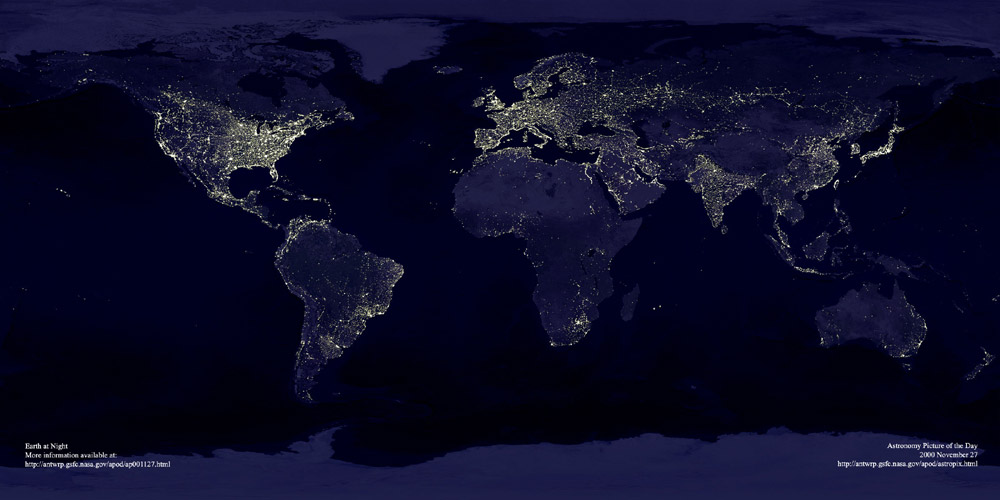
I've wondered for a while about how far away we could see the earth if we were using our current technology and we had our current light output. At what distance could we see the artificial light the earth produced?

This paper Detection Technique for Artificially-Illuminated Objects in the Outer Solar System and Beyond provides some sort of evidence on the question


Existing optical telescopes and surveys can detect artificially illuminated objects comparable in total brightness to a major terrestrial city at the outskirts of the Solar System
...
For this signature to be detectable, the night side needs to have an artificial brightness comparable to the natural illumination of the day side. Clearly, the corresponding extraterrestrial civilization would need to employ much brighter and more extensive artificial lighting than we do currently since the global contrast between the day and night sides is a factor ∼ 6 × 10^5 for the present-day Earth


Lets ignore that our telescopes will get better (about 2.5% a year?) so how quickly at current rates will the earth take to be this bright?

over the last three centuries, and even now, the world spends about 0.72% of its GDP on light. This was the case in the UK in 1700 (UK 1700), is the case in the undeveloped world not on grid electricity in modern times, and is the case for the developed world in modern times using the most advanced lighting technologies.”

But what is that in terms of extra light produced? "In 1700 a typical Briton consumed 580 lumen-hours in the course of a year, from candles, wood and oil. Today, burning electric lights, he uses about 46 megalumen-hours—almost 100,000 times as much."

So that means if we grew at the same rate we have for the last 300 in about 300 years we will be producing enough light that if it was all shone out into space the earth would be as bright at night to an outside observer as it is in the day. I dont think you can make projections this far and it still leaves the question of how long after that ambient external light would be that bright. Still I think its interesting that even with current detection technology as civilisation the 300 years advanced from us would be nearly visible to us. I would guess this prediction will reduce but 300 years is my first estimate to when we could see ourselves.

Monday, October 10, 2011

The Dead Zoo Dodo

I have mentioned before my weird obsessions with taxidermy, weird tourist destinations and tall dwarfs but I have not mentioned here my first scientific obsession: Dodos

Adam Savage the Mythbuster talks here about the same obsession he has


Like Möbius strips, Dinosaurs and Steve Reich, Dodos are like flypaper for nerds. There is just something about these things that seem to spark off nine year olds and set them off on a lifetime being the makers and doers of nerdy things. It was the dodo in the natural history museum of Ireland, known locally as "the dead zoo" that set me off at this age.

Unfortunately this dodo is no longer viewable to the public. I was in the museum last week, admiring the cool steampunk Victoriana makes the museum as interesting for what it says about the 1800's when it was created as about the animals in it. For example the polar bear still has an obvious bullet mark in its head, you would not see that in a modern museum.

The museum was bigger but large areas are no longer open
Exhibition space does a dodo and vanishes
The museum shut on July 5, 2007, when a flight of the main staircase collapsed. The Department of Arts originally decided to take the opportunity to carry out a €15m renovation and extension, but that was cancelled last year due to the state of the public finances.

Instead the staircase was reinstated and other minor repair works carried out, but two large balconies on the second floor have been shut off from the public due to health and safety concerns. The museum’s biggest attraction, a skeleton of a dodo, is on one of these balconies and, unless it is moved, will no longer be viewable by visitors.

Cuts keep half of 'Dead Zoo' exhibits out of public view
However, some of its best known exhibits, including a dodo skeleton and a piece of moon rock given to the State by the US, will not be on public view for the foreseeable future.


This glass box in the top floor bottom middle holds the Dodo skeleton.

The Dodo is one of the most iconic images of environmentalism before Stuart Brand persuaded Nasa to take a release of the earth the phrase "as dead as a dodo" was one of the best metaphors for the fragility of nature that we had. This sight of these bones is an important warning for us and we should make every effort that nine year olds now get to see them. For this reason I want to see the Dublin NHM Dodo moved down to a floor that is open to the public. Moving a glass box is not going to make a massive improvement to the world, but it should also not be a huge difficulty. A full restoration of the museum would be vastly preferable to this but this would be a relatively simple change to make in the meantime. This dodo is important the Natural History Museum badge has a dodo on it which says to me it is one of the most important and interesting items in the museum.

Here is my favorite song sung by an extinct flightless bird The Mountain Goats- Deuteronomy 2:10


I'm all alone here as I try my tiny song
Claim my place beneath the sky but i won't be here for long
I sang all night the moon shone on me through the trees
No brothers left and there'll be no more after me

Monday, June 06, 2011

Coding Day Dublin

Can you do anything useful in a day? This is the premise of code day where computer programmers are invited to work with scientists for a day to try solve a real problem the scientists are trying to deal with. "For those unfamiliar with a code retreat, it’s a hack day with a focus, the angle placed solidly on solving interesting technical problems." Hacking here means writing short programs that do something cool.

On the 28th of May I spent a day in the Science gallery trying to create fixes for various small problems. There were about two dozen people there with about a third of the scientists. Declan, Andrea and Qamir who organise loads of these programmers meet ups around Dublin ran the event and helped make it a really friendly atmosphere.

The small projects that seemed to work best involved visualisation. The problem of taking data and presenting it in an interesting way seems just right for a few hours timeframe. Possibly this is because rather than a complex scientific issue all that has to be understood is what sort of information needs to be conveyed.

It is quite difficult to get up to speed on a problem in such a short period of time. I had a really interesting talk with Scrazzl but even understanding their system took so long I felt like I was wasting their time. This meant we spent a lot of time just understanding the basic background of someones research. Treemetrics were also doing some really interesting Operations research work on forest management. It was really interesting to hear what people were working on but perhaps a day that was focused on one theme might allow the coders to read up and get some understanding in advance. Not that I think all such coder days should have a single theme just that it might be interesting to try one that did.

One of the most interesting projects at the day was fight malaria at home. This is a distributed computer project like SETI at home or folding at home. The aim is to test drug molecules against proteins present in malaria to check for potential binds. This could than guide researchers as to what drugs are worth testing in real life. The guys from the project were really friendly and interesting. If you do have knowledge of BOINC or even just want to learn it it would be a great project to help out on.

Instead of just criticising are very fun and worthwhile day I will give an example of the sort of focused task I am talking about.

Something that is big, widespread and multidisciplinary. I am reading The Fever by Shah at the moment which made me think Malaria was one such problem. Off the top of my head diarrhea diseases, political expenses, maths education and are all areas that people from many areas could come together and do some interesting projects/demonstrations over a day on. But malaria is one of those big thorny problems that a hackday about could be really cool. I have a Google Document of possible ideas here

Monday, May 30, 2011

Palaces of memory

Remembering is a creative process. We tend to think rote memorisation as a dull boring task. However instead we should think of it as "Moonwalking with Einstein". A big challenge to think of the oddest 'most memorable' images you can associate with what you are trying to remember.

The book 'Moonwalking with Einstein' deals with one journalists travels around the world of memory competitions. These competitions have all sorts of weird and wonderful rounds. Remembering binary number, packs of cards, poetry, random word list, matching faces to names and historic dates. It is a very entertaining book, dealing with the history of knowledge, savants, the weird world of self help marketing and the importance of living adventurously.


Many of these competition events seem pretty abstract. Some memory based skill that had some sort of humane self improvement aspect and maybe even some vague practical use would be good to learn though. But if there was one of these skills that would be cool to have I would like to practice the methods described in the book. I read a book, Inside the black room by Jack Allen Vernon, about sensory deprivation experiments in a Californian university. The author describes an Arab immigrant who unusually asked to be put back into sensory deprivation room as he wanted to train himself incase he was ever forced into a similar situation as torture.

Brian Keenan's 'an evil cradling' has vivid, gripping and terrifying descriptions of the madness that stalked him as he was held hostage in isolation in the Lebanon. For example he writes "that the human mind can travel into those dark regions and return exhausted but intact is more a miracle than that word can ever convey". One of the boys own adventure stories I read as a child had the description of an RAF POWs time in the cooler and the physical and mental regime he went through to ease the hardship. One of the parts I remember was that he remembered all the poetry he had learned at school. These tales of how to deal with sensory deprivation have really stayed with me. Maybe if the memory skills in this book could help in such a situation that would seem useful.

One of the expert mnemonists in the book Ed suggests memorising poetry and prose is useful for such a situation of sensory deprivation. "My philosophy of life is that a heroic person should be able to withstand about ten years in solitary confinement without getting terribly annoyed' he said 'an hour of memorization yields ten solid minutes of spoken poetry, and those ten minutes have enough content to keep you busy for a full day.'

I will give myself a challenge to get good at poetry memorisation in a month. The competition seems to be to '15 minute memorization time, 20 minute written recall' for poetry. I will try memorise a poem tomorrow. And again in a month and see if memory training improves poetry memorisation.

As an aside the author mentions the interesting possibility of using "neutropic 'cognitive steroids,'" but never goes into details about how these might aid a memory sports competitor. This is slightly odd given he wrote an article in 2005 (viewable here) about his experience taking one of these drugs. He said 'gym rats have steroids, and overachievers have Adderall. ' it would have been interesting to hear what effect these drugs had on his memory abilities but this book never brooches the subject in a personal way.

Tuesday, July 20, 2010

Science grows 2.5% annually why doesn't the economy?

What causes economic growth? Much of the world still lives in grinding poverty, figuring out a way to get them out of this is important. The best way seems to be for their economy to grow.

There are many theories as to what causes economic growth. The founder of Google claims
"Virtually all economic growth (in the world) was due to technological progress. I think as a society we're not really paying attention to that," Page said. "Science has a real marketing problem. If all the growth in world is due to science and technology and no one pays attention to you, then you have a serious marketing problem."

If technological progress causes growth there should be a link between the amount of scientific progress and the amount of growth. Here is a very interesting article about the rate of the increase in scientific knowledge.

'What I found, using this simple proxy for difficulty, in each field — biology, astronomy, chemistry — was a curve with the same basic shape. In every case, the ease of discovery went down, and in every case it was a curve called an exponential decay ...[I] discovered asteroids get 2.5 percent smaller each year. So while the ease of discovery drops off quickly as early researchers pick the low-hanging fruit, it can continue to “decay” a long time, becoming slightly harder without ever quite becoming impossible"

Say science increases in the level of knowledge by 2.5% a year.

What is the rate of economic growth? 'Since 1820, world development has been much more dynamic. Per capita income rose more than eightfold, population more than fivefold.' 190 years growth 8 fold increase is a growth rate of about 1.1% per annum. Or for two specific countries the UK from 1830 to 2008 had average real GDP 1.97%. The US 1830 to 2009 real GDP of 3.62%.

Other things cause economic growth

-Demographics more people of working age means more stuff gets made.

-Institutions. The rule of law matters. If people think anything the build will be plundered off them they wont build much.

-Governments. Some ways of running a country seem to result in more economic growth than others. Communism was never that good at creating economic growth for example.

-Taxation. At a certain point if you tax people too much they wont work anymore. If you dont tax people enough you might not be able to afford schools. Knowledge of what level of taxation is beneficial to economic growth should improve over time.

-Financial innovation. By getting capital to the people who best use it financial innovation is supposed to help economic growth. If it doesn't we should not spend money bailing out investment banks.

-Foreign aid: Aid to developing countries seems to have a mild positive effect on their economic growth rate though in specific areas it seems to have a negative effect

What else can affect economic growth and how great an effect does it have?

Friday, May 21, 2010

Craig Venter creates synthetic life form

There are stories about this everywhere. But one quote from wired sticks out

“Over the last five years the field has seen a 100-fold increase in the length of genetic material wholly constructed from raw chemicals,” said synthetic biologist Drew Endy of Stanford University. “This is over six doublings in the max length of a genome that can be constructed.”

Doubling in abilities in less than a year is amazing. Pretty much any exponential improvement like that ends up being a big deal if it carries on for a reasonable length of time. This is 1 million base pairs of synthetic DNA. A human is 3 billion base pairs. So at this growth rate that is less than 12 years. Not that you would artificially create a human or anything but it gives you some impression of how rapidly this technology could develop.

Tuesday, March 30, 2010

We Hate You. Please Save Us

There is an episode of the Simpson's where Springfield unites against Lisa Simpson who questions the veracity of an angel skeleton. In a very short time, the citizens launch a mob attack against the town's scientific institutions, Moe decides to destroy the skeleton of a woolly mammoth at the Springfield Natural History Museum, yelling "Take that, science!" Predictably, the tusk falls off, crushing him. "Oof, I'm paralyzed," observes Moe. "I only hope medical science can cure me."

Ireland will be saved by science. Here is a document from the Taoiseach about the new smart economy.

One main idea is to "invest heavily in research and development, incentivise multinational companies to locate more R&D capacity in Ireland, and ensure the commercialisation and retaining of ideas that flow from that investment;"

So how does Ireland treat science? Well take the LHC launched fully today. There is a great article here about the disdain this project is meet with by our government. We won't spend the 10 million annually that would make us a part of the project.

Not that no Irish people are helping out but they have to work with foreign research groups if they want to help figure out how the universe works.
“Nobody knows what is going to happen, that is why we are doing it,” stated Dr Steve Myers, the Irish physicist in charge of the largest atom smasher ever built.

So no 10 million annually out of a total of 6.5 billion it will cost to work out how the nature of the universe.

Irish scientists are not valued either. There is a poll of the greatest Irishmen of all time. There is no scientist on the list. Dr Noel Browne is the closest but he is there as a politician. No Walton, Robert Boyle or William Rowan Hamilton.

But you do have Joe Dolan, Colin Farrell, Stephen Gately, Ronan Keating, Daniel O'Donnell and Louis Walsh.


We have space for Daniel O'Donnell but not Nobel prize winner Ernest Walton. We don't have 10 million for CERN but we do have 32000 million for the governments friends.

What can you say? I'll leave it to another Nobel prizewinner

What need you, being come to sense,
But fumble in a greasy till
And add the halfpence to the pence
And prayer to shivering prayer, until
You have dried the marrow from the bone?
For men were born to pray and save:
Romantic Ireland's dead and gone,

September 1913
William Butler Yeats