Ok last time on the how often should two nuclear submarines smack into each other question. This particular sum managed to get me and Luke into the Wall Street Journal print edition here and their blog here. Which was nice.
So the sum is a mean free path calculation. Where the particles are submarines and the box they are in is the submarine patrol zone or the whole Atlantic depending.
The size of a submarines patrol area is generally set by the requirement to have a surface support vessel within 24 hours. If one of these could travel at 20 knots an hour it could cover an circle with radius of 900 kilometers. The maximum operating depth is not much more than 600m and the submarine has to operate about 100m below the seasonal thermocline. A stealth mode speed is about two meters per second. The size of a nuclear submarine is about 150m length by 12m diameter plus a conning tower of about 8m high by 12 meters long. We modeled this cylinder as a sphere, which on these scales should not be too bad.
A support ship can support up to 14 subs. So we took it that there were 14 in its particular area in the small sum. If there were 14 gas particles wandering around a box the size of the Atlantic (big) or a ships support area (small). from a depth of 100m to 600m. At a speed of 2 meters a second. How often would you expect one to hit another is what we worked out.
Nuclear submarines have to stay 100 meters below the seasonal thermocline. We took the thermocline to be zero based on this
The model "mean free path" used is derived here
Now these are big ifs, thinking of things as being random gas particles is a big IF. People thought derivatives acted like random particles (the Black–Scholes model) and they just lost a lot of money. So I think this is more "fun application" of physics rather than "rigorous analysis". Thanks to Luke and Carl who crunched the numbers and got the data (i.e who did all the work).
Showing posts with label collison. Show all posts
Showing posts with label collison. Show all posts
Sunday, March 15, 2009

Wednesday, March 04, 2009
Satellite Collisions
If something is worth doing its worth overdoing. So rather then continue to explore the massive conspiracy against life that is nuclear weapons I want to look at satellites.
"In an unprecedented space collision, a commercial Iridium communications satellite and a defunct Russian satellite ran into each other Tuesday above northern Siberia, creating a cloud of wreckage, officials said today."
There are all sorts of worries here about the effects of shards of satellite debris hurtling round the earth. Mainly though there are incredibly cool graphics of stuff smashing together.
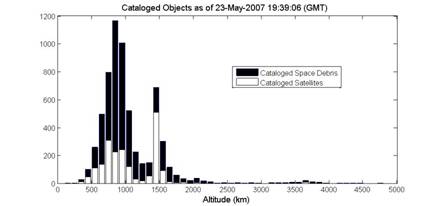
Now I believe thinking about nuclear submarines as wandering particles (as i did here) makes sense on the grounds they are supposed to act in a random manner. Satellites however are deliberately put into set orbits to exclude collisions. They do change path occasionally though based on fuel leaks, gravity effects or being moved for operational reasons but they do not change path often enough for this model to be anything like a good fit. But if we did think of satellites as particles in a box how often would there be hits? If you are interested in a better back of the envelope there is one here.
"The Iridium satellite spanned about 5 meters across its solar arrays. Strela-2M used gravity gradient stabilization, and probably spanned 17 meters including the gravity boom. When calculating collision probabilities, it's important to remember that booms and antennae mean that many satellites have much larger cross-sections than the size of their main body would imply."
Number of particles=300 satellites
Size of particles= 2 meterish sphere
speed: 8000 mps
size of box= 0.06370550904E+12 cubic kilometers
as in earth Mean radius is 6,371.0 km. So sphere of size (6,371.0 km + 800) - sphere of size (6,371.0 km + 700) is the total area.
total volume of satellite = 600 cubic meters
satellite per unit area= 600/0.06370550904E+12 cubic kilometers
A java program to calculate this is below
Satellites should hit every 1.42E7 years. Which makes me fairly sure I've gotten my zeroes wrong somewhere.
"In an unprecedented space collision, a commercial Iridium communications satellite and a defunct Russian satellite ran into each other Tuesday above northern Siberia, creating a cloud of wreckage, officials said today."
There are all sorts of worries here about the effects of shards of satellite debris hurtling round the earth. Mainly though there are incredibly cool graphics of stuff smashing together.
Now I believe thinking about nuclear submarines as wandering particles (as i did here) makes sense on the grounds they are supposed to act in a random manner. Satellites however are deliberately put into set orbits to exclude collisions. They do change path occasionally though based on fuel leaks, gravity effects or being moved for operational reasons but they do not change path often enough for this model to be anything like a good fit. But if we did think of satellites as particles in a box how often would there be hits? If you are interested in a better back of the envelope there is one here.
"The Iridium satellite spanned about 5 meters across its solar arrays. Strela-2M used gravity gradient stabilization, and probably spanned 17 meters including the gravity boom. When calculating collision probabilities, it's important to remember that booms and antennae mean that many satellites have much larger cross-sections than the size of their main body would imply."
Number of particles=300 satellites
Size of particles= 2 meterish sphere
speed: 8000 mps
size of box= 0.06370550904E+12 cubic kilometers
as in earth Mean radius is 6,371.0 km. So sphere of size (6,371.0 km + 800) - sphere of size (6,371.0 km + 700) is the total area.
total volume of satellite = 600 cubic meters
satellite per unit area= 600/0.06370550904E+12 cubic kilometers
A java program to calculate this is below
class Sat {
   public static void main(String[] args) {
   int numPart=300;//sat number
       int sizePart=2; // sat sizeg.
       int speed=8000;//sat speed
       Double below=new Double (1d);
       below=1.41421356*3.14159265*2;//sqrt(2)*pr*r is part of mean free path sum
       Double sizeBox =new Double(63705509040000000000d);//areas sats are in
       double totalSat= numPart*sizePart;//total volume of sats
       double SatPerUnit=totalSat/sizeBox;//how many sats per unit area?
       Double meanFreePath=new Double(1d);
       meanFreePath=1/(below*(1/sizeBox));//mean free path calculation
       Double often= new Double(1d);
       often=meanFreePath/speed;
       often=often/(365*24*3600);
       System.out.println("Satelites should hit every
"+often+" years");
   }
}
Satellites should hit every 1.42E7 years. Which makes me fairly sure I've gotten my zeroes wrong somewhere.
Wednesday, February 25, 2009
Submarine Collision Probability 2
Suppose submarines were spherical particles just wandering round the ocean. Occasionally they would hit the shore its surface or its maximum depth and would bounce off and head away again. Submarines do not move randomly but they do not follow fixed ordered paths either as that makes them easy targets.
The submarine was modelled as a cylinder of length 140 meters and radius 6 meters so it has a volume of 63360 meters cubed. If this is instead seen as a sphere this volume would have a radius of 24.73 meters. Forgive the spherical cow nature of this sum. From a previous calculation you have 25 particles (submarines) of volume 63360 cubic meters each in a space the size of 300 million cubic kilometers. How often will one hit another?
A problem very similar to this is how quickly two gasses will mix. Gas particles fly around very quickly air molecules at about 400 meters per second (which is faster then the speed of sound!) and all that stops cigar smoke instantly filling a room is that the gas molecules hit off each other so much they do not just zip across the room. The calculations below are based on an explanation found here. Maxwell and a few other worked out how often particles should collide and called the distance a particle travels without colliding the Mean free path.
Each particle has a volume of 63360 cubic meters. So 25 particles are 1,584,000 cubic meters. Instead of being in a box these submarine particles are in the atlantic with an operating range in depth of 300 meters. So the 'box' these particles are in is of size 30 000 000 000 000 000 cubic meters. Each particle has 12 million cubic kilometers to itself. so in 12 million cubic kilometers of ocean 63360 meters of it are particle. So 1 part in 190 000 000 000 of the available Atlantic is a submarine.
So how many particles per meter is that? 25*63360 submarines in 30 000 000 000 000 000 meters cubed of water.
Whats area is swept out by a particle (submarine) in a given period of time? I figure submarines wander around at 20kph so that's a sweep volume of pi*d*d*x in a distance x. travelling at 20kph that's pi*24.7*24.7*(20kph*1000m*24hr)=919994045 meters swept per day.
Now along this path how long will it on average travel before hitting another particle?
The mean free path formula is

where n is the number of particles per unit volume. And r is 24.7m. So the length you'd expect to travel between collisions is 1/2710* n.
Actually i think I've found a flaw in my reasoning here. I think the correct answer is about once ever 300 years. Which is still a bit too often isn't it? Ill post the calculations later.
The submarine was modelled as a cylinder of length 140 meters and radius 6 meters so it has a volume of 63360 meters cubed. If this is instead seen as a sphere this volume would have a radius of 24.73 meters. Forgive the spherical cow nature of this sum. From a previous calculation you have 25 particles (submarines) of volume 63360 cubic meters each in a space the size of 300 million cubic kilometers. How often will one hit another?
A problem very similar to this is how quickly two gasses will mix. Gas particles fly around very quickly air molecules at about 400 meters per second (which is faster then the speed of sound!) and all that stops cigar smoke instantly filling a room is that the gas molecules hit off each other so much they do not just zip across the room. The calculations below are based on an explanation found here. Maxwell and a few other worked out how often particles should collide and called the distance a particle travels without colliding the Mean free path.
Each particle has a volume of 63360 cubic meters. So 25 particles are 1,584,000 cubic meters. Instead of being in a box these submarine particles are in the atlantic with an operating range in depth of 300 meters. So the 'box' these particles are in is of size 30 000 000 000 000 000 cubic meters. Each particle has 12 million cubic kilometers to itself. so in 12 million cubic kilometers of ocean 63360 meters of it are particle. So 1 part in 190 000 000 000 of the available Atlantic is a submarine.
So how many particles per meter is that? 25*63360 submarines in 30 000 000 000 000 000 meters cubed of water.
Whats area is swept out by a particle (submarine) in a given period of time? I figure submarines wander around at 20kph so that's a sweep volume of pi*d*d*x in a distance x. travelling at 20kph that's pi*24.7*24.7*(20kph*1000m*24hr)=919994045 meters swept per day.
Now along this path how long will it on average travel before hitting another particle?
The mean free path formula is
where n is the number of particles per unit volume. And r is 24.7m. So the length you'd expect to travel between collisions is 1/2710* n.
Actually i think I've found a flaw in my reasoning here. I think the correct answer is about once ever 300 years. Which is still a bit too often isn't it? Ill post the calculations later.
Monday, February 16, 2009
Nuclear submarine collision what are the chances?
"A Royal Navy nuclear submarine was involved in a collision in the middle of the Atlantic, it was reported.
The crash between HMS Vanguard and French submarine Le Triomphant, which was also carrying nuclear warheads, is believed to have occurred on February 3 or 4, The Sun claimed."
A nuclear submarine seems to be about 140 meters with a radius of 12. So that's a volume of about 63360 cubic meters.
The Atlantic ocean is 354,700,000 cubic kilometers. There are 1 000 000 000 cubic metres is a cubic kilometer. Of course subs can only dive to about 400 metres. So say they stay in the top 300 meters then the volume might be more like 106.4 million km squared * 300 meters=30 million cubic km. More likely they avoid the top 20 meters where ships might hit them, so their range is estimated to be 20-2320 meters deep.
This is assuming a submarine is a cylinder which it isn't.
How many nuclear submarines are there? There seems to be about 50 in the world. Navies will keep their own submarines separate. But that still means there are in the Atlantic maybe 25 submarines that the French or UK subs could run into. This does reduce the number of subs the Russians Or Americans can hit significantly though. They have a top speed of about 40 km per hour. So I assume they are wandering around at 20kph. So assuming all the worlds submarines are in the Atlantic ocean at the same time how often would you expect one to hit another if they were traveling round at random?
The crash between HMS Vanguard and French submarine Le Triomphant, which was also carrying nuclear warheads, is believed to have occurred on February 3 or 4, The Sun claimed."
A nuclear submarine seems to be about 140 meters with a radius of 12. So that's a volume of about 63360 cubic meters.
The Atlantic ocean is 354,700,000 cubic kilometers. There are 1 000 000 000 cubic metres is a cubic kilometer. Of course subs can only dive to about 400 metres. So say they stay in the top 300 meters then the volume might be more like 106.4 million km squared * 300 meters=30 million cubic km. More likely they avoid the top 20 meters where ships might hit them, so their range is estimated to be 20-2320 meters deep.
This is assuming a submarine is a cylinder which it isn't.
How many nuclear submarines are there? There seems to be about 50 in the world. Navies will keep their own submarines separate. But that still means there are in the Atlantic maybe 25 submarines that the French or UK subs could run into. This does reduce the number of subs the Russians Or Americans can hit significantly though. They have a top speed of about 40 km per hour. So I assume they are wandering around at 20kph. So assuming all the worlds submarines are in the Atlantic ocean at the same time how often would you expect one to hit another if they were traveling round at random?
Subscribe to:
Posts (Atom)