"All of us have photographic memories, but spend a lifetime learning how to block off the things that are really in there." Granger in Fahrenheit 451. In Fahrenheit 451 there is a group of men who memorise books because they want to preserve them if all the physical copies are burned.
This was the natural state of books before the printing press. The Iliad, the Táin Bó Cúailnge and other epic poems were designed to be memorised and recited rather than read. But what books do people memorize now? I have included the text file size to give some idea of how long the book is.
The Bible 4.2 MB
I have never heard of anyone who memorized the bible but it does seem oddly popular. A Plan For Memorizing The New Testament In 5 Years. The New testament is 996 kB in size. I have never met anyone who has memorised the bible. How many people have?
Milton: Paradise Lost John Basinger did this in his 70's. 12 books, 10565 lines and 60,000 words in 8 years. The filesize is about 495 kB.
The Qu'ran 1.1 MB People who have memorised this have a special name of Hafidh. 'The total number of hafidh and hafidhas currently alive in the world has been estimated in the tens of millions.'
'But becoming a hafiz is also believed to bring rewards in the hereafter, guaranteeing the person entrance to heaven, along with 10 other people of his choosing, provided he does not forget the verses and continues to practice Islam.'
'The children, ages 7 to 14, are full-time students, in class 8 a.m. to 5 p.m., Monday through Friday, even in the summer. But they are not studying math, science or English. Instead, they are memorizing all 6,200 verses in the Koran, a task that usually takes two to three years.'
that is three years of full time work? Over 5000 hours or over half way to Gladwell's 10000 hours theory. Presumably once you spend 5000 hours memorising the Qur'an you would spend a considerable amount of time thinking and discussing it. Which means there are millions of near genius level experts in the Qur'an in the world.
I can think of things I would rather be an expert in but it is worth considering what it is about the Qu'ran that devotes this level of commitment to it.
Mao: The Little Red Book 273kb
One of the most read books ever. It still seems remarkably popular given it was written by the man who killed the most people ever.
'Acknowledging that she had never memorized Mao's quotations, Chen Di said the indoctrination of Mao, which was still inscribed on a few school walls today, was impressed in her mind as a primary school girl.' I cannot find a figure on how many people memorized all of this book but at 900 million copies 'sold' and many of them expected to memorise large passages it must be in the millions.
The Torah: Memorizing the Jewish holy book seems to have an important place in the religion but I cannot get any figures on how many people today have done this.
Can you think of any others? Dr Seuss' 'Cat in the Hat' has probably been memorised by many adults just from reading it to their kids a thousand times.
Books designed to be memorised, like the iliad, have tricks involving characters, meter, rhyme and rhythm. I have gotten two books recommended by Josh Foer, The Book of Memory and Memory in Oral Traditions that examine these methods. So hopefully I will blog about these tricks again.
The effort people must go to to memorize a book is incredible. We can now buy books for the cost of a few hours work. Or a kindle that we can get thousands of books on gutenberg for under sixty euro. Books are 0.2% of the average Americans spending. To think that we have such a low cost per hour worked on a physical or digital book now but people will still spend thousands of hours memorizing one is amazing.
Wednesday, November 16, 2011

Sunday, November 06, 2011
When could we see ourselves?
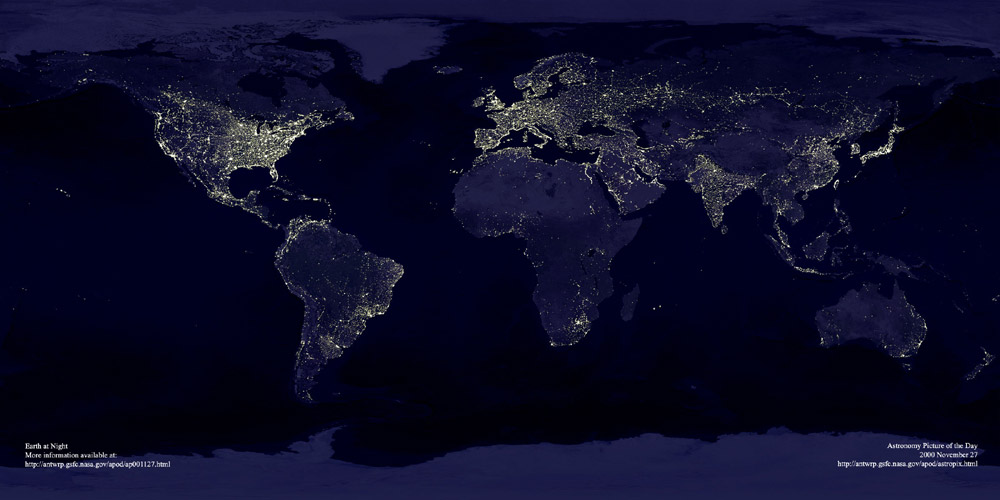
I've wondered for a while about how far away we could see the earth if we were using our current technology and we had our current light output. At what distance could we see the artificial light the earth produced?
This paper Detection Technique for Artificially-Illuminated Objects in the Outer Solar System and Beyond provides some sort of evidence on the question
Existing optical telescopes and surveys can detect artificially illuminated objects comparable in total brightness to a major terrestrial city at the outskirts of the Solar System
...
For this signature to be detectable, the night side needs to have an artificial brightness comparable to the natural illumination of the day side. Clearly, the corresponding extraterrestrial civilization would need to employ much brighter and more extensive artificial lighting than we do currently since the global contrast between the day and night sides is a factor ∼ 6 × 10^5 for the present-day Earth
Lets ignore that our telescopes will get better (about 2.5% a year?) so how quickly at current rates will the earth take to be this bright?
“over the last three centuries, and even now, the world spends about 0.72% of its GDP on light. This was the case in the UK in 1700 (UK 1700), is the case in the undeveloped world not on grid electricity in modern times, and is the case for the developed world in modern times using the most advanced lighting technologies.”
But what is that in terms of extra light produced? "In 1700 a typical Briton consumed 580 lumen-hours in the course of a year, from candles, wood and oil. Today, burning electric lights, he uses about 46 megalumen-hours—almost 100,000 times as much."
So that means if we grew at the same rate we have for the last 300 in about 300 years we will be producing enough light that if it was all shone out into space the earth would be as bright at night to an outside observer as it is in the day. I dont think you can make projections this far and it still leaves the question of how long after that ambient external light would be that bright. Still I think its interesting that even with current detection technology as civilisation the 300 years advanced from us would be nearly visible to us. I would guess this prediction will reduce but 300 years is my first estimate to when we could see ourselves.
Tuesday, November 01, 2011
The Population Surge is Stopping
Population surge difficult to halt and almost impossible to reverse was published yesterday in the Irish times. It is also availible in blog form here. The article makes some interesting and arguable claims about human environmental damage to the planet. These are based however on claims about human population that do not match the evidence or the UN's demographic predictions.
This is not true the figures from the UN are here. In detailed indicators look in births and in select country look in world.
Between 1960-1965 302136 babies were born each day. Between 1985 and 1990 375909 babies and between 2005 and 2001 367320 babies. The 500000 figure is not just wrong but drastically wrong.
The growth rate is being arrested. As I have said before in "We have reached Peak Baby" the number of children each woman has has been falling for decades.
"1968 women got 1.87 adult daughters. Ehrlich called it population bomb. Now women get 1.07 daughters, 92% of way to population balance done." Says Hans Rosling. In 43 years we have gone from 1.87 adult daughters to 1.07 a decline of .8 and we only need a decline of .07 more to reach long term balance of the numbers of women. Rural agrarian Bangladesh has reached stasis in adult female population levels for example.Look at the gapminder video here for yourself the number of children per women is declining
Though surprisingly accurate population estimates get better over time. For example the 2050 estimate has been recently honed in
It says something that an decline in the high estimate an over 2.5 times bigger than the increase in the low estimate is not the headline.
There are still countries that have very high birth rates per woman. Senegal for example had 7.5 babies per woman in 1968 4.8 babies and in 2010. But these countries are developing at a speed that is likely to see these birthrates drop rapidly. "Senegal has lower borrowing costs than Ireland." and a GDP growth rate of 4.2%. As these countries that still have a high birthrate develop their birthrate will drop rapidly the way ours and other developed countries did.
The article is in the Irish Times gives the wrong figure for the number of births per day and "unimaginable 14 billion" scare figure. The demographic evidence and historical trends indicate the population will not go to this level. Current UN estimates are for the high population prediction do not match this figure for 2081. There were never that many babies born per day and the birthrate has been falling so fast that we will not reach the 14 billion in 2081 figure.
Today, just like every day for the last 50 years, around half a million babies will be born.
This is not true the figures from the UN are here. In detailed indicators look in births and in select country look in world.
Between 1960-1965 302136 babies were born each day. Between 1985 and 1990 375909 babies and between 2005 and 2001 367320 babies. The 500000 figure is not just wrong but drastically wrong.
The geometric nature of population growth makes it extraordinarily difficult to arrest, and almost impossible to reverse. The last population doubling took only 40 years. Even if global population growth rate drops to just one per cent, today’s seven billion would swell to an unimaginable 14 billion in 70 years.
The growth rate is being arrested. As I have said before in "We have reached Peak Baby" the number of children each woman has has been falling for decades.
"1968 women got 1.87 adult daughters. Ehrlich called it population bomb. Now women get 1.07 daughters, 92% of way to population balance done." Says Hans Rosling. In 43 years we have gone from 1.87 adult daughters to 1.07 a decline of .8 and we only need a decline of .07 more to reach long term balance of the numbers of women. Rural agrarian Bangladesh has reached stasis in adult female population levels for example.Look at the gapminder video here for yourself the number of children per women is declining
Though surprisingly accurate population estimates get better over time. For example the 2050 estimate has been recently honed in
U.N. Raises “Low” Population Projection for 2050
The "low-variant" scenario of population growth now foresees 117 million more people on the planet in 2050 than it did two years ago.
While the "median-variant" scenario, often seen as "most likely," remains almost the same as before - predicting a world with 9.2 billion people by mid-century
...
The high projection, however, foresees some 10.5 billion people - a 295 million person decrease from the previous high projection. The medium projection is 9.2 billion people,
It says something that an decline in the high estimate an over 2.5 times bigger than the increase in the low estimate is not the headline.
There are still countries that have very high birth rates per woman. Senegal for example had 7.5 babies per woman in 1968 4.8 babies and in 2010. But these countries are developing at a speed that is likely to see these birthrates drop rapidly. "Senegal has lower borrowing costs than Ireland." and a GDP growth rate of 4.2%. As these countries that still have a high birthrate develop their birthrate will drop rapidly the way ours and other developed countries did.
The article is in the Irish Times gives the wrong figure for the number of births per day and "unimaginable 14 billion" scare figure. The demographic evidence and historical trends indicate the population will not go to this level. Current UN estimates are for the high population prediction do not match this figure for 2081. There were never that many babies born per day and the birthrate has been falling so fast that we will not reach the 14 billion in 2081 figure.
Monday, October 10, 2011
The Dead Zoo Dodo
I have mentioned before my weird obsessions with taxidermy, weird tourist destinations and tall dwarfs but I have not mentioned here my first scientific obsession: Dodos
Adam Savage the Mythbuster talks here about the same obsession he has
Like Möbius strips, Dinosaurs and Steve Reich, Dodos are like flypaper for nerds. There is just something about these things that seem to spark off nine year olds and set them off on a lifetime being the makers and doers of nerdy things. It was the dodo in the natural history museum of Ireland, known locally as "the dead zoo" that set me off at this age.
Unfortunately this dodo is no longer viewable to the public. I was in the museum last week, admiring the cool steampunk Victoriana makes the museum as interesting for what it says about the 1800's when it was created as about the animals in it. For example the polar bear still has an obvious bullet mark in its head, you would not see that in a modern museum.

The museum was bigger but large areas are no longer open
Exhibition space does a dodo and vanishes
Cuts keep half of 'Dead Zoo' exhibits out of public view

This glass box in the top floor bottom middle holds the Dodo skeleton.
The Dodo is one of the most iconic images of environmentalism before Stuart Brand persuaded Nasa to take a release of the earth the phrase "as dead as a dodo" was one of the best metaphors for the fragility of nature that we had. This sight of these bones is an important warning for us and we should make every effort that nine year olds now get to see them. For this reason I want to see the Dublin NHM Dodo moved down to a floor that is open to the public. Moving a glass box is not going to make a massive improvement to the world, but it should also not be a huge difficulty. A full restoration of the museum would be vastly preferable to this but this would be a relatively simple change to make in the meantime. This dodo is important the Natural History Museum badge has a dodo on it which says to me it is one of the most important and interesting items in the museum.

Here is my favorite song sung by an extinct flightless bird The Mountain Goats- Deuteronomy 2:10
Adam Savage the Mythbuster talks here about the same obsession he has
Like Möbius strips, Dinosaurs and Steve Reich, Dodos are like flypaper for nerds. There is just something about these things that seem to spark off nine year olds and set them off on a lifetime being the makers and doers of nerdy things. It was the dodo in the natural history museum of Ireland, known locally as "the dead zoo" that set me off at this age.
Unfortunately this dodo is no longer viewable to the public. I was in the museum last week, admiring the cool steampunk Victoriana makes the museum as interesting for what it says about the 1800's when it was created as about the animals in it. For example the polar bear still has an obvious bullet mark in its head, you would not see that in a modern museum.
The museum was bigger but large areas are no longer open
Exhibition space does a dodo and vanishes
The museum shut on July 5, 2007, when a flight of the main staircase collapsed. The Department of Arts originally decided to take the opportunity to carry out a €15m renovation and extension, but that was cancelled last year due to the state of the public finances.
Instead the staircase was reinstated and other minor repair works carried out, but two large balconies on the second floor have been shut off from the public due to health and safety concerns. The museum’s biggest attraction, a skeleton of a dodo, is on one of these balconies and, unless it is moved, will no longer be viewable by visitors.
Cuts keep half of 'Dead Zoo' exhibits out of public view
However, some of its best known exhibits, including a dodo skeleton and a piece of moon rock given to the State by the US, will not be on public view for the foreseeable future.
This glass box in the top floor bottom middle holds the Dodo skeleton.
The Dodo is one of the most iconic images of environmentalism before Stuart Brand persuaded Nasa to take a release of the earth the phrase "as dead as a dodo" was one of the best metaphors for the fragility of nature that we had. This sight of these bones is an important warning for us and we should make every effort that nine year olds now get to see them. For this reason I want to see the Dublin NHM Dodo moved down to a floor that is open to the public. Moving a glass box is not going to make a massive improvement to the world, but it should also not be a huge difficulty. A full restoration of the museum would be vastly preferable to this but this would be a relatively simple change to make in the meantime. This dodo is important the Natural History Museum badge has a dodo on it which says to me it is one of the most important and interesting items in the museum.
Here is my favorite song sung by an extinct flightless bird The Mountain Goats- Deuteronomy 2:10
I'm all alone here as I try my tiny song
Claim my place beneath the sky but i won't be here for long
I sang all night the moon shone on me through the trees
No brothers left and there'll be no more after me
Thursday, September 15, 2011
A/B testing. Is Khan doing it wrong?
A/B testing is where you try an old way of doing things and a new way each with a sample of the users and see which one works better. It is frequently used by ads where you test two wordings "Buy new coke!" and "Buy improved coke!" to see which one gets more clicks.
If you ever write a book or need to name a shop you should spend a few quid buying google ads for the two names you are trying to pick "How to start a fight" and "How to win an argument" and see which one gets clicked on more. That one should be the name.
This is one of those embarrasing posts that is probably wrong. But I think the A/B testing used by the Khan academy makes a fairly fundamental mistake. The Khan acedemy has lessons in various subjects. So presumably they want to use A/B testing to see if kids taught "1+1=2" or "1 + 1 = 2" learn more quickly and such.
A/B testing is a useful way to see if little tweaks result in better user experience. In Khan's case learning. It does not substitute for good design vision but can help make some relatively small tweaks. Improving the Khan acedemy and kids education is really important so if there is a bug in their A/B testing they might be making the wrong choices about how to improve their teaching.
For this kind of testing you need to pick the number of test cases in advance. How not to run an A/B test explains why and the effects of looking before all the test is finished. This is an odd feature of frequentist statistics
'However, the significance calculation makes a critical assumption that you have probably violated without even realizing it: that the sample size was fixed in advance. If instead of deciding ahead of time, “this experiment will collect exactly 1,000 observations,” you say, “we’ll run it until we see a significant difference,” all the reported significance levels become meaningless. This result is completely counterintuitive and all the A/B testing packages out there ignore it'
The A/B testing used by Khan seems not to do this as the gae bingo system says
"Controlling and ending your experiments
Typically, ending an experiment will go something like this:
You'll notice a clear experiment winner and click "End experiment, picking this" on the dashboard. All users will now see your chosen alternative."

This seems to be saying that either you should notice what is statistically significant which you won't always or that something can be declared statistically significant before all the samples are tested. Think of it this way. If every test has a 5% chance of being wrong and you think of everytime you look at the A/B test as adding 5% to the chance of being wrong. It is not quite that bad but it gives you a feeling of the problem.
Now there are ways you can tell that something is statistically significant really early in a test. "Bayesian Statistics and the Efficiency and Ethics of Clinical Trials" deals with these. In medical trials you want to know as early as possible if a new treatement is better or worse than an old one. Giving someone the wrong ad wont kill anyone but the wrong cancer drug might. This paper goes through how you would figure this out using Bayesian methods. These methods are also described in chapter 37 of MacKay's 'Information Theory, Inference, and Learning Algorithms'
But looking at the code GAE bingo uses for A/B testing they do not seem to be using these methods. So it looks to me that they are making the mistake of letting you stop a test when you want to. Which in frequentist statistics can be an error.
Also I think Vanity another rails A/B testing framework makes the same assumption
"This experiment will conclude once it has 1000 participants for each alternative, or a leading alternative with probability of 95% or higher:"
The system used by the BBC is based on time and not numbers according to this article. "Example use
For 5 in 100 people to get a two-option test running for 24 hours the function is initialised like this:". Which is not nearly as bad. But it is assuming that at the end of the time period you have had enough users to make a good test.
There is a proper explanation as to what can happen if you stop a trial early in "How not to run A/B testing". But from my reading many of the A/B testing frameworks out there seem to be making this error. Please correct me in the comments.
Addition: Ben from gae bingo got back to me in a comment on their blog.
"You're right that this is an issue, and that's a great blog post. However, this is significantly mitigated by a) letting your experiments run long enough to get a large-ish sample size for your population and b) simply not checking your dashboard constantly and making snap decisions.
We could build stuff into the system to mandate that, but at the moment I believe we'll be able to get solid value out of the existing framework (just like most A/B systems)." This seems fair enough, Khan are going to have such a high volume of users that they will be able to get a large sample size quickly.
Allen Downey has a great review of the problem with simulations here
Wednesday, August 17, 2011
War is on its last legs
Famine is not looking too great either. Pestilence and death are down but not nearly out.
The recent riots in London had all sorts of people claiming the world had gone Mad Max and it was time to shut down facebook and make all teenagers join the army. There is a great summary of the moral panic in this article "Civil disorder and looting hits Britain, We have been here before". I think its interesting how the rioting that probably wont even be visible in the end of the year crime statistics made everyone freak out so much.
For all the talk of moral decay is the world in general a worse place than it used to be? War along with the other horsemen is a pretty good definition of how bad things are. Unless Bob Geldof finally gets that concert to end death set up. Even pestilence would seem to be a big ask to fix. What is the trend for war deaths recently?
Many people have predicted a century of appalling death tolls from war. Robert McNamara the ex US defense secretary and self confessed war criminal (at 3:10 ) for example.
So how have we done in the last decade on the predicted 3 million deaths a year?

The Quaker economist describes the decline with "Just in the last fifty years, the progress towards peace has been startling. If this trend continues — and I am cautiously optimistic that it will — then as pressure from civil society increases and international institutions of conflict resolution mature, warfare as a regular practice may cease sometime late this century."
While talking about sending the four apocalyptic horsemen to their dotage the decline of Famine is also impressive

There are some fairly serious disclaimers on this famine decline. The first is that agricultural productivity growth is declining at the moment
 combine this with a possible loss of farm productivity when global warming kicks in and there could be problems.
While on the subject of how things are not good but significantly better than they used to be the last decade was the best one in human history.
Nearly everything is getting better. Including life expectancy which you could take as evidence that even death is not what he was. Oddly all three of these sources give different numbers on 'major armed conflicts' but all agree the number is declining.

If two of the biggest problems mankind has faced for all of history are on the decline so rapidly they could be almost unknown within our life times I would say that is good news. And probably more important evidence of how we are progressing than a few rioters stealing runners.
The recent riots in London had all sorts of people claiming the world had gone Mad Max and it was time to shut down facebook and make all teenagers join the army. There is a great summary of the moral panic in this article "Civil disorder and looting hits Britain, We have been here before". I think its interesting how the rioting that probably wont even be visible in the end of the year crime statistics made everyone freak out so much.
For all the talk of moral decay is the world in general a worse place than it used to be? War along with the other horsemen is a pretty good definition of how bad things are. Unless Bob Geldof finally gets that concert to end death set up. Even pestilence would seem to be a big ask to fix. What is the trend for war deaths recently?
Many people have predicted a century of appalling death tolls from war. Robert McNamara the ex US defense secretary and self confessed war criminal (at 3:10 ) for example.
Blight and McNamara project the level of warfare forward into the twenty- first century based on population growth, and suggest a “speculative” but “conservative” estimate of “at least 300 million” fatalities from war in the twenty-first century, of which perhaps 75 million would be military
So how have we done in the last decade on the predicted 3 million deaths a year?
So far they haven't even been close. In fact, the last decade has seen fewer war deaths than any decade in the past 100 years, based on data compiled by researchers Bethany Lacina and Nils Petter Gleditsch of the Peace Research Institute Oslo. Worldwide, deaths caused directly by war-related violence in the new century have averaged about 55,000 per year, just over half of what they were in the 1990s (100,000 a year), a third of what they were during the Cold War (180,000 a year from 1950 to 1989), and a hundredth of what they were in World War II.So there has been under 2% of the expected war deaths this decade.

The Quaker economist describes the decline with "Just in the last fifty years, the progress towards peace has been startling. If this trend continues — and I am cautiously optimistic that it will — then as pressure from civil society increases and international institutions of conflict resolution mature, warfare as a regular practice may cease sometime late this century."
While talking about sending the four apocalyptic horsemen to their dotage the decline of Famine is also impressive
On the day that a famine is declared in Africa -- thanks as much to Somalia's political dysfunctionality as to a severe drought -- comes news that the world drought severity index has been falling for three decades. You can check for yourself by going here and clicking on "make time series":

There are some fairly serious disclaimers on this famine decline. The first is that agricultural productivity growth is declining at the moment
 combine this with a possible loss of farm productivity when global warming kicks in and there could be problems.
While on the subject of how things are not good but significantly better than they used to be the last decade was the best one in human history.
We estimate that between 2005 and 2010, nearly half a billion people escaped extreme hardship, as the total number of the world's poor fell to 878 million people.
Nearly everything is getting better. Including life expectancy which you could take as evidence that even death is not what he was. Oddly all three of these sources give different numbers on 'major armed conflicts' but all agree the number is declining.

If two of the biggest problems mankind has faced for all of history are on the decline so rapidly they could be almost unknown within our life times I would say that is good news. And probably more important evidence of how we are progressing than a few rioters stealing runners.
Monday, August 15, 2011
We are getting better at nearly everything
How quickly are humans getting better? We tend to think technology is getting better or that humans augmented by technology are improving. New swimming records happen regularly as swim suit technology improves. This post just throws up some evidence about human progress.
The Effect of Testing for Performance Enhancing Drugs on the Progress of World Records in Weightlifting “From 1964 to 1988 the relative strength of the world record holders in those weight classes increased by 21% …The same analysis in other types of sports, where there had been some changes in training methods over the same period of time, revealed that the maximum improvement was only 9%“ So most improvement in weightlifting seems to have been from pharmacological rather than having a wider range of people to select from or improved training mechanism reasons. However what about areas of human endeavour that drug taking seems unlikely to help?
In chess taking steroids seems unlikely to help. Though future nootropics might. "We conclude that there has been little or no ‘inflation’ in ratings over time—if anything there has been deflation. This runs counter to conventional wisdom, but is predicted by population models on which rating systems have been based…The results also support a no answer to question 2. In the 1970’s there were only two players with ratings over 2700, namely Bobby Fischer and Anatoly Karpov, and there were years as late as 1981 when no one had a rating over 2700 (see [Wee00]). In the past decade there have usually been thirty or more players with such ratings."
Even musicians are getting better Virtuosos Becoming a Dime a Dozen "The overall level of technical proficiency in instrumental playing, especially on the piano, has increased steadily over time." One good explanation for this and the chess improvement is just that more people are getting to try these, people who are not as limited by nutrition and disease as they would have been int he past.
This explanation is expanded in this rather good post "Two Hour Marathon in 2045"
"But the pipeline that selects and trains runners behaves, in some ways, like the model. If a person with record-breaking potential is born in Kenya, where running is the national sport, the chances are good that he will be found, he will have opportunities to train, and he will become a world-class runner. It is not a certainty, but the chances are good.
If the same person is born in rural India, he may not have the opportunity to train; if he is in the United States, he might have options that are more appealing.
So in some sense the relevant population is not the world, but the people who are likely to become professional runners, given the talent. As long as this population is growing exponentially, world records will increase linearly.
That said, the slope of the line depends on the parameter of exponential growth. If economic development increases the fraction of people in the world who have the opportunity to become professional runners, these curves could accelerate."
Progress of things like number of children suffering malnutrition and having clean water can really result in increasing the number of great chess or piano players as well as the world running record. We are getting better at loads of things because more people are getting to try them without the poverty induced hinderances they used to have. According to this model it is not that population is increasing exponentially but at the moment population of people who have a chance at being great at something is.
If you have other explanations for why and in what human achievment is progressing I would love to hear them.
Tuesday, August 09, 2011
Do Budget Cuts and Riots Go Together?

I saw this paper 'Austerity and Anarchy: Budget Cuts and Social Unrest in Europe, 1919-2009'
with the intro
'In the wake of this week's London riots, some commentators have linked the youth unrest to budget cuts. The authors of CEPR DP8513 explore the historical basis for this view and finds that austerity and violence have tended to go hand in hand.'
I am reading through the paper now. But I wonder if there was an image that could quickly show a connection between the two.
Wikipedia lists the riots since 1950 as
1958 Notting Hill race riots
1970 Garden House riot
1971 Priestlley riots
1975 Chapeltown race riot
1977 Battle of Lewisham
1980 St. Pauls riot
1981 England riots · Brixton riot · Chapeltown race riot · Toxteth riots · Moss Side riot · Handsworth race riots
1985 Brixton riot · Broadwater Farm riot
1987 Chapeltown race riot
1989 Dewsbury race riot
1990 Strangeways Prison riot · Poll Tax riots
1991 Meadow Well riots
1995 Manningham riot · Brixton riot
2001 Bradford riots · England riots · Oldham race riots · Harehills riot
2005 Birmingham race riots
2010 UK student protests
2011 London riots
Now if you look at the government spending as a percentage of GDP here. On top of this graph I put a bar for every riot each year one occurred.
Counting all riots as the same is not fair. Their graph goes from 34->48 whereas the riots go from 0->6. Laying the first on the second is not considered good practice in data visualisation. Also and this is a big one. If GDP drops as in a recession and the percentage of government spending to GDP stays the same total government spending will drop. a fairer graph would look at gdp or government spending adjusted compared to riots not the two combined.
The proper paper says rioting and austerity go hand in hand. I will read it carefully to see how close the link is. But a quick look at the data and no obvious major link jumps out at me.
Friday, August 05, 2011
We have reached Peak Baby

When will we reach peak babies? In what year will the most children be born? I bet last night a shiny pint that we will reach peak babies in the next three years. That the most babies ever born will be in a year before 2015.
Now I accept that we could never actually know how many children will be born in the future. The bet will end when I present enough evidence to convince those I am betting with rather than with a proof. Demographics is regarded as one of the most predictable of social sciences but some possible future invention could drastically increase the number of babies. We could have brave new world style artificial wombs of some such that vastly increases the birth rate for example.
Hans Rosling the statitician tweeted recently.

I looked up the UN data on this here. In detailed indicators look in births and in select country look in world. The highest birth number in the world was 1985-1990
Period Births per year
1950-1955 97 769
1955-1960 102 894
1960-1965 110 280
1965-1970 118 200
1970-1975 121 715
1975-1980 120 676
1980-1985 129 088
1985-1990 137 207
1990-1995 134 960
1995-2000 132 473
2000-2005 131 644
2005-2010 134 072
2010-2015 135 775
2015-2020 135 396
2020-2025 133 800
2025-2030 132 452
2030-2035 131 991
2035-2040 132 099
2040-2045 131 926
2045-2050 131 127
2050-2055 129 904
2055-2060 128 785
2060-2065 127 998
2065-2070 127 402
2070-2075 126 725
2075-2080 125 823
2080-2085 124 775
2085-2090 123 753
2090-2095 122 837
2095-2100 121 992
Now it could all of a sudden rise up and any prediction for the future is unlikely to be as accurate as historical estimates. Still I think I win the bet.
This does not mean that population will drop. As we are living longer world population is still expected to grow. But it does mean we can say that Malthus was wrong. Human numbers will not grow exponentially barring some disaster.
Thursday, August 04, 2011
Crowd Sourced Optimal Fantasy Football Team

All my fantasy football attempts have the problem that I know nothing about football. So for example Berbatov is unlikely to do as well this season as last season so picking him would seem unwise. But how does someone who knows nothing about football find out who will play well next season?
The wisdom of the crowds is the James Surowiecki about "the aggregation of information in groups, resulting in decisions that, he argues, are often better than could have been made by any single member of the group." This sort of thing does not work if the crowd has a bias in a particular direction.
I decided to look at the people is the "team selected by %" that fantasy premier league shows you. If I rerun the optimisation described in this post but instead of trying to great a team that has the maximum number of points last season I try and get the team whose players have been selected by the most other fantasy football managers.
The idea is that a team with the right number of defenders, goalkeepers, midfielders and forwards, that has at most three players from one team, that costs less than 100 and whose members have been picked most often should be really good.
The most popular team is
      Player Club Pos Price Pts people
7     Al-Habsi  WIG  GK    45 125  199410
30        Bale  TOT MID    80 118   189087
37      Barton  NEW MID    60 131   123865
69      Cahill  BOL DEF    55 105   180751
184      Given  AVL  GK    50   0   215091
205  Hangeland  FUL DEF    65 154   192333
231       Huth  STO DEF    60 138   165684
266    Kompany  MCI DEF    60  95  197352
323      N'Gog  LIV STR    55  48   279932
334 Odemwingie  WBA STR    75 171   218485
421     Suarez  LIV STR    95  68   343361
424    Taarabt  QPR MID    65   0   141086
452      Vidic  MUN DEF    80 148   172773
472   Wilshere  ARS MID    65  93   220381
477 Yaya Toure  MCI MID    80 146   167706
Some of these players were probably picked for the first few games and will be transfered out when they are about to play tougher games.
The average player is picked 26794 times. These players have been picked 200486 people on average.
This team would have scored 1415 points last season. The best team I could have picked for last season would have scored 2332 points. I have updated the dataset to include this people picked statistic.
Monday, August 01, 2011
Fantasy Football Optimization 2

So it turns out I was thick last post about picking the fantasy football team. As my friend Bren explained to me "you choose 11 players to be "on the pitch" each week, plus a captain who scores double (and a vice captain in case the captain doesn't play). can only have 1 keeper in the first 11, can choose any formation with a minimum of 3 defenders, 3 midfielders and 1 forward."
So the problem is now pick 11 players that will actually play and some really cheap players that won't
So whats the cheapest of each player you could get?
The cheaperst players in each position are about 4 or 4.5 each. For example
Goalkeeper
Moreira SWA 4.0 0
Defenders
Whitbread NOR 4.0 0
Tate SWA 4.0 0
Midfield
Lappin NOR 4.5 0
Gecov FUL 4.5 0
Allen SWA 4.5 0
Strikers
Miller WBA 4.5 6
Hulse QPR 4.5 0
Agyemang QPR 4.5 0
So if you picked from this price of player knowing they would not play that would allow you to spend more money on those that were on the pitch. Now defenders score less points than midfielders and strikers so lets say we only want three of them. And we then buy two cheap ones that we dont play. 2 cheap defenders costs 8 and one goalie for 4 means we now have 88 to pick the remaining 12 players. The case whether you should have 5 midfielders or 3 strikers is less clear. I will try both and see which has a higher score.
Attempt 1. Cheap goalie and 2 defenders and 1 midfielder. Cost 16.5 on 4 non playing players. Trying to have 3 strikers. The constraints would now be
num_goalkeepers <- 1
num_defenders <- 3
num_midfielders <- 4
num_strikers <- 3
max_team_cost <- 835
max_player_from_a_team <- 3
Gives a team of
1         Hart  MCI  GK    70 175
48    Ivanovic  CHE DEF    70 144
49        Huth  STO DEF    60 138
51      Hughes  FUL DEF    50 129
197       Adam  LIV MID    90 192
198    Malouda  CHE MID   105 186
200    Dempsey  FUL MID    85 168
201   N'Zogbia  WIG MID    75 167
210     Jarvis  WOL MID    60 133
386   Berbatov  MUN STR    95 176
388 Odemwingie  WBA STR    75 171
scoring 1779. You would make Adam your captain and he would have double points.
Attempt 2. Cheap non playing goalie and 2 defenders and 1 striker. Trying to have two strikers. Cost 16.5 on 4 non playing players.
num_goalkeepers <- 1
num_defenders <- 3
num_midfielders <- 5
num_strikers <- 2
max_team_cost <- 835
max_player_from_a_team <- 3
1         Hart  MCI  GK    70 175
48    Ivanovic  CHE DEF    70 144
49        Huth  STO DEF    60 138
51      Hughes  FUL DEF    50 129
197       Adam  LIV MID    90 192
198    Malouda  CHE MID   105 186
200    Dempsey  FUL MID    85 168
201   N'Zogbia  WIG MID    75 167
210     Jarvis  WOL MID    60 133
386   Berbatov  MUN STR    95 176
388 Odemwingie  WBA STR    75 171
with a score of 1769. Again Adam would be your captain. It looks like three strikers is a better plan than 5 midfielders. But it is a close run thing.
Just to make things really complicated Bren explained that you should generally have one good player on the subs bench in case one of the rest of the team is injured. "it's quite common for one of the main team to miss a week so you may need to make 1 sub an excellent player (probably defender since they're cheaper)". Having a defender as your good sub has the advantage that you are allowed to play with one forward and three midfielders so if one of your three forwards, four midfielders or three playing defenders gets injured a defender can sub in for any of those.
So assuming we actually want four defenders. We would have one cheap goalie and one cheap defender and one cheap midfielder. At a cost of 12.5 for non playing players.
num_goalkeepers <- 1
num_defenders <- 4
num_midfielders <- 4
num_strikers <- 3
max_team_cost <- 875
max_player_from_a_team <- 3
giving a team of

         Player Club Pos Price Pts
1         Hart  MCI  GK    70 175
46      Cole A  CHE DEF    75 150
49        Huth  STO DEF    60 138
51      Hughes  FUL DEF    50 129
54    Bardsley  SUN DEF    50 123
197       Adam  LIV MID    90 192
200    Dempsey  FUL MID    85 168
201   N'Zogbia  WIG MID    75 167
203    Downing  LIV MID    85 163
386   Berbatov  MUN STR    95 176
388 Odemwingie  WBA STR    75 171
393   Davies K  BOL STR    65 132
1884 points -123 as Bardley wont play = 1761. Basically Bardsley a Sunderland defender is really cheap at 5. This is one more than you pay for a player you don't want to play but if you do need to lay him he gets 123 points a season.
Davies looks a little low there with 132 points. The worst midfielder has 163 points. So what if we get rid of the third striker and try 5 midfielders?
num_goalkeepers <- 1
num_defenders <- 4
num_midfielders <- 5
num_strikers <- 2
max_team_cost <- 875
max_player_from_a_team <- 3
   Player Club Pos Price Pts
1         Hart  MCI  GK    70 175
46      Cole A  CHE DEF    75 150
49        Huth  STO DEF    60 138
51      Hughes  FUL DEF    50 129
53      Distin  EVE DEF    55 124
197       Adam  LIV MID    90 192
200    Dempsey  FUL MID    85 168
201   N'Zogbia  WIG MID    75 167
203    Downing  LIV MID    85 163
210     Jarvis  WOL MID    60 133
386   Berbatov  MUN STR    95 176
388 Odemwingie  WBA STR    75 171
1886-124 for Distin who usually wont play = 1762. So this is my best single fantasy football team of last season.
The more I learn about this game the more nuances it has. Off the top of my head
1. Model that the captain gets double points. In this case Adam the highest scoring player is actually quite cheap. But in the case where he was really expensive you would want to take into account that he can earn double points.
2. Take into account who teams are playing. With a full game by game scoring dataset you can investigate really interesting patterns like if playing top five club means less points and bottom five more. And if so make transfers based on upcoming games. This seems to be where a huge amount of the skill in fantasy football is.
3. Change the code so you can have 3->5 defenders, 3-5 midfielders and 1-3 strikers but only 11 total players.
4. Just picking cheap non playing players is probably wrong. You at least want to pick the best cheap players you can. Which I have not. I am told Shane Ferguson is a good buy so I will probably make him one of the cheap players.
If any of the intuitions about having a good substitute or any of my other assumptions are wrong please correct me.
If you predict different points for players this season. If you want to try this method for next season but dont want to run the program linked to in part one
1. Copy the dataset I have here
2. Put this data into a new google docs spreadsheet.
3. Make your predictions on the number of points they will score. So if you think Berbatov won't score 176 points this season but only 160 change that points value. You can delete players you are not interested in as well.
4. Put your new spreadsheet URL in the comments
and I will run a optimization over your predictions for you.
Saturday, July 30, 2011
Fantasy Football Optimisation
Some friends challenged me to a game called fantasy "football" where you pretend to be a Russian billionaire. Not the bit where you steal natural resources off the population but where you buy a bunch of poncy overpaid foreigners who flounce around and earn insane amounts of money.
While I'm ranting about "football". Why do football ads always say it has "the beauty of a dance". If you like dancing that much go to the ballet
Anyway So I have to pretend to know something about this "football" which I dont but I do know a bit about optimization and more about copying stuff. I remembered this old R package article about optimising for fantasy football. This was written by prasoonsharma and I have just reused his code.
I scraped last seasons scores off the fantasy premierleague website. Some parsing turned this into the correct format. You can download the cleaned up data here
The constraints for this version of the game are slightly different than the one prasoonsharma was playing. This means you need more goalies, have more money to spend on players and other such changes.
The best single team for last season would have been
with a total score of 2224 points. You get to change the team every week in the real game. This optimisation is just if you got to pick one team and leave it.
Picking a fantasy football team involves
1. Predicting how many points each player will score that week
2. Optimising based on this prediction so you pick the team that covers all the rule constraints that scores the most points.
This code carries out the second part. If you have a prediction for how many points players will score that is better than
"exactly the same amount they scored last season" you can change the data with your new prediction and run it (or I can run it for you if you want). A web app that allowed you to enter your player score predictions and ran an optimisation so that the best team that could be picked based on your predictions was then created might be useful. If you save the data in a new google doc and change the Pts values to your player predictions. Then post a link to that google doc in the comments I will run the optimisation for you.
While I'm ranting about "football". Why do football ads always say it has "the beauty of a dance". If you like dancing that much go to the ballet
Anyway So I have to pretend to know something about this "football" which I dont but I do know a bit about optimization and more about copying stuff. I remembered this old R package article about optimising for fantasy football. This was written by prasoonsharma and I have just reused his code.
I scraped last seasons scores off the fantasy premierleague website. Some parsing turned this into the correct format. You can download the cleaned up data here
The constraints for this version of the game are slightly different than the one prasoonsharma was playing. This means you need more goalies, have more money to spend on players and other such changes.
The best single team for last season would have been
        Player Club Pos Price Pts
1         Hart  MCI  GK    70 175
5     Al-Habsi  WIG  GK    45 125
48    Ivanovic  CHE DEF    70 144
49        Huth  STO DEF    60 138
51      Hughes  FUL DEF    50 129
54    Bardsley  SUN DEF    50 123
55     Johnson  WOL DEF    50 120
197       Adam  LIV MID    90 192
200    Dempsey  FUL MID    85 168
201   N'Zogbia  WIG MID    75 167
210     Jarvis  WOL MID    60 133
212     Barton  NEW MID    60 131
386   Berbatov  MUN STR    95 176
388 Odemwingie  WBA STR    75 171
393   Davies K  BOL STR    65 132
with a total score of 2224 points. You get to change the team every week in the real game. This optimisation is just if you got to pick one team and leave it.
Picking a fantasy football team involves
1. Predicting how many points each player will score that week
2. Optimising based on this prediction so you pick the team that covers all the rule constraints that scores the most points.
This code carries out the second part. If you have a prediction for how many points players will score that is better than
"exactly the same amount they scored last season" you can change the data with your new prediction and run it (or I can run it for you if you want). A web app that allowed you to enter your player score predictions and ran an optimisation so that the best team that could be picked based on your predictions was then created might be useful. If you save the data in a new google doc and change the Pts values to your player predictions. Then post a link to that google doc in the comments I will run the optimisation for you.
Tuesday, June 28, 2011
The Kilbrittain Whale
I love weird crap. I have loads of holiday photos of my wife looking bemused outside some odd tourist destination. Here is one of my wife outside the udderly brilliant Cork Butter Museum last Sunday.

But last week I think I may have reached the Zenith of weird tourist destinations. This acme of travel strangeness is the Kilbrittain Finn whale. This specimen of the second largest species of whale is mounted in the middle of a town several kilometers inland.

How did it get here? The Channel 4 whale autopsy provides some of the answers about this poor animals beaching in 2009. Three minutes in (or 20 seconds in the video below) you see the frankly unbelievable result of a bad autopsy of a whale. Exploding entrails all over the Denmark beach is the sort of image that stays with you.
What this pathological investigation misses though is the Machiavellian intrigue that lead to this particular resting place for the whale. When it landed in 2009 various locals tried to make off with the 50 ton pile of putrifying Balaenoptera physalus. "Apparently, an attempt was made on Saturday night under cover of darkness to steal the jaws but their bulk proved too much for the perpetrators. "
There are stories of a beach based stand off between the communities of Kilbrittain and Courtmacsherry. "Shortly after it died two men from Courtmacsherry, also known as a drinking village with a fishing problem, approached with a chainsaw. Their plan was to saw off its head and mount the jaw bones in the village. However, they were confronted by Kilbrittain residents who told them they were claiming the carcass." Presumably at some point in these tense negotiations two large groups of adults both armed with heavy machinery both realised that they were fighting for control of several dozen tons of rotting whale carcass.
There is no simile that really can convey the logic here. No metaphor can quite sum up the Irish ability to fight over possession of something that no one would want. But if I had go for one description it would be "like a stand off over 50 tons of festering cetacean".
Now having 'won' the whale, some lads from the local abattoir spent 18 months rendering the stinking baleen bag. This year and a half long job is shown in a frankly horrifying pictographic montage beside the the spoiled beluga that now rests in the middle of Kilbrittain park.
There was a great moment on redneck roundup (as nationwide is known inside RTE) about the whale where one of the guys who spent the lifespan of a hamster hacking at the pile of rancid blubber admits they may have gotten the order of some of the bones wrong.
One thing words cannot convey is the stench coming off this attraction. Some flesh still seems to cling to the head parts resulting in an overpowering odour of death.

It was so bad we could not eat the ice-creams we brought to the park. I advise you to go see the Kilbrittain whale while it still has this stench. There is nothing like the smell of dead whale to make you wonder about what some people will go see/fight over.
But last week I think I may have reached the Zenith of weird tourist destinations. This acme of travel strangeness is the Kilbrittain Finn whale. This specimen of the second largest species of whale is mounted in the middle of a town several kilometers inland.
How did it get here? The Channel 4 whale autopsy provides some of the answers about this poor animals beaching in 2009. Three minutes in (or 20 seconds in the video below) you see the frankly unbelievable result of a bad autopsy of a whale. Exploding entrails all over the Denmark beach is the sort of image that stays with you.
What this pathological investigation misses though is the Machiavellian intrigue that lead to this particular resting place for the whale. When it landed in 2009 various locals tried to make off with the 50 ton pile of putrifying Balaenoptera physalus. "Apparently, an attempt was made on Saturday night under cover of darkness to steal the jaws but their bulk proved too much for the perpetrators. "
There are stories of a beach based stand off between the communities of Kilbrittain and Courtmacsherry. "Shortly after it died two men from Courtmacsherry, also known as a drinking village with a fishing problem, approached with a chainsaw. Their plan was to saw off its head and mount the jaw bones in the village. However, they were confronted by Kilbrittain residents who told them they were claiming the carcass." Presumably at some point in these tense negotiations two large groups of adults both armed with heavy machinery both realised that they were fighting for control of several dozen tons of rotting whale carcass.
There is no simile that really can convey the logic here. No metaphor can quite sum up the Irish ability to fight over possession of something that no one would want. But if I had go for one description it would be "like a stand off over 50 tons of festering cetacean".
Now having 'won' the whale, some lads from the local abattoir spent 18 months rendering the stinking baleen bag. This year and a half long job is shown in a frankly horrifying pictographic montage beside the the spoiled beluga that now rests in the middle of Kilbrittain park.
There was a great moment on redneck roundup (as nationwide is known inside RTE) about the whale where one of the guys who spent the lifespan of a hamster hacking at the pile of rancid blubber admits they may have gotten the order of some of the bones wrong.
One thing words cannot convey is the stench coming off this attraction. Some flesh still seems to cling to the head parts resulting in an overpowering odour of death.
It was so bad we could not eat the ice-creams we brought to the park. I advise you to go see the Kilbrittain whale while it still has this stench. There is nothing like the smell of dead whale to make you wonder about what some people will go see/fight over.
Friday, June 17, 2011
Really Old Idea

Sports really annoys me. Particularly at the end when they get boring. When they know they have a minute to go in football they start kicking the ball between them and generally acting the micky. I thought I was dead clever when I thought that they should have random end times of sports. If you do not know when the game will end it is harder to try run down the clock.
Axelrod had the idea of random endings years ago. Many other game theorists have had similar ideas at various times.
Then I heard that random endings have a much longer history. Adapt the new book from Tim Harford explains one really old example. This century IBM got a patent for "a “smooth-finish” auction, an auction that is programmed to end at a random time". This gets over the problem on ebay where at the end of an auction people try not to bid what they value the item at but at just enough to win the auction just before it closes. So instead of people bidding one cent over the current bid with one second left on the auction.
Paul Klemperer pointed out that this idea is quite old. Even though the is a US patent for it.
In a candle auction, the end of the auction is signaled by the expiration of a candle flame, which was intended to ensure that no one could know exactly when the auction would end and make a last-second bid. Sometimes, other unpredictable processes, such as a footrace, were used in place of the expiration of a candle.
Pepys wrote about such an auction in the 1660's
Auction by candle was known in England by 1641, when it is mentioned in the records of the House of Lords.[6] The practice rapidly became popular, and in 1652, John Milton wrote, "The Council thinks it meet to propose the way of selling by inch of candle, as being the most probable means to procure the true value of the goods."
This 350 years old idea is my current record on simple ideas that someone has beat me to. Hartford's book Adapt is full of these sorts of interesting stories. This extract about the Spitfire gives you a good feel for the book.
Monday, June 13, 2011
Malaria Modeling
There are two very interesting passages in Shah's 'The Fever' that suggest modeling of malaria can have an important role
This paper is the source of this information.
Another interesting point seems to suggest that a scapegoat that is more attractive to mosquitoes than people are.
Increasing livestock numbers has serious effects on any ecosystem. the pig under the bad scheme should not be promoted without serious analysis. Which leads to a more general problem with complex problems like malaria. I want to talk about these issues in another post. There is an interesting Ted talk on malaria here. A lot of the ideas are impractical which is another reason to talk about practicality later.
Jeffrey Sacks also talks about the important role of livestock that distract mosquitoes in the end of poverty
While on the subject of development I thought this quote was fascinating Justin Kilcullen head of Troicaire 48:18 in the Frontline 30/05/11 here
"Development aid is what we give to the developing world because we do not give them a decent deal in trade, because we have screwed them on their debts, because the flow of resources...lets change the economic structures that keeps these people poor thats the long term answer". If the head of an aid agency does not think they are the long term answer for development then they are probably not.
For the moment I am going to examine OpenMalaria to see how it can model these issues.
HIV-positive people are most infective to others when the levels of virus in their bodies are high...Malaria triggers such spikes. Malaria infection, by inducing HIV to replicate, increases the viral load in HIV infected people. According to mathematical models, HIV may be responsible for 980,000 episodes of malaria and malaria responsible for mare than 8,000 Hiv infections in a single district of Kenya. The global effect of the malevolent partnership has yet to be mapped
This paper is the source of this information.
Another interesting point seems to suggest that a scapegoat that is more attractive to mosquitoes than people are.
the greater availability of cow and hog flesh attracted the interest of malaria mosquitoes.Hovering between home and stable ninety-nine out of one hundred times. That bit of anopheline caprice cost Plasmodeum dearly. As cows and sheep sprouted across the English countryside, malaria transmissionground to a halt
Increasing livestock numbers has serious effects on any ecosystem. the pig under the bad scheme should not be promoted without serious analysis. Which leads to a more general problem with complex problems like malaria. I want to talk about these issues in another post. There is an interesting Ted talk on malaria here. A lot of the ideas are impractical which is another reason to talk about practicality later.
Jeffrey Sacks also talks about the important role of livestock that distract mosquitoes in the end of poverty
Another important point is that some types of mosquitoes prefer to bite people, whereas others feed off cattle. Transmitting malaria requires two consecutive human bites: the first for the mosquito to ingest the parasite and the second for the mosquito to infect another person, roughly two weeks later. If the mosquito feeds frequently on cattle rather than on people, the odds are that at least one of the bites, if not both, will be taken from cattle. In India, for example, the predominant type of anopheles tends to bite humans about one third of the time, and cattle the rest. Africa, sadly has another predominating mosquito type which prefers human biting nearly 100 per cent of the time. Mathematically, the chance that an Indian mosquito will feed off two humans in a row is about one in nine, whereas in Africa it's about one in one
While on the subject of development I thought this quote was fascinating Justin Kilcullen head of Troicaire 48:18 in the Frontline 30/05/11 here
"Development aid is what we give to the developing world because we do not give them a decent deal in trade, because we have screwed them on their debts, because the flow of resources...lets change the economic structures that keeps these people poor thats the long term answer". If the head of an aid agency does not think they are the long term answer for development then they are probably not.
For the moment I am going to examine OpenMalaria to see how it can model these issues.
Monday, June 06, 2011
Coding Day Dublin
Can you do anything useful in a day? This is the premise of code day where computer programmers are invited to work with scientists for a day to try solve a real problem the scientists are trying to deal with. "For those unfamiliar with a code retreat, it’s a hack day with a focus, the angle placed solidly on solving interesting technical problems." Hacking here means writing short programs that do something cool.
On the 28th of May I spent a day in the Science gallery trying to create fixes for various small problems. There were about two dozen people there with about a third of the scientists. Declan, Andrea and Qamir who organise loads of these programmers meet ups around Dublin ran the event and helped make it a really friendly atmosphere.
The small projects that seemed to work best involved visualisation. The problem of taking data and presenting it in an interesting way seems just right for a few hours timeframe. Possibly this is because rather than a complex scientific issue all that has to be understood is what sort of information needs to be conveyed.
It is quite difficult to get up to speed on a problem in such a short period of time. I had a really interesting talk with Scrazzl but even understanding their system took so long I felt like I was wasting their time. This meant we spent a lot of time just understanding the basic background of someones research. Treemetrics were also doing some really interesting Operations research work on forest management. It was really interesting to hear what people were working on but perhaps a day that was focused on one theme might allow the coders to read up and get some understanding in advance. Not that I think all such coder days should have a single theme just that it might be interesting to try one that did.
One of the most interesting projects at the day was fight malaria at home. This is a distributed computer project like SETI at home or folding at home. The aim is to test drug molecules against proteins present in malaria to check for potential binds. This could than guide researchers as to what drugs are worth testing in real life. The guys from the project were really friendly and interesting. If you do have knowledge of BOINC or even just want to learn it it would be a great project to help out on.
Instead of just criticising are very fun and worthwhile day I will give an example of the sort of focused task I am talking about.
Something that is big, widespread and multidisciplinary. I am reading The Fever by Shah at the moment which made me think Malaria was one such problem. Off the top of my head diarrhea diseases, political expenses, maths education and are all areas that people from many areas could come together and do some interesting projects/demonstrations over a day on. But malaria is one of those big thorny problems that a hackday about could be really cool. I have a Google Document of possible ideas here

Saturday, June 04, 2011
Bad Taxidermy

I have had a frankly morbid interest in taxidermy since I was a child. I particularly like bad taxidermy.
My absolute favorite form of taxidermy is when naturalists in the past attempted to reconstruct animals having never seen them. The weird mistakes they made should make raise serious epistemological questions. If animals we know that are quite similar to ones we see are gotten wrong how wrong are our reconstructions of Dinosaurs? More generally miscontructed taxidermy shows how our our ignorance and presumptions can distort our world.
My competition for the best misconstructed animal is between the Horniman walrus and King Fredericks lion.
With the Horniman walrus naturalist were sent the skin of the animal. Not realising it had wrinkles just kept stuffing the skin until it bloated up like some sort of zeppelin.

And the lion of King Frederick I of Sweden in 1731 where they had no idea what a lion looked like. The reconstruction has these weird old persons false teeth and lolcat eyes.

Paris for some unknown reason has particularly excellent taxidermy using shops
1. Deyrolle on rue du Bac.
2. Aurouze which they used in Ratatouille
3. The catacombs these freaked the bejasus out of me.
While I am on the subject I also recommend 'Stuff the World' a documentary on the world taxidermy championships.
The best crap taxidermy animatronics I have seen. And it is not a big category was in Strontium in Scotland. The wildlife museum there has a tunnel you crawl through where various crap animals on rails roll toward you. Strontium was on our travel list of places elements were discovered but that is a whole other blogpost.

If you also like appalling stuffed dead animals "crappy taxidermy" blog is a goldmine. If you know of any animals stuffed by people who have never seen the animal please post it in the comments
Friday, June 03, 2011
Spongebob New Wave Pants
I was watching Spongebob as usual last Saturday morning and I noticed how most of the characters were modeled on 70's rock musicians. Elvis Costello is a dead ringer for the eponymous hero and Brian Eno could take the wrap of a Squidwort crime if he ever took part in a line up.


Do you know any other 70's rock star look a likes?


Do you know any other 70's rock star look a likes?
Monday, May 30, 2011
How much is technology worth?
How much would you have to be paid to give up your mobile and your computer? How much is reading these pearls of wisdom, viewing pictures of amusing cats and forum fighting with idiots worth to you?
The brilliant Barking up the Wrong Tree blog it looks like mobiles are worth about 10% of income.
Median wage wage in US is about $32,000. So mobiles probably worth about 3 thousand dollars a year to the average American.
The value of the internet seems to vary from $1700 to $3800 according to this slate article
This means that in the 15 years that the internet and mobiles have become ubiquitous we are something like $5000 richer per year because of them.

The brilliant Barking up the Wrong Tree blog it looks like mobiles are worth about 10% of income.
Keeping life satisfaction constant, we subsequently derive substantial GDP per capita estimates equivalent to a 10 percentage point increase in broadband and mobile phone penetration.
Median wage wage in US is about $32,000. So mobiles probably worth about 3 thousand dollars a year to the average American.
The value of the internet seems to vary from $1700 to $3800 according to this slate article
a model based on the value of people's time, ultimately estimating that Internet access is worth 2 percent of full income. Thus, they estimated the value of the welfare gain provided by the Internet ranged as high as $3,800 per person.
This means that in the 15 years that the internet and mobiles have become ubiquitous we are something like $5000 richer per year because of them.

Palaces of memory
Remembering is a creative process. We tend to think rote memorisation as a dull boring task. However instead we should think of it as "Moonwalking with Einstein". A big challenge to think of the oddest 'most memorable' images you can associate with what you are trying to remember.
The book 'Moonwalking with Einstein' deals with one journalists travels around the world of memory competitions. These competitions have all sorts of weird and wonderful rounds. Remembering binary number, packs of cards, poetry, random word list, matching faces to names and historic dates. It is a very entertaining book, dealing with the history of knowledge, savants, the weird world of self help marketing and the importance of living adventurously.

Many of these competition events seem pretty abstract. Some memory based skill that had some sort of humane self improvement aspect and maybe even some vague practical use would be good to learn though. But if there was one of these skills that would be cool to have I would like to practice the methods described in the book. I read a book, Inside the black room by Jack Allen Vernon, about sensory deprivation experiments in a Californian university. The author describes an Arab immigrant who unusually asked to be put back into sensory deprivation room as he wanted to train himself incase he was ever forced into a similar situation as torture.
Brian Keenan's 'an evil cradling' has vivid, gripping and terrifying descriptions of the madness that stalked him as he was held hostage in isolation in the Lebanon. For example he writes "that the human mind can travel into those dark regions and return exhausted but intact is more a miracle than that word can ever convey". One of the boys own adventure stories I read as a child had the description of an RAF POWs time in the cooler and the physical and mental regime he went through to ease the hardship. One of the parts I remember was that he remembered all the poetry he had learned at school. These tales of how to deal with sensory deprivation have really stayed with me. Maybe if the memory skills in this book could help in such a situation that would seem useful.
One of the expert mnemonists in the book Ed suggests memorising poetry and prose is useful for such a situation of sensory deprivation. "My philosophy of life is that a heroic person should be able to withstand about ten years in solitary confinement without getting terribly annoyed' he said 'an hour of memorization yields ten solid minutes of spoken poetry, and those ten minutes have enough content to keep you busy for a full day.'
I will give myself a challenge to get good at poetry memorisation in a month. The competition seems to be to '15 minute memorization time, 20 minute written recall' for poetry. I will try memorise a poem tomorrow. And again in a month and see if memory training improves poetry memorisation.
As an aside the author mentions the interesting possibility of using "neutropic 'cognitive steroids,'" but never goes into details about how these might aid a memory sports competitor. This is slightly odd given he wrote an article in 2005 (viewable here) about his experience taking one of these drugs. He said 'gym rats have steroids, and overachievers have Adderall. ' it would have been interesting to hear what effect these drugs had on his memory abilities but this book never brooches the subject in a personal way.
Subscribe to:
Posts (Atom)