Tuesday, May 26, 2009

Fair Division of Advertising

Wired today had a really interesting article on how Google uses auctions to sell advertisements here.
it has spawned—dozens of millionaire geeks, billions of auctions, and new ground rules for businesses in a data-driven society.
There is a great paper here(pdf) on the game theory of these online auctions.

But what other mechanisms are there to distribute out advertisements? One way is to use voting which I will describe again. Another method is the algorithmic fair division explained in my last post.

The glpk program given can be used to divide desired ad words between two bidders. You can add more bidders by adding constraints and people. There is an advantage to using this linear programming system of adword selling. It is not designed to maximise earnings but fairness. The procedure guarantees certain criteria described here. One advantage of these criteria is that the least unhappy buyer will be as happy as possible. As Amarillo Slim said "You can shear a sheep many times, but you can skin him only once." If you can keep each party as happy as possible you might maximise revenue over time rather then just for each particular auction. In the given program each party is assumed to have the same resources, 100, a fair division linear program for most applications would give each party a different level of resources.

Dinosaurs are interested in fair division


The book on fair division is this one

So using the previous code but with different data.

/*
Coke and Pepsi want to buy advertisements. They each have 100 dollars to spend.
The adwords they desire are
1. Refreshing drink 2. Black Fizzy water
3. cola 4. pop
param c gives how much each company desires an ad on
each of these words. Minimax guarantees that
the company that does worst gets
the most ads on the topics they want possible.
*/
param c : 1 2 3 4 :=
1 10 40 10 40
2 40 20 30 10 ;
end;

Tuesday, May 19, 2009

Fair Division

"The only way to rectify our reasonings is to make them as tangible as those of the Mathematicians, so that we can find our error at a glance, and when there are disputes among persons, we can simply say: Let us calculate [calculemus], without further ado, to see who is right" Leibniz

If you want to divide items between two people you want to make sure that the person who gets least gets as much as possible.

This Maximin algorithm where you maximise what the person who gets least gets. To do this each person should put a valuation on each item. You can then use linear programming to divide items fairly between people. This program is written for the GLPK(there is a tutorial on it here)

This program is a modified version of this one

param m, integer,:= 2;
/* number of people dividing stuff */

param n, integer, > 0;
/* number of items to be divided */

set I := 1..m;
/* set of people */

set J := 1..n;
/* set of items */

param b{i in I},:= 100;
/* resource capacity of person i.
How much each person can want */

param c{i in I, j in J}, >= 0;
/* amount received if item j
is given to agent i */

var worst;
/*how is the worst person doing?*/

var x{i in I, j in J},>=0;
/*
here ,>=0;
means that the items can be subdivided.
here , binary;
means that items cannot be subdivided
x[i,j] = 1 means job j is assigned to agent i */

s.t. one{j in J}: sum{i in I} x[i,j] = 1;
/* item j must be assigned.
An item can be split due to >=0
being used instead of binary;*/

s.t. lim{i in I}: sum{j in J} c[i,j] * x[i,j] <= b[i];
/* total amount received by all items
to person i must not exceed the person's capacity */

s.t. wor{i in I}: sum{j in J} c[1,j] * x[1,j] >= worst;
s.t. wor2{i in I}: sum{j in J} c[2,j] * x[2,j] >= worst;
/*constraint on who gets worst deal*/
maximize obj: worst;

data;

param n := 4;

/*Divorce between Donald and Ivana Trump
described in Win-Win solution.
Items to be divided are Conneticut estate, Palm beach mansion,
Trump plaza apartment, Trump Tower Triplex
param n := 4;
*/
param c : 1 2 3 4 :=
1 10 40 10 40
2 40 20 30 10 ;
end;


This last data part param c is important. The first line the columns are the items to be divided. The rows are the valuations placed on them. So c[i,j] is the value person i places on item j.
With splitting items allowed this results in

No. Column name St Activity
------ ------------ -- -------------
1 worst B 73.3333
2 x[1,1] NL 0
3 x[2,1] B 1
4 x[1,2] B 0.833333
5 x[2,2] B 0.166667
6 x[1,3] NL 0
7 x[2,3] B 1
8 x[1,4] B 1
9 x[2,4] NL 0

With splitting items not allowed the answer comes out as

No. Column name Activity
------ ------------ -------------
1 worst 70
2 x[1,1] * 0
3 x[2,1] * 1
4 x[1,2] * 1
5 x[2,2] * 0
6 x[1,3] * 0
7 x[2,3] * 1
8 x[1,4] * 1

This algorithm can be used to divide up items in a divorce, resources between countries and loads of other areas.
I will try make this easier for people to use. Any suggestions/comments are welcome.

Tuesday, April 28, 2009

Blind Rubik's Cube 2


I decided after getting slagged for my incredibly girly last cube to do something a bit less pink. So I went to the craft shop. Where I did not look in anyway out of place amongst all the girls buying glitter and sparkles.

The materials I had to choose from were clockwise from top left
Tire Rubber, paper, foam, felt,velcro hooks, velcro, canvas, ribbon and mesh. I also got black sandpaper later.


I removed the stickers. I then washed off the residual stickiness with glue. I sandpapered 5 of the faces. After some thought I went for foam, velcro hooks, canvas, sandpaper, mesh and clear.

Sunday, April 26, 2009

Swine Flu


There has been a worrying outbreak of swine flu. there is a good description of it here. The new scientist has another article on the issue here.

The pandemic ventilator project here says
So what do we know? First the people that are dying are not the typical elderly and very young. They are mainly healthy young and middle aged adults. The death rate seems fairly high, perhaps as great as 10%. Death rates early on in a pandemic however are very difficult to pin down, as we really do not know how many people were infected but in fact had very mild symptoms and were not counted. The virus is spreading to many geographical locations quickly. The WHO has already stated that it’s first line defense against pandemic outbreaks, which is containment, is no longer possible. The reason that there are no major travel restrictions imposed by governments is not that they think the threat is too minor, but that it is past the point where travel restrictions will help. What is still unknown is how severe it will eventually be, and how readily it will spread.

There is not much information in this post. All I am trying to do is point out some sources of useful information on this new flu outbreak.

Sunday, April 19, 2009

Blind Rubik's Cube


I saw this and thought a tactile rubik's cube was a good idea.

So I made one. Anyone need a cube they won't look at? Id love to send one to Bernard Morin the blind topologist.

1. Peel off the stickers
2. Get rid of crud left using white spirit
3. Scour the cube and the buttons with a stanley knife
4. Glue buttons onto cube
5. Wait


The result looks a bit like the Borg assimilated hello kitty.

I am going to do up another but this time with different textures instead of shapes. This gets over the symmetry problems. What substances should I use? I want to use felt and thinking of it reminded me of fuzzy felt

I dont want to get all Angela's Ashes here but really was fuzzy felt the best toy ever?

Friday, April 10, 2009

Shannon limit progress


Shannon was the guy who came up with much of the theory of digital computers but is mostly famous for creating information theory. I found out today invented the worlds first wearable computer to cheat at roullette in Vegas here. This is pretty similar to finding out Einstein invented a time machine to grift rubes in three card monte.

He also developed a motorised pogo-stick and flame throwing trumpet. A picture of Shannon using these or even just juggling on his unicycle would finally prove the internet was useful.

So how has attempts to get a code that approaches the Shannon limit progressed? "The Shannon limit or Shannon capacity of a communications channel is the theoretical maximum information transfer rate of the channel, for a particular noise level."

It is really important because it controls how much information a device can transmit. Which is important if you make phone calls or communicate with a satellite.
So in 1948 Shannon put a limit on how much information can be transferred. Mathematicians (and engineers) devise ways to encode information to make communications close to this limit. As maths progresses you would expect the codes to get closer to this limit.

I have taken this first picture from this very good article. You can see how codes improve over time


In this picture you can see new codes moving closer to 0 on the y-axis showing improvements in the coding schemes. I'm having trouble getting the world record closeness to the Shannon limit for particular dates. When I do I'll add them.
What I have so far is
Year Power Who
1977 2.1 dB Reed–Solomon code(now 1–1.5db)
1997 .27 db hamming code
2009 0.0045 dB LDPC codes

Sometimes codes have been invented before they were practical, but even then people tend not to have known how good they were.
"LDPC codes were invented by Robert Gallager in 1962! However, LDPC codes were largely forgotten until their rediscovery by David Mackay in 1998, who not only rediscovered them but used powerful modern computers (which were not available to
Gallager) to simulate their performance and thereby demonstrate their astonishing power"

The importance of this progress has been summed up by suggesting future historians will write
"Claude Shannon formulated the notion of channel capacity in 1948 A.D. Within several decades, mathematicians and engineers had devised practical ways to communicate reliably at data rates within 1 percent of the Shannon limit...."
Coding theory is one where we can see practical applied progress in mathematics over the last 60 years.

Thursday, April 09, 2009

Rubik's Progress

How quickly is maths improving? Say you look at how good your best solution to certain problems is over time. You can estimate how much improvement there is in maths over this time. Most of maths is based around proofs which are pretty hard to measure the quality of. But by looking at applied results you might get evidence to how much the pure maths knowledge has improved also.
So take the example of optimal algorithms for Rubik's cubes (most of this data taken from here).

Start 1974 until now how many face turns are needed to solve the Rubik's cube in the worst case?

52 moves 1981 using Thistlethwaite's Algorithm
42 moves 1990 Kloosterman (doc)
39 moves Mike Reid (i'm trying to get a date for this)
29 moves 1995."In 1995 Michael Reid proved that using these two groups every position can be solved in at most 29 face turns"
27 moves 2006, Silviu Radu
26 moves August 2007, Daniel Kunkle and Gene Cooperman
25 Moves Mar 2008 Tomas Rokicki
23 moves Jun 2008 Tomas Rokicki
22 moves August 2008 Tomas Rokicki

This implies 20 moves are enough using the given algorithm but it has not been proved

Now the best possible solution is at least 20 moves (known as gods algorithm). This number used to be 18 but was improved in 1995 by Michael Reid. The bounds on solutions to the Rubik's cube is improving from two sides. The ability to solve a Rubiks cube going from 52 to 22 moves does not seem earth shattering. There are probably more important maths calculations that have improved over time though. Can you think of any? As usual if you have any more information or corrections I will add them.

Wednesday, April 08, 2009

Timing Accuracy

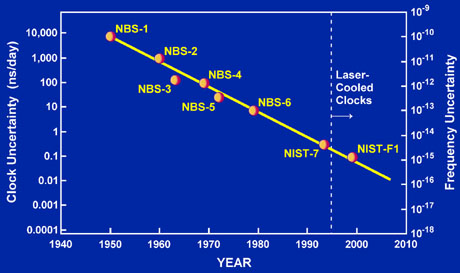
As technological improves you would expect that our ability to measure things would improve. So if we take the accuracy of measurements as a crude gauge of technological progress can we graph how quickly we are progressing?

So take time. How quickly is our ability to measure time accurately improving?

I'm going to have a look at how accurately people have been able to measure time since the start of the modern world (about the time Newton got hit by an apple) till now. I take accuracy to mean how many seconds you could count before you would be out by one on average.

1656, Dutch astronomer Christian Huygens. It had an error of less than one minute a day according to here
1721, George Graham improved the pendulum clock’s accuracy to within a second a day
1761 John Harrison, half a second a day
1889 to Siegmund Riefler's clock with a nearly free pendulum, which attained an accuracy of a hundredth of a second a day
1952 Quartz clock at accuracy of 1 in 10^8 seconds.

Modern times are graphed here

For the atomic age I got the figures from here
So that gives the data

year accuracy
1650 10E+03
1721 10E+05
1889 10E+07
1952 10E+08
1955 10E+10
1970 10E+13
1989 10E+16
2008 10E+17

One problem with this line of thought is that exponential increases tend to stop. Otherwise we would be up to our ears in Fibonacci's rabbits. The problem with this exponential reasoning is described here

There are all sorts of other things whose accuracy have improved over time. Has temperature and mass measurement accuracy increased at the same rate?

Monday, April 06, 2009

Turkeys Voting for Christmas

Surely this expression should mean that things should not engage in acts they don't have the cognitive capacity needed to do. A bit like saying dogs should not do quantum theory. Taleb has a theory of turkey philosophy here.

But that is not the excepted meaning which is

like turkeys voting for (an early) Christmas (British & Australian humorous)
if people are like turkeys voting for Christmas, they choose to accept a situation which will have very bad results for them
Usage notes: Turkeys are large birds which are often eaten on Christmas Day.

Other then the obvious practical difficulties of running meleagrine elections Christmas has to be the best thing that has ever happened to turkeys. I remember a talk on the long now that the best way to ensure your species survival is to be really tasty.

Without Christmas we would have no reason to have such large numbers of turkeys. People don't keep skunks because they serve no useful purpose. Numbers would be vastly reduced. If only wild turkeys survived and they were not farmed for food their numbers would be orders of magnitude less.

Of course there is the question of whether it is a good idea for turkeys to put all their eggs in one basket Christmas wise. They have intelligently diversified in the American market into thanksgiving. Some sort of Summer festival in Asia would be where they should concentrate their marketing on next I would think.

Friday, March 27, 2009

What have a panzer tank and a Dublin taxi got in common?


You can use statistical methods to estimate their numbers boom boom

How many taxis are there in Dublin? I'm going to try guess without looking it up then see if I'm right. And I'm going to use Panzers to do it.

During WW2 the allies had to try guess how many tanks the germans had. From the Guardian
"The statisticians had one key piece of information, which was the serial numbers on captured mark V tanks. The statisticians believed that the Germans, being Germans, had logically numbered their tanks in the order in which they were produced"

People are always trying to guess how many of something there is. Iphones, kindles, computer worms, all sorts of man made objects. Mainly though it is important for military reasons.

Lancasters square law says that the power of a modern military force is proportional not to the number of units it has, but to the square of the number of units. This means that relatively small changes in the number of units an enemy has can have big changes in their effectiveness. Play around with the graph of x^2-x; here if you want to see for yourself. This is also important in computer game simulations of military operations.

Anyway I'll get some data on the Dublin Taxi driver licence numbers and get back with the calculation. The estimation problem should make more sense with an example.

Tuesday, March 24, 2009

The Lottery of Penalties

Croatia boss Slaven Bilic: "Penalties are a lottery and the players felt confident enough to take the spot kicks."
Redknapp's post-match attitude was that penalties are a "lottery"
Max Tonetto: “We played a great game, and unfortunately we were punished by the lottery of penalties.”

There is not much research on this area. This paper implies
The research shows that the individual goal-scoring skills do play a role in scoring goals from penalties and that the result is not exclusively a matter of luck… The belief that a penalty shootout is a lottery made players more receptive to the negative consequences of anxiety-caused stress.”

So according to Geir Jordet and Esther Hartman's research not only is a penalty kick not a lottery but saying it is hurts your team.

Sunday, March 15, 2009

Submarine Collision Probability 3

Ok last time on the how often should two nuclear submarines smack into each other question. This particular sum managed to get me and Luke into the Wall Street Journal print edition here and their blog here. Which was nice.

So the sum is a mean free path calculation. Where the particles are submarines and the box they are in is the submarine patrol zone or the whole Atlantic depending.

The size of a submarines patrol area is generally set by the requirement to have a surface support vessel within 24 hours. If one of these could travel at 20 knots an hour it could cover an circle with radius of 900 kilometers. The maximum operating depth is not much more than 600m and the submarine has to operate about 100m below the seasonal thermocline. A stealth mode speed is about two meters per second. The size of a nuclear submarine is about 150m length by 12m diameter plus a conning tower of about 8m high by 12 meters long. We modeled this cylinder as a sphere, which on these scales should not be too bad.

A support ship can support up to 14 subs. So we took it that there were 14 in its particular area in the small sum. If there were 14 gas particles wandering around a box the size of the Atlantic (big) or a ships support area (small). from a depth of 100m to 600m. At a speed of 2 meters a second. How often would you expect one to hit another is what we worked out.

Nuclear submarines have to stay 100 meters below the seasonal thermocline. We took the thermocline to be zero based on this

The model "mean free path" used is derived here

Now these are big ifs, thinking of things as being random gas particles is a big IF. People thought derivatives acted like random particles (the Black–Scholes model) and they just lost a lot of money. So I think this is more "fun application" of physics rather than "rigorous analysis". Thanks to Luke and Carl who crunched the numbers and got the data (i.e who did all the work).

Thursday, March 05, 2009

Malware News 2012

Turing Bots Are Coming
Autonomous IM bots with near human appearance have become an increasing source of malware infection in the last few months. Early attempt at such IM "Turing bots" first occurred in 2007. However recent improvements in the technology have lead to increased success in these infection methods. The bots attempt to appear human in instant messenger communications. This is generally to attempt to learn bank account information.

Eliezer Yedkawsky who has for years pointed out the security threat of artificial intelligence warned yesterday "Why does a dog wag its tail? Because the dog is smarter than the tail. If the tail was smarter, it would wag the dog."

A security expert dismissed as preposterous the idea that smarter then human AI coming from IM bots represents an existential threat to humanity.

NamScan closes

In related news a Vietnamese Anti Virus company NamScan closed yesterday. The Buddhist workers at the company refused to create software that would destroy intelligent AI bots. A company spokesman said "this is a strange cult that has grown up in our company. The engineers believed that if a program a collection of bits could pass the Turing test then it was in some way "human" and destroying it would be immoral".

The ruling on the court case between the antivirus industry and PETAI (people for the ethical treatment of AI) is due next week. A spokesman for the antivirus industry said "without the ability to stop these programs the whole internet will collapse".

Wednesday, March 04, 2009

Satellite Collisions

If something is worth doing its worth overdoing. So rather then continue to explore the massive conspiracy against life that is nuclear weapons I want to look at satellites.

"In an unprecedented space collision, a commercial Iridium communications satellite and a defunct Russian satellite ran into each other Tuesday above northern Siberia, creating a cloud of wreckage, officials said today."


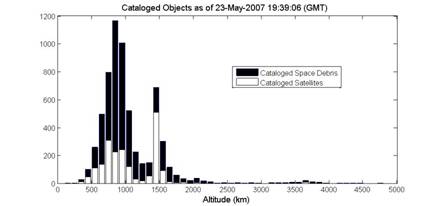
There are all sorts of worries here about the effects of shards of satellite debris hurtling round the earth. Mainly though there are incredibly cool graphics of stuff smashing together.

Now I believe thinking about nuclear submarines as wandering particles (as i did here) makes sense on the grounds they are supposed to act in a random manner. Satellites however are deliberately put into set orbits to exclude collisions. They do change path occasionally though based on fuel leaks, gravity effects or being moved for operational reasons but they do not change path often enough for this model to be anything like a good fit. But if we did think of satellites as particles in a box how often would there be hits? If you are interested in a better back of the envelope there is one here.

"The Iridium satellite spanned about 5 meters across its solar arrays. Strela-2M used gravity gradient stabilization, and probably spanned 17 meters including the gravity boom. When calculating collision probabilities, it's important to remember that booms and antennae mean that many satellites have much larger cross-sections than the size of their main body would imply."

Number of particles=300 satellites
Size of particles= 2 meterish sphere

speed: 8000 mps

size of box= 0.06370550904E+12 cubic kilometers
as in earth Mean radius is 6,371.0 km. So sphere of size (6,371.0 km + 800) - sphere of size (6,371.0 km + 700) is the total area.

total volume of satellite = 600 cubic meters
satellite per unit area= 600/0.06370550904E+12 cubic kilometers

A java program to calculate this is below

class Sat {
public static void main(String[] args) {
int numPart=300;//sat number
int sizePart=2; // sat sizeg.
int speed=8000;//sat speed
Double below=new Double (1d);
below=1.41421356*3.14159265*2;//sqrt(2)*pr*r is part of mean free path sum
Double sizeBox =new Double(63705509040000000000d);//areas sats are in
double totalSat= numPart*sizePart;//total volume of sats
double SatPerUnit=totalSat/sizeBox;//how many sats per unit area?
Double meanFreePath=new Double(1d);
meanFreePath=1/(below*(1/sizeBox));//mean free path calculation
Double often= new Double(1d);
often=meanFreePath/speed;
often=often/(365*24*3600);
System.out.println("Satelites should hit every
"+often+" years");
}
}

Satellites should hit every 1.42E7 years. Which makes me fairly sure I've gotten my zeroes wrong somewhere.

Friday, February 27, 2009

Carrying stolen money

There was a bank raid this morning where an bank employee was made carry 7 million euro out of a bank. The story is here

"The official, who is in his 20s, was then forced to drive his car to the bank. After withdrawing the money, he handed it over to the gang at Clontarf DART station."

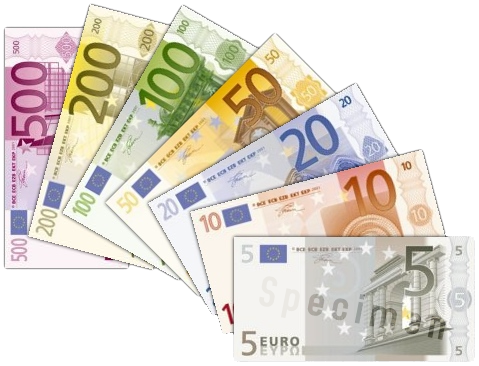
I am ignoring the horror of the attack and just asking what would 7 million euro weigh? In 2 euro coins it would weigh 29750kg


A bank note is around 1 gram according to here.
So 7 million euro is
14000 500 euro notes (1.1g) or 14.4kg.
100 euro notes (1g) are about 5 times that 70kg which a normal man could not carry nonchalantly out of a building.
50 euro notes (.9g) would weigh 126kg which most people could not lift.

So how did the employee carry this money? You would think there would be restrictions on employees carting large bags of money around.

There is also the size issue. 500 notes are Size: 160 x 82 x 0.12 mm so 14000 would be a pile 168 cm high. So say you want to put these into a duffel bag. This is roughly 600 mm long by 300 mm wide by 300 mm high

So you can fit three pile lengthways, three sideways and 2500 notes upwards. So in a duffel bag you can have a bit more then (there is left over room at the top and sides) 3*3*2500= 22500 500 euro notes. This is 11250000 euro weighing about 25 kilos.

How many 100 note (1g) of Size: 147 x 82 x 0.12 mm, 50 note (.9g) of Size: 140 x 77 x 0.12 mm could be carried?

Nuclear war 2.0

In the latest in my increasingly unhinged worries about nuclear war I started wondering what would happen if someone accidentally spilled coffee into the wrong machine and it did all kick off. Off course there are so many back ups no such accident could happen like the way a drunken depressive could never be the one with the final say on when Armageddon comes...

Anyway if they did launch what would be the effects on your house?

Turns out some people have already made a shinny web 2.0 app that lets you see this


Its great family fun to play around with. Center the flag on the nearest location you think will be nuked and have a look at the various effects. You can go for that retro 50's bomb, the humongous 60's version, all the glamour of a modern small tactical nuke.

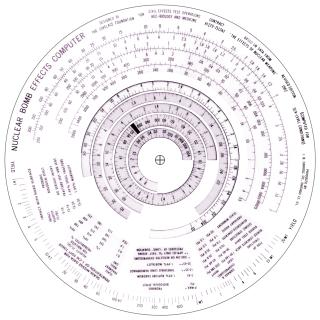
Playing with these toys the maps and the nuke computer and such is a really odd feeling. Part of me is impressed with the sheer Promethean hubris of the enterprise. Its hard not to admire the technocrat logic of the slide rule nuke computer the shiney mashup of the nuke map or the eery idea of subs wandering round blind in the ocean. Mainly though I wonder how I got stuck on this planet that is clearly packed full of psychotic apes.

Thursday, February 26, 2009

MADness

After doing all the calculations for the chances of submarines wandering around blind filled with nuclear weapons crashing into each other i got a bit scared

There is something painfully absurd about the idea of blind mute spheres of death wandering round the oceans hoping not to bang into each other.


We like to think nuclear war was only a problem around the time of Bob Dylan's first album and was shot in kodachrome photos but the fact is it could still kick off today.

"I did a preliminary risk analysis which indicates that relying on nuclear weapons for our security is thousands of times more dangerous than having a nuclear power plant built next to your home."
Diffie

So for fun why not compute like it was 1962 and see what would happen if various nukes went off in your vicinity. There is a fun print and make Nuclear Bomb Effects Computer here and some more here. They are basically versions of slide rules people used to calculate how big fire balls and such would be.

Hey get the kids involved, its crafty and its edumacational. Why not teach them about how close to a bomb they would need to be so that all that would be left is the enamel of their teeth?

Wednesday, February 25, 2009

Submarine Collision Probability 2

Suppose submarines were spherical particles just wandering round the ocean. Occasionally they would hit the shore its surface or its maximum depth and would bounce off and head away again. Submarines do not move randomly but they do not follow fixed ordered paths either as that makes them easy targets.

The submarine was modelled as a cylinder of length 140 meters and radius 6 meters so it has a volume of 63360 meters cubed. If this is instead seen as a sphere this volume would have a radius of 24.73 meters. Forgive the spherical cow nature of this sum. From a previous calculation you have 25 particles (submarines) of volume 63360 cubic meters each in a space the size of 300 million cubic kilometers. How often will one hit another?

A problem very similar to this is how quickly two gasses will mix. Gas particles fly around very quickly air molecules at about 400 meters per second (which is faster then the speed of sound!) and all that stops cigar smoke instantly filling a room is that the gas molecules hit off each other so much they do not just zip across the room. The calculations below are based on an explanation found here. Maxwell and a few other worked out how often particles should collide and called the distance a particle travels without colliding the Mean free path.

Each particle has a volume of 63360 cubic meters. So 25 particles are 1,584,000 cubic meters. Instead of being in a box these submarine particles are in the atlantic with an operating range in depth of 300 meters. So the 'box' these particles are in is of size 30 000 000 000 000 000 cubic meters. Each particle has 12 million cubic kilometers to itself. so in 12 million cubic kilometers of ocean 63360 meters of it are particle. So 1 part in 190 000 000 000 of the available Atlantic is a submarine.

So how many particles per meter is that? 25*63360 submarines in 30 000 000 000 000 000 meters cubed of water.

Whats area is swept out by a particle (submarine) in a given period of time? I figure submarines wander around at 20kph so that's a sweep volume of pi*d*d*x in a distance x. travelling at 20kph that's pi*24.7*24.7*(20kph*1000m*24hr)=919994045 meters swept per day.

Now along this path how long will it on average travel before hitting another particle?

The mean free path formula is

where n is the number of particles per unit volume. And r is 24.7m. So the length you'd expect to travel between collisions is 1/2710* n.

Actually i think I've found a flaw in my reasoning here. I think the correct answer is about once ever 300 years. Which is still a bit too often isn't it? Ill post the calculations later.

Monday, February 16, 2009

Nuclear submarine collision what are the chances?

"A Royal Navy nuclear submarine was involved in a collision in the middle of the Atlantic, it was reported.

The crash between HMS Vanguard and French submarine Le Triomphant, which was also carrying nuclear warheads, is believed to have occurred on February 3 or 4, The Sun claimed."

A nuclear submarine seems to be about 140 meters with a radius of 12. So that's a volume of about 63360 cubic meters.

The Atlantic ocean is 354,700,000 cubic kilometers. There are 1 000 000 000 cubic metres is a cubic kilometer. Of course subs can only dive to about 400 metres. So say they stay in the top 300 meters then the volume might be more like 106.4 million km squared * 300 meters=30 million cubic km. More likely they avoid the top 20 meters where ships might hit them, so their range is estimated to be 20-2320 meters deep.

This is assuming a submarine is a cylinder which it isn't.
How many nuclear submarines are there? There seems to be about 50 in the world. Navies will keep their own submarines separate. But that still means there are in the Atlantic maybe 25 submarines that the French or UK subs could run into. This does reduce the number of subs the Russians Or Americans can hit significantly though. They have a top speed of about 40 km per hour. So I assume they are wandering around at 20kph. So assuming all the worlds submarines are in the Atlantic ocean at the same time how often would you expect one to hit another if they were traveling round at random?

Thursday, February 12, 2009

facebook relationship forensics

Has anyone noticed the modern skill of divining your friends relationship status based on social networking clues? You feel a bit CSI trawling through tweets to divine if someones missus is just not going to the pub or has been red carded.

This requires powers of divination that would shame an extispicist. It would also shame the animal whose entrails he was reading if it didnt have bigger problems at the time.

Why isn't there a word for thinking today is a different day? If you could go "oh the game is on tonight Ive been daisy all day" rather then having to go into an explanation of how you think its Friday not Thursday etc.