Friday, March 11, 2011

Analog Computer Museum

This week I was lucky enough to visit the Analog Computer Museum near Frankfurt. Bernd who owns and protects the collection I have known for years via email so I was happy out to finally get to meet him and his wife. These Analog computers carry out calculations using electronic components.


Bernd works as a software archeologist. That is he updates the systems of banks and such that are written in OS' and languages that almost no one knows anymore. If the software running your bank was written int he 60's and you want to get it running on Linux Bernd is the man to call. These languages are so obscure they make the COBOL look like the Beatles. The job seems to pay well enough as he can afford warehouses to keep his computer collection in and a collection of vintage sports cars he drives at terrifying speeds on the local autobahns.
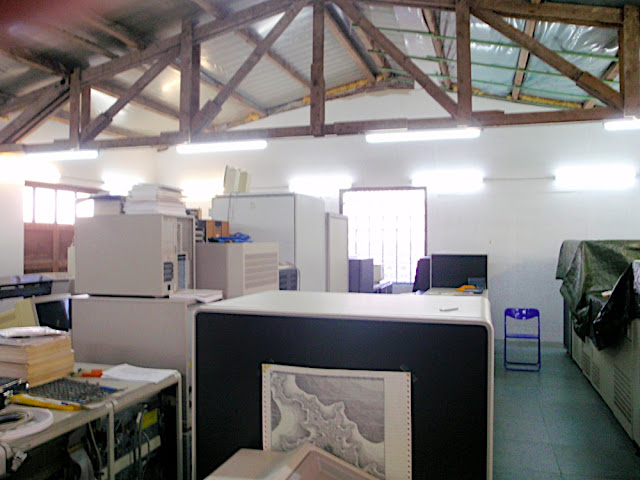


Yes I take my wife to Computer Museums but in fairness shes a physicist and I suspect she thought this rocked as much as I did
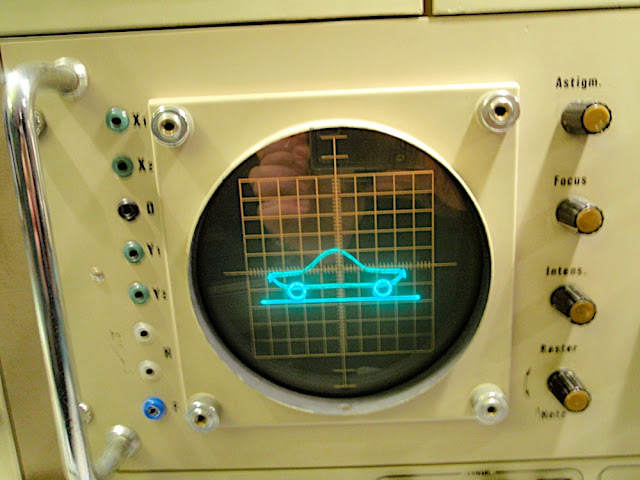


These machines are ideal for real time simulation. This Telefunken currently simulating a car was used to train nuclear powerstation operators with simulations of various 'problems'
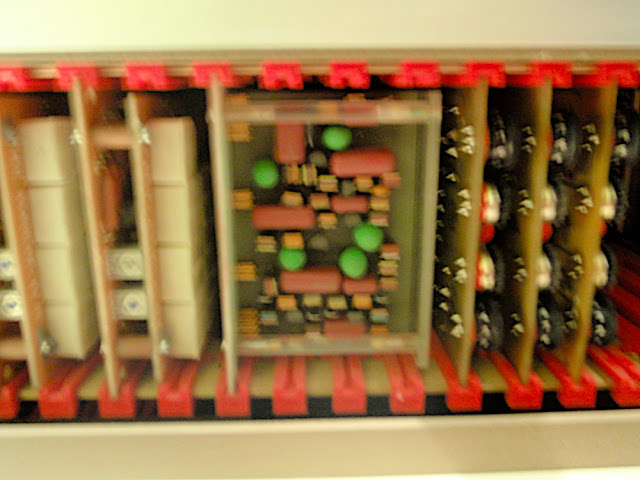

Next time you call rand() think of this board that was used to generate random numbers through electronics


Old school fractal printed out and taped to the side of a Vax. It is like chalking up a kill on the side of a WW2 fighter plane. Computing from the time where men were men and debuggers were nervous.

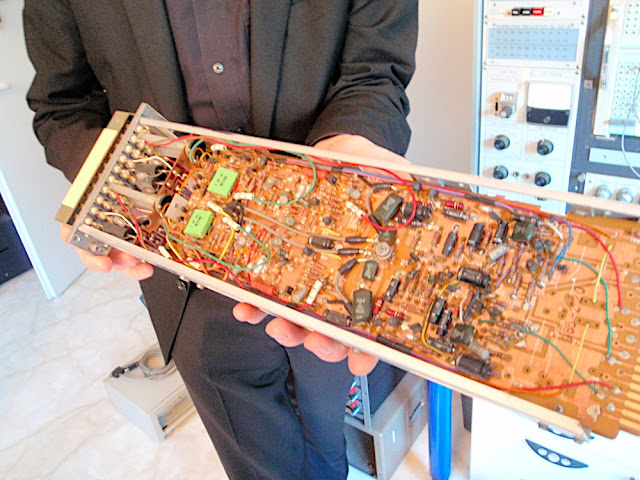
I cannot rationalise why these analog computers are so cool (pics here). I think its to do with getting to the bare metal of a computation. Also something of the history of these machines is amazing. Looking at the circuit boards you can imagine national characteristics they describe. The German machines based on mathematical abstractions are beautifully clean (and easy to fix apparently). The Japanese machines were a mess like their remote controls. The British machines had a distinct boffin feel to them. The machines from communist countries really seems like a scramble of clever but under resourced hacks. The American machines were big brash and heavy.

Kevin Kelly claims that a technology never dies

What happens is that most technologies become obsolete, diminish their role, but they don't disappear--more idea-based and can be resurrected more easily. Seems like a silly claim: the hand-axe, the arrowhead--they don't exist any more. And that's what I thought too... Looking on the Internet was able to find an example of whatever the challenger had given to me: brand new steam-powered valve for a steam-powered car; they're making flint axes exactly the same way, using exactly the same tools to the point they are almost indistinguishable from the original; archeological artifacts, making in huge numbers today.

But I really worry that the knowledge of many of the engineers who created these machines will be lost. One thing is that the analog museum really wants donations of machines that may be thrown out. If you see a box of the brand Dornier, TeleFunken, Gould, Aritma, BBC, Electronic Associates Inc, Solartron or even just something you think might be of interest send him an email. Even parts of these machines could be really useful to help repair the computers he has.

I do not think these machines are purely of historic interest. It is possible that in the future analog computers will be used in the real time simulations they excel in. One area I think they could be useful for is search engines. Linear algebra calculations are at the heart of modern search engines. this is described in
The $25,000,000,000∗ Eigenvector the linear algebra behind google and How Google Finds Your Needle in the Web's Haystack

These calculations do not need to be precise (the google algorithm uses random walks) which removes one of the big objections to analog computers.

George Dyson in the this years edge question 'What Scientific concept would improve everybody's cognitive toolkit?' describes a search engine based on analog computers here
Analog computing, once believed to be as extinct as the differential analyzer, has returned. Not for performing arithmetic — a task at which even a pocket calculator outperforms an analog computer — but for problems at which analog computing can do a better job not only of computing the answer, but of asking the questions and communicating the results. Who is friends with whom? For a small high school, you could construct a database to keep track of this, and update it every night to keep track of changes to the lists. If you want to answer this question, updated in real time, for 500 million people, your only hope is to build an analog computer. Sure, you may use digital components, but at a certain point the analog computing being performed by the system far exceeds the complexity of the digital code with which it is built. That's the genius that powers Facebook and its ilk. Your model of the social graph becomes the social graph, and updates itself.


Analog computer methods of calculating eigenvectors have been described decades ago (pdf here).

It is possible that the techniques of analog computers could be the future of search engines. We should make some effort to save these machines, any manuals written on them and if possible some of the knowledge of those who made and used them.

Think Different

I am fascinated by how people think differently from each other. I think there are big differences in the fundamental methods people use to think, but because we rarely talk about how we think these are not well known.

Feynman talks here about how he heard numbers in his head when he counted and his friend saw numbers visually.


He believed that such fundamental differences explained why we sometimes have such difficulties communicating with each other.

I 'see' numbers as a kind of line and I have heard other people describe other ways they 'see' numbers

Reading is another place people think differently. When I read I 'hear' the words as I read them. This is called subvocalisation and is normal but it slows down reading. "Subvocalization, or silent speech, is defined as the internal speech made when reading a word, thus allowing the reader to imagine the sound of the word as it is read". There are all sorts of online guides as to how to stop subvocalising. My wife does not subvocalise and never has. She describes seeing words as the actual word rather then hearing it and then understanding what it means.

Do left handed people who do that hook handed over the top writing have a fundamentally different view of writing? Do you know of any other basic cognitive tasks that people carry out in completely different ways?

Monday, February 28, 2011

NOW Who is the popular one?


Someone of the two of you readers were kind enough to nominate this blog for the Irish blog awards


Science/Education 2011 Best Science/Education Blog
Technology 2011 – Best Technology Blog/Blogger

Thank you very much to all of you who read my nonsense especially those who decided it was worth pointing out to other people

On a related trumpet blowing note Tyler Cowen thinks this blog shows that Ireland is going to collapse into anarchy,
@tylercowen
Will the Irish be more or less impatient than the Egyptians?, http://tinyurl.com/4zyyxsg

Which now I think about it may not be a complement

Congratulations to my friends in thebeernut, L. Mulligan grocers and Dungarvan Brewing Company on their nominations.

A no lose lottery would help Haiti

In this post I want to try and persuade you that there is a form of lottery the Prize Linked Savings scheme that would be popular and fairly cheap to run for the people in Haiti. In my next post I want to explain why such a scheme would actually be useful

"PLS is a kind of savings account that pools some of the interest from all depositors and pays out a big lottery prize every month or so. It combines the thrill of the lottery with the safety of a savings account. It’s sometimes called a “no-lose lottery,” since a depositor is automatically entered into the lottery but can’t lose the original money she deposits."

Lotteries are incredibly popular in Haiti. Probably due to the crushing poverty there the hope and 'chance to dream' lotteries provide is seen as vitally important

"the lottery system in which an astonishing number of Haitians invest their income and their dreams." "At the time of the last official count, in 2005, the streets of Port-au-Prince were home to nearly 2,000 of them" (borlettes lottery shops) "– more than double the number of schools and universities in the city"."All told, Haitians spend as much as $1.5 billion per year on the borlette – a staggering amount in a country whose gross domestic product last year was $6.9 billion"

"You can bet two balls to come up at once, and if that happens you make a ‘marriage’ and win 500 times your bet. If your married numbers are consecutive, you win 1,000 times your bet. The Haitian dream is a bet of US $1,000 that reaps US $10,000 on a consecutive marriage. Many a hopeful future has been built on less." Borlette lottery in Haiti is remarkably popular which is a good indication that a lottery that also acts as a savings scheme will be popular

The overhead cost of these Haitian lotteries is relatively low as they use the numbers and thus the security mechanisms of outside lotteries. These lotteries tend to use the numbers from other countries lotteries for example the New York State Lottery or the Santo Domingo State Lottery

Another expense is the prize won in the lottery. You want your prize to be equivalent to a million euro. This is an amazing life changing amount in Ireland where the average wage is 35K. So a million is about 30 times average income. For Haiti this would be $730 *30= 21 thousand dollars. A million Haitian gourde is about 25 thousand dollars.

If we had a monthly prize of this much that would cost 12*25k=300 thousand a year in prizes. Say you double that with some smaller prizes. 600 thousand which if you were earning 3% interest means you would have to take in 10,000000 dollars. This is a lot of money but in the context of $1.5 billion spent on lotteries in Haiti it is not that much.

If you could take in ten million dollars you could run a no lose lottery in Haiti and use the interest to pay for the prizes. But why would you want to? I will explain in the next post why PLS would be useful to the people of Haiti

Friday, February 18, 2011

The Great Stagnation in Ireland

There is a new ebook by Tyler Cowen about how growth rates and progress in general has declined since 1973. There is a podcast here where he discusses the argument.

The book, is short you can read it in an evening, and published only in ebook format. It is a bit like an evening with your smart friend as he explains something rather than an economic treatise thats full of equations and aids insomnia. It is well worth the 4 dollars and few hours it takes to read.

Loads of commentators have examined various parts of the argument for stagnating progress. I even joined the argument here. I am going to try give a few datapoints that relate to Ireland that are part of the great stagnation argument here. Ireland has not been stagnating since 1973. In that time we moved from an improvished bachwards country to a modern well off one (and then slipped back somewhat again).
But there some areas where we are stagnating in similar ways, there are areas where we made similar mistakes to the Americans (and the rest of the OECD) and if we can expect a similar decline in growth here that means we should alter our expectations.

Stagnating medicine

We spend too much on medicine and do not get good value for that spending. There is a piece here by Ronan Lyons where he argues convincingly that with our age profile we should be spending a third less than what we currently do on medicine


It is generally agreed that access to the health system in Ireland is bad. If we spend more than we should and people cannot get healthcare as easily as other OECD countries do it is fair to say that Irish healthcare is not improving our quality of life the way it should be

Stagnating education

'In the past decade, funding per student has been increased in real terms by 61 per cent, yet performance has decreased by 15 per cent.

This disconcerting news was reinforced before Christmas when the international ranking of the reading, mathematics and science skills of Ireland’s 15-year-olds was published. Reading skills dropped from fifth to 17th, the sharpest drop among 39 countries, with one quarter of all 15-year-olds classified as effectively illiterate. This was more politely termed in the report as “below the level of literacy needed to participate effectively in society”.'

We are spending more and getting less on education. Literacy is one of those basic measures that is hard to fake. Anyone who leaves school illiterate is a failure of our education system. In this school education area Ireland seems to have stagnating improvement.

Expecting too high growth
One of the major conclusions of the book is that Americans expected growth to continue at previous rates and this facilitated the financial crisis. People believed house prices would go up forever without wages increasing at the same rate. When people realised that they could not afford their debts and no one was going to buy them off them the house of cards collapsed.

In Michael Lewis' Vanity Fair piece makes a similar claim that Ireland expected too much growth
'An Irish businessman named Denis O’Brien sat on the board of the Bank of Ireland in 2005, when it was faced with the astonishing growth of Anglo Irish, which was about to double in size in just two years. “I remember the C.E.O. coming in and saying, ‘We’re going to grow at 30 percent a year,’” O’Brien tells me. “I said, How the fuck are you going to do that? Banking is a 5-to-7-percent-a-year growth business at best.”'

If the financial crisis in America was aided by delusions of future growth the Irish collapse was to an even greater extent.

Expecting growth to be much higher than it will be leads you to paying too much for things. For example buying empty buildings on the grounds that NAMA will make a profit on them eventually.

Other Claims
There is a very interesting section on how the internet might entertain us but does not provide many jobs. There is a similar argument to in "An Exodus Recession?" that because we can sit at home and look at youtube essentially for free the recession both does not feel as bad but is measurably worse as people do not go out and spend money on cinemas etc that employ people.
This does not relate specifically to Ireland though I do think the internet has improved our lives in ways that are hard to measure and that probably help those who like reading and arguing more than they help the average person.

Cowen also claims that increased emphasis on scientific research could again get progress moving faster again. I was watching Bronowski's the ascent of man last night from 1973, the year Cowen claims the stagnation began. Bronowski gives a warning that the next step in mankinds progress is dependent on science and that if we don't prevent scientific progress from stagnation some other civilisation will.


Expecting growth to return now

I have heard many people running for office who claim anyone who questions that we can return to the good old days of 5%+ growth of being unpatriotic. In this narrative our debts are huge but they were in the 1980's as well ans well soon have 5%+ growth that will evaporate our debts for us.

The evidence is that once countries get as rich as we are now their quick growth from playing catchup then slows. Some of us might be able to get more productive now but not nearly the increase that happened in the 90's when we went from working on farms producing vegtables and potatoes to producing Viagra and Pentiums.

We are not going to have the growth rates we had in the 90's we like the rest of the OECD have entered a period of lower growth, what Tyler Cowen calls 'the great stagnation'. Anyone who says we should plan for Ireland growing at a rate higher then the 6.7% interest rate on the ECB/IMF loan are is trying to get you to take on billions of their debt.

The great stagnation a great short book. Though its arguments apply to America the lessons of what they Japan and other countries who developed before Ireland are important for us to learn.

Thursday, February 17, 2011

Watson is better off having a three way competition

It seems non intuitive but I think Watson is more likely to win because its competition are so good. If you look at how well it did on Jeopardy here it seems to show Watson is better having humans splitting the points on questions it cannot answer as it is so quick to answer the ones it can.

When the humans buzz in they are right 19/23 about 83% of the time. Suppose Jennings was up against watson and me and I got zero buzz ins. Jennings may have gotten 11 of the buzz ins that Rutter got. Watson seems so fast on the buzzer that it seems to buzz first for nearly every question it could answer 44/50 times it tries to answer it is first.

This means that Jennings could nearly have doubled the number of answers he had but because there are two people who are really good at the sorts of questions only humans could answer these points are divided amongst the humans. Of the 23 human answers only 6 did Watson try to buzz in on.

There is a similar probability puzzle that might help in a three way duel. "You're a cowboy, and get involved in a three way pistol duel with two other cowboys. You are a poor shot, with an accuracy of only 33%. The other two cowboys shoot with accuracies of 50% and 100%, respectively. The rules of the duel are one shot per cowboy per round. The shooting order is from worst shooter to best shooter, so you get to shoot first, the 50% guy goes second, and the 100% guy goes third, then repeat. If a cowboy is shot he's out for good, and his turn is skipped. Where or who should you shoot first?"

Theres another explanation of a three way duel here.

Sometimes having 2 really good competitors increases your chances of winning.

Wednesday, February 16, 2011

When will you be able to ask Watson?

Watson is a computer currently playing the quiz Jeopardy. You can see a video of this here


One useful question is how long this sort of supercomputer like power will take to be seen in everyday life? It has 3000 cores running and answers in less than three seconds. On one machine would take 2 hours to answer a question according to here
So how long to get a desktop computer to be able to answer at this speed? I propose that half the speed improvement in Watson like programs will be from Moore's law and half from algorithm improvements. To go from 7200 seconds to say 2 seconds will require about 13 halvings in speed. I predict this will occur in the time it take processors to improve 7 doublings in computation. You can buy your own supercomputer now on the cloud and depending on how long you are willing to wait you could get an answer to a Watson like answer for costs of around a dollar (if you had the data and software Watson uses).

One comparison here is with chess. "It has been estimated that doubling the computer speed gains approximately fifty to seventy Elo points in playing strength (Levy & Newborn 1991:192)."

If doubling in processing power happens ever two years that would imply about a 30 point increase a year. The actual improvement (in computer v computer games) is described as 'With a 40-point annual improvement due to hardware upgrades, and a 30-point annual improvement due to software upgrades'. Implying improved algorithms are responsible for half the improvement.

This argument is summed up in this explanation as to why a fairly normal computer Deep Fritz in 2002 was an improvement over the supercomputer Deep Blue in 1997 'Deep Fritz has improved considerably over Deep Blue. Despite Deep Fritz having available only about 1.3% as much brute force computation, it plays chess at about the same level because of its superior pattern-recognition-based pruning algorithm'

I claim there is an analogy to Moore's law that says something like.

Once computers get good enough at a task to have a flashy TV challenge from then on algorithms will cause half the improvement in that task

So if I am right I think Watson like computation instead of talking over 25 years to move from twelve refrigerators to something we can use everyday should take less than 10 years. I would take an even money bet that in five years there will be a service you can use from your phone that is a lot closer to Watson than to a search engine we see today.

*update A friend just made this bet with me
"20 euro bet that January 2015 there is a search engine that with a set of quiz questions from one gameshow program (the weakest link, who want to be a millionaire, university challenge) and it has to get 7/10 right". The effects of learning by reading (and autonomous cars) are examined in this rather long but brilliant blogpost

Monday, January 31, 2011

Are Kitchens Better?

There is a really interesting debate going online right now about whether the rate of improvement in America and the west in general has slowed. The debate has been started by a book by Tyler Cowen called "the great stagnation" which I have yet to read.


Above is a graph from here of how quickly different products became popular
Paul Krugman raises a similar point about how American Kitchens have not improved much from the 1950's here where he points out "By any reasonable standard, the change in how America lived between 1918 and 1957 was immensely greater than the change between 1957 and the present."

You could argue that kitchen equipment is much cheaper than they were in the 1950's. Or that rice cookers, food processors and microwaves are a great improvement. Coffee machines are probably the exception to the stagnation rule as they do seem to have improved vastly. There is also the explanation that if your home kitchen has not improved maybe the kitchen that cooks your food has.

Has the big change been that people do not use their kitchens anymore? In a 1950's kitchen could you order a pizza to be delivered? Dominos started in 1960 according to the history of pizza delivery here so you probably could. I doubt Italian, Chinese, Mexican and Indian food were regularly delivered to ordinary peoples homes though.

Has the technology and labour moved from the domestic kitchen into industrial kitchens that now do 90+% of the work in preparing many of our meals? How much of the supposed lack of improvement could be explained in terms of more processing happening outside the home?

“About 44 percent of food dollars are spent outside the home – a figure that started rising sharply in the 1970s, as more women joined the work force. Full-service restaurant revenue rose 5 to 7 percent a year in the decade leading up to the Great Recession”. So do seem to be eating out more?

Houses with small numbers of people cook less. And houses have less people nowadays, due to demographics. If people eat out more (or order in). Why would they buy some brand new kitchen invention? I have seen people with kitchens filled with shiny new equipment they have never used but I think this is fairly rare.


If the dial up pizza restaurant can have a new dough maker that is more efficient it makes sense for them. I can ring them up now and get the use of their new industrial standard food technology for the minute it takes them to make my pizza. Maybe home technology stagnated and the restaurant/supermarket/Microwave dinner technology improved?

I think it is worth noting that the improvements in Irish kitchens in this time have been huge. The 1918 world Krugman describes is superior to my grandmothers life in the mid fifties rural Ireland. She did not have running water or electricity and in her lifetime between 1950 and 1980 the changes she saw were massive.

Thursday, December 23, 2010

Crowdsourcing Taxonomy

I had an interesting debate on twitter with Panos Ipeirotis and Anand Kulkarni about what counts as a crowdsourcing application.

Wikipeidia defines crowdsourcing as
"Crowdsourcing is the act of outsourcing tasks, traditionally performed by an employee or contractor, to an undefined, large group of people or community (a crowd), through an open call."
And they are even so nice as to give a list of crowdsourcing projects


These seem to fall into a few areas
1. Microwork. MTurk, Freelancer.com, 99designs. You go on mturk you put in a task like "tell me if this sentence is in English" and an amount "1 cent per task" and then you let the people on mturk do the classifications for you.

I think this sort of work will be huge. There are talented people sitting around willing to do something interesting for cash in their spare time just waiting to be harnessed.

Many projects exist to crowdsource advertising ideas. for example IdeaBounty. These advertising ideas seem similar to other microwork projects.

2. Games with a purpose. Galaxy finder, Foldit etc. There is a task like "count the number of spiral galaxies" you put this out there as a 'fun' task and people do it for you free, gratis and for nothing.

This is similar to citizen science projects but explicitly involves the use of fun and game mechanics to get people to do the work.

3. Market mechanisms could be thought of as a form of collective intelligence. In a market the competing forces of supply and demand result on a value being placed on an item. So for example on ebay many people have decided the value of collectible baseball cards. Or on intrade many have decided the probability Obama is to be reelected.

Is market formation a form of crowdsourcing? I think prediction markets are great and should be used more but their placing accurate values on the probability of an event is a byproduct of their action rather than the intention of those operating on it. People would rather if the odds were wrong so they could make money being right.

For some reason I don't think a prediction market is a crowdsourcing application and none are listed on the wikipedia list.

As an aside I read a brilliant blog post two days ago (that I now cannot find) that pointed out that ebay is essentially a storage device. You sell things they go into the ebay and when you want them back you go on the ebay and find the product again and buy it. Your storage costs are usually just the postage and packing charges. This is similar to the argument that there are two ways to produce cars. One is to build factories and hire people and such the other is to send boat loads of cows to Tokyo where magically you get boats filled with cars back in return.

4. Microlending
Kiva and other sites allow you to lend money to business. Say a guy want to plough my field. 10 people give you 5 dollars each so you can buy a plough. The field gets ploughed. They get 6 dollars back after harvest. This again does not seem like crowdsourcing of jobs as you are lending capital not labour.

Artists using a street performer protocol to pay to get an album made is something similar. Kickstarter is one site that does this

5. Wikies, Forums, social search engines, message boards
People on Forums, give their advise and knowledge almost always for free. It is pretty amazing when you think about it. The fact that some very clever and skilled individual is willing to take their time to tell me the arguments to a Java function are wrong is amazing. The wikipedia page does not class these as crowdsourcing but again I cannot see why not.

6. Competitions, kaggle, Netflix, DARPA, Goldcorp and InnoCentive regularly have prizes where they put out a task such as 'improve on our recomendations' or 'make a car that drives itself' and people try to do the best they can at it. I think prizes as a way to encourage innovation are also going to be massively important in the future.

7. Response to events. The guardian set up a webpage to get people to read through all the mp expenses reports to find things that looked excessive and wikileaks have used crowdsourcing to examine the millions of leaked documents and highlight the most interesting.

8. Crime detection. Crowdsourcing has been used for illegal immigrant spotting in Texas and other similar uses.

9. Missing persons. After hurricane Katrina and Steve Fossett's loss crowdsourcing was used to locate missing people.

10. Politics. Oxfam Novib, Moveon.org and other such sites try to use crowdsourcing to create a community based political movement. If these are counted as crowdsourcing ventures I do not see why hobby sites that try promote brewing or knitting are not.

11. Art. Improv everywhere, mechanical olympics, Flash mobs are all listed as crowdsourcing projects.

12. Citizen science. Digitized versions of old weather or other science reports are made available to people to increase our knowledge of past events. Even the open data movement must have some basis in crowdsourcing. If people are not expected to analyse the data there is not much point making it availible to them.

13 Cartography. Open street map, Waze and other projects hope to use peoples GPS systems to build up a map of the environment. This can include real time traffic data.


Reading through wikipedias list of crowdsourcing projects these are the types of projects that occured to me. Most classes are probably wrong and need to be split or combined. Maybe the hierarchy needs to be different. Please comment or write a rebuttal to if you are interested in what projects count as crowdsourcing.

Tuesday, November 16, 2010

What is the worst thing to know?

Knowledge is rarely a good thing but sometimes it actively reduces your quality of life. Take coffee as an example. Coffee is an accepted addiction, you cannot go around going 'Sorry I am not with it yet, I have not had my Vodka' but the same excuse for coffee is nearly mandatory as so many of us need coffee to function.

Some strange people learn about coffee though and as a result they no longer can cope with Nescafe instant. Next they notice burnt flavours and incorrect coloration in coffee shop coffees and an epic impossible quest for the 'God Shot'. Expresso starts to ruin their lives.

If you are addicted to a drug becoming snobby about that drug is a really bad idea. You don't see crackheads demanding only the finest Columbian devils dandruff in their rocks. Yet coffee addicts get themselves addicted to a drug then try and make sure they are miserable almost all the time they take the drug.

A normal coffee drinker gets a mild amount of pleasure from instant and when they go to a coffee shop get a fair amount. Someone who has gone to the trouble to learn about coffee lives in a constant state of disappointment except the rare occasions the world champion barista they have taken two hours to go to does not do something almost imperceptibly wrong.

The worst thing to know about I think is fonts. I don't even notice fonts but I have friends who can spot the bad font in a street with 100 other signs. You never hear them happy about fonts all they seem to bring is pain. The entire world just seems to become an annoyance to someone who knows how text should look.

America Is F*cked.......(Graphically at least) from Jess Gibson on Vimeo.


Do you have any nominations for things you are really better off not knowing?

Monday, October 25, 2010

Which Keanu Film


Bizarrely unaging Keanu Reeves. Stick the answers below in here if you cannot name the film
Ovyy naq Grqf
Gur Qrivyf Nqibpngr
Wbuaal Zarhzbavp
Zl Bja Cevingr Vqnub
Punva Ernpgvba
Gur Zngevk
Guhzofhpxre
Pbafgnagvar
N Fpnaare Qnexyl
Cneragubbq
Fcrrq
Cbvag Oernx

Name the Schwarzenegger Film


Past below into rot13 to get the answers
Grezvangbe
Ongzna
Urephyrf va Arj Lbex
Gur Ynfg Npgvba Ureb
Cerqngbe
Pbzznaqb
Gehr Yvrf
Raq bs Qnlf
Gbgny Erpnyy
Ehaavat Zna
Renfre

Monday, October 04, 2010

The Travesty of Goats in Trees

This year I have been happy whiling away the months to the steady and lofty beat of the goats in trees calender

Every month brought a new sylvestral capric delight. So hoping for another fun year of arboreal ungulates i looked up the 2011 calendar. However I was shocked when I looked at this years chronology of tree based mammals.

See the fun loving soaring tribes? Now see this years calendar.

July, April and February are repeats. December does not even have any goats in a tree. The trip of goats in the photo are entirely ground based, what a sham.

I would not lightly give out about the folk at the august Brown Trout publishers but this shoddy display of could lead to dangerous Bovidaen Déjà vu.

Which means I am stuck without a calendar for next year. Any recommendations?

Tuesday, September 28, 2010

Til 3

Design: Airports should let you know your going to die

Music:Brian Eno - By This River

Word: Saturnine meaning sluggish in temperament; gloomy; taciturn

Nerd: Grace Hopper was cooler then i imagined

Tech:Billboards can recognise age and gender

Design: Pizza Boxes can be better

Science: Pierre de Maricourt started science by showing magnetic action at a distance which contradicted Aristotle.

Sunday, September 26, 2010

A failed Mturk translation test

The Mturk is Amazon's platform where you can put up jobs for people to do. These tend to be things like translation or image categorisation that humans are good at but computers are not.

According to Panos Ipeirotis' research mturk workers seem to be highly educated. The majority having degrees and about 10% having postgraduate degrees. Much mturk work is boring and probably does not use the skills these well educated workers have.

A few days ago google announced sponsorship for projects they think are carrying out good work. One winner was

"The Khan Academy will receive $2 million toward funding its work on the "make educational content available online for free" theme. The academy does just that, with a library of over 1,800 videos with lessons on math, science, finance, and history.

Bill Gates is a big fan of the Khan academy "This guy is amazing," he wrote. "It is awesome how much he has done with very little in the way of resources."
.

I am also a huge fan of the Khan academy I think that these videos and other online education videos such as MIT's online courses have amazing potential to transform the education of millions of people.

How far could googles 2 million grant stretch? Obviously it is up to Mr Khan to decide how to use his resources but I thought it would be interesting to see if the mturk could be used to translate one of his mathematics videos. The languages with over 100 million speakers are Mandarin, Spanish, English, Hindi, Bengali, Cantonese, Arabic,Portuguese, Russian and Japanese. 10 languages for 2000 videos would be 20,000 video translations. If each video cost 100 dollars to translate that would spend the 2 million dollars google donated. If this cost can be reduced more languages could be added.

A mathematics video is not something the average person can translate. However we know a large number of turkers have degrees and many are from India where they would likely have an understanding of English and Hindi or Bengali.

I tried an experiment to see if I could get one of Khan's videos translated into Hindi using the mturk at a cost of 5 dollars. Unfortunately I failed. The first person who accepted the task dictated what Khan said into text. Which is useful but not what I was looking for. The second person posted up another video on Solving linear inequalities in English not a translation of Khan's video.


This small experiment tells me that you need to be very clear on the mturk how you ask for a task to be completed. It also says that it might be worthwhile once you find someone who understands and completes the task to encourage them to translate other videos rather than rely on the vagaries of who happens to accept your mturk task.

This experiment ignored the problem of copyright. Khan owns his videos and it is unfair for someone to come along and copy him. I was not trying to steal any glory from Mr Khan with this experiment just to see if the mturk could be used to translate his videos.

Other people have successfuly used mturk to reduce the cost of translations. 'How I reduced translation costs of 200 articles from $9000 to $46' is an interesting article on one successful usage. This tells me that the problem was more likely with my unclear instructions than with the mturk platform. You can even monitor translations taking place in the mturk here so I still think this method would be cost effective. However my simple experiment failed.

Thursday, September 23, 2010

TIL 2

Music: I have had this song stuck in my head for ten years after hearing it once. I finally figured out the name. The Swains - Numberless As The Sands On The Seashore

Science: What happens if you put your hand into the LHC stream?. I also like that bra is a word <

History: You could get excommunicated for believing that god could not create a four dimensional universe or even mulitple universes due to the 297 condemnations of 1277. This is pretty odd to think guys in 1277 were being condemned for things physicists get condemned for today.

Film: The last exorcist is a good horror film. Full of ambiguities and non obvious twists. The wikipedia review is fair "It doesn't fully deliver on the chilly promise of its Blair Witch-style premise, but The Last Exorcism offers a surprising number of clever thrills."

Beer: Homebrew should do more better videos like this one

Maths: Drop a printed map of the land on the land and there must be some common point.

Word of the day: Muckefuck means bad coffee particularly substitute coffee

Wednesday, September 22, 2010

TIL 1

Shampoo does not make any sense (Kaye effect)

Medieval love letters mainly involved explanations of previous sexual assaults
"Even when you were unwilling, resisted as much as you could, and tried to dissuade me, since your nature was weaker I often forced you to consent with threats and blows"

Iron and Wine do a great version of "waiting for superman"

There are some fun retro howto documentaries on burning people to death on an industrialised scale

Malware attacks have moved onto nuclear programs

You can get the illicit thrill of buying drugs through sandwiches

Other people dislike Diageo

Word of the day: Götterdämmerung

Wednesday, September 15, 2010

The Bayeux Tapestry is a Swashbuckling Adventure

I went to see the Bayeux tapestry a few days ago. If you are ever in Northern France go see it. It is an amazing experience to see a thousand year old hand made item, particularly one that tells a story. Seeing the individual threads and mistakes of something that old is just breathtaking.


But one thing that struck me about it is how fun the story is. I imagined it either as a dry scolarly repetition of the story or an ancient piece of propaganda. Instead it is more of a swashbuckling adventure. Compare one swashbuckling film 'The Princess Bride' with the tapestry and see the similarity. They both have

Kidnapping
Harold gets kidnapped when he lands in France


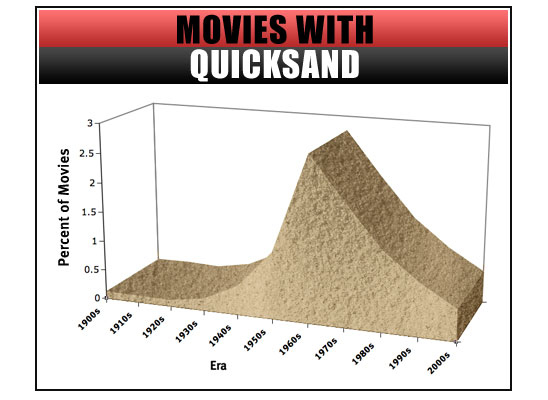
Quicksand
Harold rescues two men from Quicksand


I really miss quicksand it used to be everywhere "nearly 3 percent of the films in that era (the 60s) showed someone sinking in mud or sand or oozing clay". But you just don't see it anymore. It has sadly gone the way of grappling hooks and that using a knife to slide down a sail trick.


Abseiling
A guy they are trying to catch uses a rope to escape.


Forced Marriage
Williams daughter is married by herself with a priest slapping her.


The princess bride marriage is also forced

God's Hand
Monty Python style God's hand comes from the clouds.


Which is a bit like having a miracle man around


Sword Fights


And the tapestry has all sorts of other stuff you see in matinee adventures like horse chases, giant animals, oaths, dragons and divine heavenly light


In Table form you can see the genre cliches


Obviously the Bayeux Tapestry served many purposes at the time. But I think we might underestimate one of those was entertainment. You could remake this story now as 'Indian Jones and the Norman Conquests', it is already in comic book form.

Tuesday, September 14, 2010

Thoughts on France

Some things I noticed on a recent trip to France. None are earth shattering.

1. The Rise of the robots. The Hotels, McDonalds the Petrol Stations are all computer booths.


I can think of a few reasons for this. The French all seem to have credit cards so that makes it easier to have card run business. It also means that most shops look at you funny if you try pay with a 50 euro note.

I have heard French labour laws make hiring/firing people difficult so maybe using machines is efficient in a high labour cost country.

Eventually the same effects will happen here and many of these sorts of jobs will be automated in the next few years.

2. Desperado beer is inexplicably popular given how much good booze France has.


You see aisles of the stuff, people in queues have six packs of it. The only explanation I can think of is that wine has become stronger recently leaving a gap in the market for stronger beer. still this stuff is only 5.8% so though strongish it does not fill in the 8% light wine gap.


3. Sophie le giraffe. It is like a secret society. Parents around Ireland have been sneaking in this teething aid. Some friends smuggled back 4 for their friends. I was aware of the child minding powers of savanna ungulates. They have a series of creches here but whoever starts importing these into our homes in Ireland will make a few quid


4. "All our beef is French and Irish" Most restaurants had a sign like this displayed. This was the only non local food that was advertised as such. Our farmers tend to come across as EU sponging yokels but if Irish beef is the one food that is displayed as not French they must be doing something right.

5. An active lifestyle is encouraged which is good. There was via ferrata all over the area of the alps I was in and phone numbers to check canyoning conditions for particular rivers. I presume the French avoid getting constantly sued for this sort of fun.


Basically France is a great spot for your holidays.

Monday, August 09, 2010

Cat Bubbles

For something to be a bubble its price probably has to increase faster than inflation. People have to believe that other people believe it will increase in price forever. This is the madness of crowds effect like tulip mania in the 1600's where the price of Tulips rose to ridiculous levels.

I have heard arguments recently about higher education in the US being a bubble. But what about Pets? Animal based bubbles have a long and fun history. For example Alpaca's and Ostriches twice have been bubble commodities.

There is a really interesting article on how spending has changed during the recession here. It presents this table


From these figures could pets also be a bubble? The cat has hardly changed in thousands of years. Certainly not enough of a recent efficiency increase to make it worth a 14.4% growth in costs. So keep an eye on the costs of pet ownership especially of the fancier breeds to see if bubble thinking comes along.

Wednesday, July 28, 2010

Evacuating the Love Parade

An important issue for crowd safety is how long it would take to evacuate a venue. Like the last article this is not to attempting to figure out the exact right answer to how large entrance/exits need to be but to try see if someone with a limited knowledge and a search engine could easily see in advance that the entrance/exit to the love parade was dangerous. Even large venues can require evacuation in the case of a natural or manmade disaster. These disasters could be weather related as happened here here and here. In the case of man made safety risks venues also are sometimes evacuated. As described here
"On December 12, 2004, the stadium Santiago Bernabeu in Madrid was evacuated because of a bomb threat.... In eight minutes, more than 70,000 people left the premises without incident."

The respected Spiegel says

"Much of the critique has centered around the fact that the tunnel where the panic took place was the only entrance to and the only exit from the party site. "
If this tunnel was the only exit available (another tunnel seems to have been reserved for emergency vehicles) how quickly should people have been able to exit?

This soccer stadium with a capacity of over 25,000 claims 'The target evacuation time for the entire Stadium at full capacity is 8 minutes.'

This document on evacuation planning states
"The maximum Emergency Evacuation Time for sports ground varies between two and a half minutes and eight minutes"

Stadiums do not have as much free space as larger venues but they still allow for moving people onto the pitch as happened at a baseball game after the 1989 San Francisco earthquake. In the case of some natural disasters or terrorist threats a site wide evacuation might be needed so even large sites probably need to be able to be evacuated reasonably quickly.

The acceptable evacuation time for a stadium seems to be under ten minutes. If Spiegel is correct and this tunnel really was the only exit any evacuation would have taken hours which is not be acceptable.

The pictures here give a very good impression of what happened. The width of the tunnel does indeed look like 16 meters. And the 'ramp' described earlier just looks like something people tried to escape up rather than a designated route.

Monday, July 26, 2010

How many people can pass through a tunnel?

A tragedy happened at the love parade when 19 people lost their lives. This will be investigated by professionals who will come out with detailed analysis on how this incident took place. I want to see what someone in half an hours worth of searching can say about how wide a tunnel you need to fit that number of people.

I worked as a volunteer at the special Olympics some years ago. The job mainly involved making sure spectators could get into and out of the events easily, that emergency services can easily gain access and that spectators and athletes were kept separate. The venues were not huge and the spectators were happy and sober. Still I got some impression of the kinds of things needed to ensure crowd safety at events.

I want to put a figure on how many people could safely fit through the tunnel that was the sole access point to the love parade venue. A 16 meter width is given by most media outlets.

But some say it is 30 meters wide. Most seem to put the number of people there at 1.4 million but others at only 500,000 'an event set up for 250,000 ended up with an estimated 500,000 to 1 million'.

How long does it take to get everyone into a venue? How many people an hour will try enter a venue? I do not think all 1.4m people try enter in an hour. But I would guess most people try to enter a venue in a three hour period. Each hour you could expect over 300,000 people to try and enter through the tunnel. People are unpredictable meaning that you would need to be able to have more than this safely in case loads turn up at the same time.

Who else deals with crowd volumes like this? Every few years during the Muslim Hajj there is a crowd related accident. They are building a new bridge to improve safety. There is a description of this bridge here (pdf).
the new, multi-level bridge structure which will accommodate and ease the flow of 3 million worshippers during a single daylight period. The proposed new Jamarat bridge is a superior structure formed of 4 platform levels... each of the bridge’s 4 floors is roughly 600 m-long, with variable widths (ranging from 60 m to 97 m

The engineers describe these 4 floors as at least 60 meters wide. Each 60 meters in width is supposed to handle .75 million people if scaled linearly to 16 meters that would be 200 thousand people during the day. The new Saudi bridge is designed with a much larger channel to move people than they had in Germany. Pilgrims may act differently to other crowds as they stop to perform religious ceremonies.

Another terrible crowd incident was the Hillsborough disaster where 96 people died. A quick search about football crowd safety found this document. It is a very interesting article and well worth a read

The document states
"the safety limit for crowd density is defined as 40 people in 10 square metres for a moving crowd" the tunnel at 16m wide and 100 meters long should only hold 6400 people. Walking at 38 meters per minute. 100 meters would mean it would take 156 seconds to get through the tunnel. 6400 people every 156 seconds is 147,000 in an hour. This means it would take ten hours for 1.4 million people to safely travel through.

Reuters here states
"Authorities have not yet been able to explain how exactly the tragedy happened -- near a tunnel that led to a ramp into the festival grounds. Most of the victims were found dead on the ramp and none in the tunnel, authorities said"

The football document also in Section '2.8 Wembley Complex Station' gives this equation
No. of Units of Exit Width = Number of Persons (1)
required (each width = 0.55m) Flow Rate (2) x Evacuation Time (3)

"Where number of persons (1) means the maximum number of people that could be expected to be on a platform at any time. Flow rate (2) means 40 persons per minute for escape routes incorporating stairs, and 60 persons per minute for level escape routes (without stairs). Passenger walking speeds should be assumed to be 38 metres per minute for horizontal circulation."

Using the Wembley equation above 16 meters *.55 meters means 29 people can safely span across the tunnel. 40 flow past a minute if the escape route has a stairs and 60 if it is flat. The ramp sounds like it would hinder flow in a similar way to a stairs.

Once again this is all back of the envelope and as more facts come out a much better estimate of how many people could safely negotiate the site will emerge. A reasonable estimate of the number of people who could travel through the tunnel in an hour is (tunnel width/person width)*number or people per minute * 60 minutes
which in a 16 meter wide tunnel with a stairs at the end is (16/.55)*40*60=70,000
Best case scenario with a wider tunnel and no stairs 30 meters/.55 meters *60 people *60=200,000 which is less than the expected number of people.

This calculation indicates that a cursory look at at the venue entrance would give someone grave concerns about safety for a smaller crowd than turned up on the day.

Tuesday, July 20, 2010

Science grows 2.5% annually why doesn't the economy?

What causes economic growth? Much of the world still lives in grinding poverty, figuring out a way to get them out of this is important. The best way seems to be for their economy to grow.

There are many theories as to what causes economic growth. The founder of Google claims
"Virtually all economic growth (in the world) was due to technological progress. I think as a society we're not really paying attention to that," Page said. "Science has a real marketing problem. If all the growth in world is due to science and technology and no one pays attention to you, then you have a serious marketing problem."

If technological progress causes growth there should be a link between the amount of scientific progress and the amount of growth. Here is a very interesting article about the rate of the increase in scientific knowledge.

'What I found, using this simple proxy for difficulty, in each field — biology, astronomy, chemistry — was a curve with the same basic shape. In every case, the ease of discovery went down, and in every case it was a curve called an exponential decay ...[I] discovered asteroids get 2.5 percent smaller each year. So while the ease of discovery drops off quickly as early researchers pick the low-hanging fruit, it can continue to “decay” a long time, becoming slightly harder without ever quite becoming impossible"

Say science increases in the level of knowledge by 2.5% a year.

What is the rate of economic growth? 'Since 1820, world development has been much more dynamic. Per capita income rose more than eightfold, population more than fivefold.' 190 years growth 8 fold increase is a growth rate of about 1.1% per annum. Or for two specific countries the UK from 1830 to 2008 had average real GDP 1.97%. The US 1830 to 2009 real GDP of 3.62%.

Other things cause economic growth

-Demographics more people of working age means more stuff gets made.

-Institutions. The rule of law matters. If people think anything the build will be plundered off them they wont build much.

-Governments. Some ways of running a country seem to result in more economic growth than others. Communism was never that good at creating economic growth for example.

-Taxation. At a certain point if you tax people too much they wont work anymore. If you dont tax people enough you might not be able to afford schools. Knowledge of what level of taxation is beneficial to economic growth should improve over time.

-Financial innovation. By getting capital to the people who best use it financial innovation is supposed to help economic growth. If it doesn't we should not spend money bailing out investment banks.

-Foreign aid: Aid to developing countries seems to have a mild positive effect on their economic growth rate though in specific areas it seems to have a negative effect

What else can affect economic growth and how great an effect does it have?

Monday, June 07, 2010

How scared should you be of nut allergies?

The wife today was selling nuts and parents kept telling her that nuts were banned in their kids school to prevent deaths from nut allergies. How many life years are saved from banning nuts in schools versus those lost through not eating nuts?

I will look at American figures as they are available and have a large sample, which are both handy. "about 150 people die annually from serious allergic food reactions" which compares with "2,000 children drown each year" according to here. So 150 people out of the 2.5 million who die each year in America die from some food allergy. Imagine all these people had 80 years left to live. You have lost 1200 human years.

Now if you happen to be the one with the allergy you would want some reasonable precautions taken. My argument here is a guesstimate on how the over anxiety about how nuts might affect us.

“We try to relieve anxiety about nut allergy by signs saying, ‘this is a nut free zone,’ which suggests that nuts are a clear and present danger,” Dr. Christakis said. “But in doing so, we increase the anxiety.” So imagine this sort of fear of nuts made everyone stop eating nuts. How many life years would be lost? "those eating nuts daily had up to 60% fewer heart attacks than those who ate nuts less than once per month". Given four hundred and fifty thousand people die each year from heart attacks. Preventing 60% of these would be 270 000 lives. Say you only saved one year off each of these that is 270000 life years as opposed to 1200 from banning nuts. This 60% figure seems really high but other studies show massive improvements here and here says '1 ounce of nuts more than 5 times/week can result in a 25 to 39 percent reduction in coronary heart disease risk among people whose characteristics match those of the general adult U.S. population'.

Now just because people who eat nuts don't get heart attacks does not mean the nuts stop the heart attacks. But the googleable studies take this correlation versus causation problem into account. Also banning nuts in schools and telling kids they might kill people wont stop all nuts being eaten. But its not hard to imagine these warnings will severely curtail nut eating.

Not many kids have nut allergies. So a blanket ban without good reason wont save many lives. There is good evidence eating nuts is very good for your health. It is reasonable to assume telling kids nuts could kill them wont encourage them to eat them.

I think this nut fear illustrates a problem many of us have with comparing sudden risks with long term risks. For example when schools ban running by kids because they might be sued but they ignore the long term health effects of kids not exercising. There are risks everywhere but when someone wants to minimise one it is worth asking how dangerous that risk is and what consequences minimising it will have.

Monday, May 24, 2010

Eurovision Voting Fraud

Forget hanging chads in Florida. Some really important vote rigging is about to happen.

I was investigating the Eurovision Song Contest last week as a prediction problem. No really it is an area of major research into how corruption agreements implicitly develop between countries. There are papers here, here and here.

But then I saw the odds for this year and there is something really odd happening. The odds from Paddy Power are here
Azerbaijan 11/8
Germany 4/1
Israel 9/1
So Azerbaijan a country that no one can spell is hot favorite. Which would not be too suspicious if they had ever had a song that wasn't entirely made up of goats being strangled before. The singer Safura and her Drip Drop has her obvious talents on display but is there something odd going on here?

Wikipedia says
After the conclusion of 2009 Eurovision, it was reported in Belarusian media that unknown people had allegedly paid and bribed students from Belarus to vote for Azerbaijan in the contest, and had even transported them to the Belarusian-Lithuanian border in 10 buses. The cost of this alleged action was claimed to be about 55 million rubles. They purportedly voted for Azerbaijan using Belarusian SIM cards, and then received Lithuanian cards to repeat the process. The Azerbaijani entry "Always" received 10 points from Belarus and 5 points from Lithuania.

So why does an old soviet country, with a pretty dodgy political system, that is 95% Muslim want so badly to win the worlds gayest contest? Turns out its a giant fight with Armenia. There is a war going on between them using the Eurovision as a battleground. I cannot wait till they get Johnny Logan in as a peace negotiator.

The Azerbaijan state broadcaster blocked out the voting number for the 2009 Armenian entry like some corporate logos in a rap video. Then and you can only read this in a full Borat accent "in August 2009, a number of Azerbaijanis who had voted for Armenia's entry during the 2009 Contest were summoned for questioning at the Ministry of National Security in Baku, during which they were accused of being "unpatriotic" and "a potential security threat". One of those summoned, Rovshan Nasirli, said that he was told by his interrogators that they had the names and addresses of all 43 Azerbaijanis who had voted for Armenia".

What is the cause of all this? According to the over 2000 word wiki article on the "Armenia Azerbaijan relations in the Eurovision Song Contest" it is Nagorno-Karabakh an area they both claim.

So it looks like Azerbaijan are willing to buy masses of fake simcards, bus people to other countries, bribe students and track down a few dozen people who voted the 'wrong way'. I wonder what is going to happen this time now that they seem to take the eurovision seriously?

Friday, May 21, 2010

Craig Venter creates synthetic life form

There are stories about this everywhere. But one quote from wired sticks out

“Over the last five years the field has seen a 100-fold increase in the length of genetic material wholly constructed from raw chemicals,” said synthetic biologist Drew Endy of Stanford University. “This is over six doublings in the max length of a genome that can be constructed.”

Doubling in abilities in less than a year is amazing. Pretty much any exponential improvement like that ends up being a big deal if it carries on for a reasonable length of time. This is 1 million base pairs of synthetic DNA. A human is 3 billion base pairs. So at this growth rate that is less than 12 years. Not that you would artificially create a human or anything but it gives you some impression of how rapidly this technology could develop.

Sunday, May 02, 2010

NO DEPOSIT...NO WORRIES

If we do not learn our lesson from the property bubble and collapse we will wind up back in the same trouble again.

There is a semi ghost estate on my bus route. It is beside the M50 beside Finglas and an area called Scribblestown in murder news reports. The estate is opposite and beside a halting site.

This Heathfield estate seems less than half full. This week I noticed the sign they have flogging houses had a new banner on it. "NO DEPOSIT...NO WORRIES"


We have learned nothing.

Tuesday, March 30, 2010

We Hate You. Please Save Us

There is an episode of the Simpson's where Springfield unites against Lisa Simpson who questions the veracity of an angel skeleton. In a very short time, the citizens launch a mob attack against the town's scientific institutions, Moe decides to destroy the skeleton of a woolly mammoth at the Springfield Natural History Museum, yelling "Take that, science!" Predictably, the tusk falls off, crushing him. "Oof, I'm paralyzed," observes Moe. "I only hope medical science can cure me."

Ireland will be saved by science. Here is a document from the Taoiseach about the new smart economy.

One main idea is to "invest heavily in research and development, incentivise multinational companies to locate more R&D capacity in Ireland, and ensure the commercialisation and retaining of ideas that flow from that investment;"

So how does Ireland treat science? Well take the LHC launched fully today. There is a great article here about the disdain this project is meet with by our government. We won't spend the 10 million annually that would make us a part of the project.

Not that no Irish people are helping out but they have to work with foreign research groups if they want to help figure out how the universe works.
“Nobody knows what is going to happen, that is why we are doing it,” stated Dr Steve Myers, the Irish physicist in charge of the largest atom smasher ever built.

So no 10 million annually out of a total of 6.5 billion it will cost to work out how the nature of the universe.

Irish scientists are not valued either. There is a poll of the greatest Irishmen of all time. There is no scientist on the list. Dr Noel Browne is the closest but he is there as a politician. No Walton, Robert Boyle or William Rowan Hamilton.

But you do have Joe Dolan, Colin Farrell, Stephen Gately, Ronan Keating, Daniel O'Donnell and Louis Walsh.


We have space for Daniel O'Donnell but not Nobel prize winner Ernest Walton. We don't have 10 million for CERN but we do have 32000 million for the governments friends.

What can you say? I'll leave it to another Nobel prizewinner

What need you, being come to sense,
But fumble in a greasy till
And add the halfpence to the pence
And prayer to shivering prayer, until
You have dried the marrow from the bone?
For men were born to pray and save:
Romantic Ireland's dead and gone,

September 1913
William Butler Yeats

Friday, March 19, 2010

Influential Books

Marginal revolution has an article on the 'books that influenced the me most'. There is a follow up article of others lists here.

No one in these lists seems to mention the Bible. And few the Odyssey and Iliad. Aesop and the brothers Grimm also seem to be ignored. Hansel and Gretel, Rapunzel, little red riding hood, Cinderella, Sleeping Beauty, Snow White, Rumpelstiltskin all come from one book. They are pretty much ubiquitious in the lives of children of my age even if they did not read the original.

Is it naive to think that these stories we heard as children probably influence our thinking far more than books read after our teenage years?

I seriously doubt there are many westeners who don't consider the three little pigs as a moral lesson more often than those from anarchy the state and utopia.

The most embarassing book most of the list writers will admit to is something by Ayn Rand which they now disown. But why is Atlas Shrugged allowable on the road to where they are but Rip Van Winkle and the works of Hans Christian Andersen's are ignored?

By most influential do we mean the book your willing to admit to that you think about while debating people? Rather than the ones that are so ingrained in our lives that they serve as a backbone to how society operates.