Andy Kirk here has an interesting blog post on
dendrochronology and visualisation literacy.
Here is an example of a
tree ring visualisation showing how over time the tree grows and leaves down rings.
I am going to visualise another time series expected lifespan.
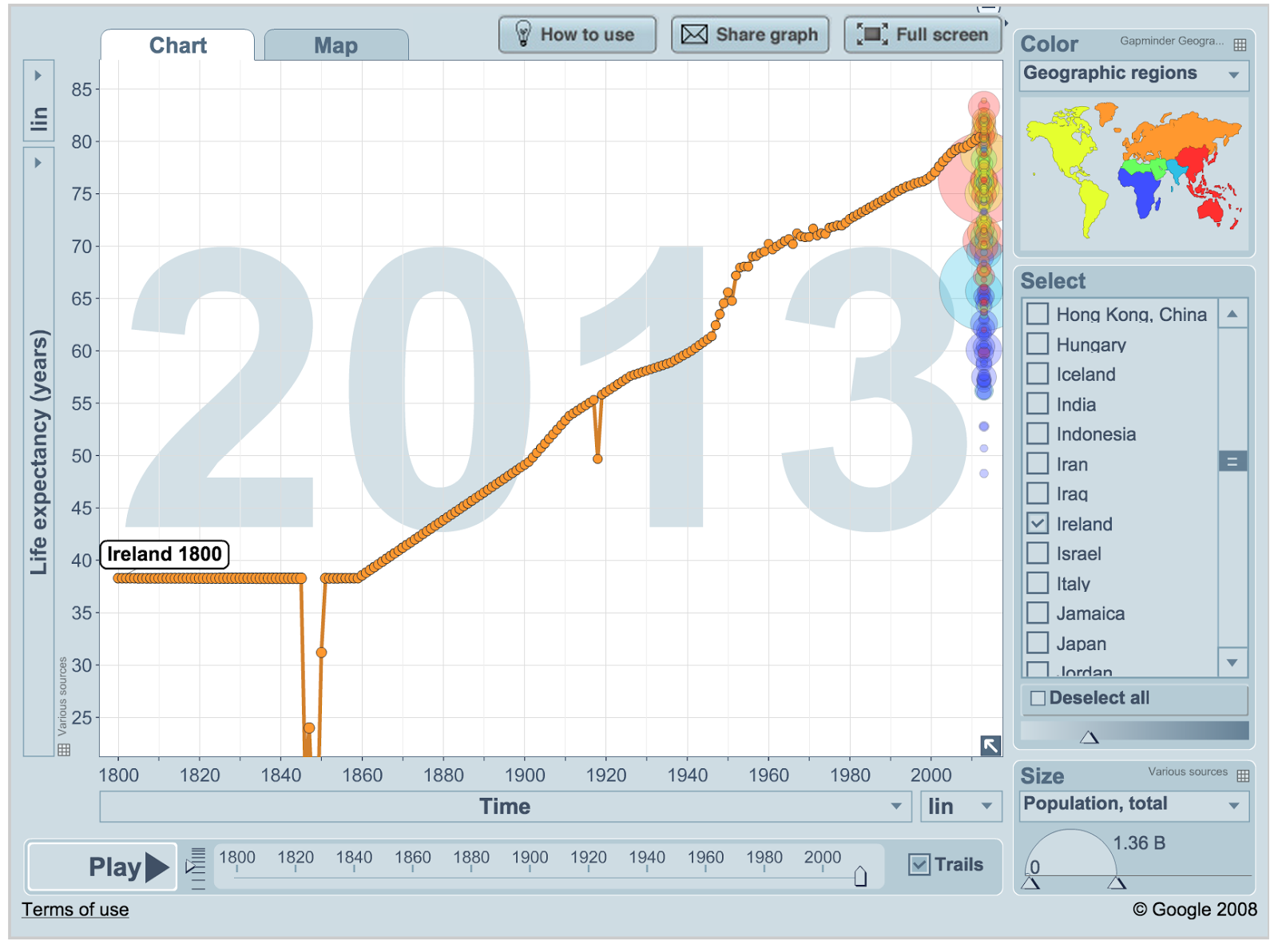
Gapminder uses a line graph to visualise life expectancy over time. I downloaded the life expectancy data from gapminder.
The interesting points here are the famine where the life expectancy dropped from an estimated 38.3 to 14.1. Also the 1918 flu epidemic causes an obvious drop from 55.3 in 1917 to 49.68 and back to 55.8 in 1919.
I use this data to create a graph using the code below. The idea is like tree rings except that instead of each line laid down in a particular year each line represents the life expectancy in that year.
The size of each ring should be a good representation on the number of years people could expect to live in that year.
However I just multiplied the years given by Gapminder *6 to give the number of pixels each circles radius should be. A proper visualisation has to be more careful not to distort the number than this. Roughly, living twice as long should look like a tree that is twice as big.
The code to create this graph in a canvas element of a webpage if
here. So what do you think, does this visualisation show increase in lifespan in the last 200 years well?