It seemed dreadful to see the great beast Lying there, powerless to move and yet powerless to die, and not even to be able to finish him. I sent back for my small rifle and poured shot after shot into his heart and down his throat. They seemed to make no impression.
I read Orwell's essay ages ago and figured it pretty much had the elephant execution story covered. Looking back I was amazingly naive about quite how many bizarre possibilities for dispatching pachyderms existed.
2. Electrocution. In order to show that his DC current was a great idea Edison decided to show AC was really dangerous. So he got Topsy the elephant and electrocuted her. Which is a massively dick move anyway you cut it. He also invented and sold the electric chair to execute criminals as a similar negative publicity campaign against AC current. The video he produced is here
3. Shooting. Tyke (elephant)
Police fired 86 shots at Tyke, who eventually collapsed from the wounds onto a blue car and died. This video is of Tyke's attack and later shooting. I am not going to embed it as it is frankly horrifying.
4. Harpooning. Chunee "Kneeling down to the command of his trusted keeper, Chunee was hit by 152 musket balls, but refused to die. Chunee was finished off by a keeper with a harpoon or sword". Having to harpoon an elephant has to be the definition of a hard day at work.
6. Lightening "Norma Jean, struck by lightning, c. 1972, during a circus parade in Oquawka, Illinois. She was buried where she died, and a marker now lies on this spot."
7. Drowning (ish). Dan Rice was a sort of PT Barnum character. He ran loads of stunts to advertise his various travelling circus events. One of these for one poor elephant was "In August 1860, Rice had Lallah Rookh swim across the Ohio River in Cincinnati, Ohio to drum up publicity for his new "Monster Show." It took her 45 minutes to swim across the river. A month later, Lallah died of a fever brought about by her swim".
8. Burning. In 1681 an elephant was burned to death in Dublin. How the poor creature got to Dublin at that time is difficult to imagine. But then to have your crate set on fire is just tragic. The autopsy revealed information that later helped show elephants had evolved from an aquatic animal. "An anatomical account of the elephant accidentally burnt in Dublin on Fryday, June 17 in the year 1681" is Allen Mullen's description of the autopsy
And the weirdest one, and I realise that is saying something, is not an execution of elephants but by elephants. Most of the elephants killed listed above had killed a person. But elephants were once a really common. Apparently death by Nelly was wildly popular from prehistoric times up until the late 1800s. Execution by elephant is an incredible wikipedia page, hard to extract from but worth reading through.
Because elephants are so easy to train and because an elephant standing on your head was such a gruesome way to die most south Asian countries seemed to practice it.
I do not know what the wide an varied history of death of and by elephant tells us. They are all pretty tragic tales. Recently an elephant escaped in Cork . Then later crushed one of the circus workers. It seems the same sort of issues that killed Chunee, Mary, Tyke and many people who have been killed by performing elephants still exist and that more than these historic stories is a tragedy.
Punk Rock Operations Research has recently been talking about the birthday problem. This problem asks how many people have to be in a room for you to have a 50% chance of two of them sharing a birthday. The usual answer is 23 people.
However as The Birthday Problem and The Birthday Problem with a mating season: A simulation approach post say because Seasons Sway Human Birth Rates the assumption the birthday problem makes of a random sampling of people usually will not hold. This clumping of people births means that the birthday problem could have a lower number than usually supposed. Think of it this way, if everyone was born on January 1st you would only need two people to be sure of having a matched birthday. In the same way if births are clumped and not evenly spread the number of people needed to get a shared birthday should drop.
I found a good dataset at An Analysis of the Distribution of Birthdays of 480,040 birth dates. This is ideal for a simulation. Presumably the US census has even better data but I can't find it.
The files used are bday.txt. This is in the form
0101 1482
0102 1213
0103 1220
0104 1319
Also a file with equal numbers of birth each day here
This code is to calculate the average number of people you need to add to a set for two to share a birthday. Which is slightly different from the original birthday problem. Knuth studied this variant and came up with a figure of 24.616 people assuming 365 days in a year.
#!/usr/bin/env ruby -w

puts 'Birthday simulation'

#binary search function I stole
def binarySearch(sortedArray, first, last, key)
   until first > last do
       mid = (first + last)/2
       if (key > sortedArray[mid])
           first = mid + 1;
           binarySearch(sortedArray, first, last, key)
       elsif (key < sortedArray[mid])
           last = mid - 1;
           binarySearch(sortedArray, first, last, key)
       else
           return mid;
      end
   end
   return first;
end

#binarySearch Test
#sorted_array = [1, 5, 6, 10, 5, 25, 40, 78, 100, 130]
#p binarySearch(sorted_array, 0, sorted_array.length-1, 1)

total=0;
matches= Array.new; #array holding how many people so far have this
found= Array.new; #have we seen this day before
tried=0;  #how many people had to be tried
i=0;

#First load an array with numbers that correspond to days. Day 0 is 1482 people, day 1 1482 upto 1482+1213 etc

#for the real dataset
File.open('bday.txt', 'r') do |f1|

# and with the everyone born randomly
#File.open('normal', 'r') do |f1|
  while line = f1.gets
    parts=line.split;#get the second number part of the line
    total=total+parts[1].to_i;
    matches[i]=total;
    i+=1;
  end
end

puts total; #sum up all the values

j=0;
matchFound=0;
totalDays=0;

while j<10000#00
where= binarySearch(matches, 0, matches.length-1, rand(total));
tried=tried+1;
 if found[where] ==1
  totalDays=totalDays+tried;
  tried=0;
  found.delete(1);#empty the array for another simulation run
  matchFound=matchFound+1;
 else
  found[where]=1
 end
 j+=1;
end
ans=(totalDays.to_f/matchFound.to_f)
puts "average birthday number ", ans;
This code with the same number born every day gives a birthday number of
24.0194321675634. And with the real bday.txt dataset from Roy Murphy gets the result of 23.9779163169884.
This code needs a complete rewrite. This code is fugly and wrong. I tried writing this piece a few years ago and failed so I'm just glad to get it out the door. Also I have to make allowances for the dataset size and the number of simulations run.
Other problems with the birthday problem revolve around getting a random sampling of people. About 1 in 80 births are of twins. So an average of one in every 40 people is a twin and twins tend to hang out together.
This dataset comes from life insurance forms. Which could be biased in that Jan 1st seems to be too popular. It could be what a form defaults to. Maybe life insurance selects for people born at a certain time. It could be that rich people buy life insurance more and rich people are more often born in a particular month.
Professions seem to clump around certain birth dates. Malcolm Gladwell points out in Outliers that professional athletes tend to have birthdates that make them old when they play under 8,9,10 and 11's sports. Kary Mullis in "dancing naked in the mind field" professes his support for astrology saying “A recent scientific study of the distribution of medical students in birth months discovered that a lot of medical students were born in late June”. If this is right then some other professional groups clump in age.
Mullis is an interesting person, and his book is very entertaining. By the time he describes his meeting with an extra terrestrial glowing raccoon you know he is nuttier than squirrel shit. Partly it is this oddness that helped him win the Nobel prize brilliant "What if I had not taken LSD ever; would I have still invented PCR?" He replied, "I don't know. I doubt it. I seriously doubt it.". PCR is used to amplify DNA fragments and is a major tool in convicting rapists, murderers and other criminals.
While on the subject of doing calculations on peoples births. Laplace did a calculation showing more baby boys were born in France than girls. Which is one of the founding calculations of probability theory.
The birthday problem turns out to be lower than people claim. It also has enough weirdness involved in the randomness assumption that it is a good illustration that people just aren't random.
When I was a kid my main ambition was to fill out the Panini Italia 90 sticker album. I promised myself when I was old and rich I would buy all the stickers I needed to fill out a championship sticker album. Some kids aim to play for Ireland, I aimed low. Turns out I am not rich but I am nerdy so at least I can work out how much it would cost to fill out the album.
This is called the Coupon Collector Problem. "Given n coupons, how many coupons do you expect you would need to draw with replacement before having drawn each coupon at least once?"
There are 539 stickers in an album to collect. The first sticker you buy is going to be one you need, a 539/539 chance of getting one you need. The second has a 538/539 chance of being one you do not have as there is one it can clash with. This keeps going until for the last sticker every new sticker has a 1/539 of beng the right one. The formula for the number of attempts you would need to calculate the coupon collector number is 539*Harmonic Number of 539. Which according to Wolfram Alpha is 6.867858*539=3701.77. The stickers are sold in packs of five. Which means 740 packs.
On amazon a box of 100 packs cost £43.95. This would mean (assuming you could get .4 of a box at that same price) that filling the album would be expected to cost 325.23 pounds.
Panini sell the stickers at 14p each. So to buy the stickers individually would cost 539*.14=75.46 pounds.
Is there some kind of mixture of boxes of random stickers and individual ones that means you can fill in the album for as cheap as possible. Say the individual stickers can be bought at the price of a box. So thats 0.1162 pounds for each sticker. Which is not that much of a saving. It becomes more efficient to buy individual stickers than random packs at this price after about 90 stickers.
The last sticker takes on average 539 stickers to be bought to find it. So this last sticker costs 0.1162*539=62.63 pounds if you buy it in packets not individually.
But are the tickets independent? As in are some rarer than others and is each pack random? Some people studied this in the very cool paper 'Paninimania: sticker rarity and cost-ef fective strategy' "We consider some issues related to the famous Panini stickers devoted to the football world cup. In particular, we address the following questions: is there a planned shortage of some stickers? What is a good cost-e ffective strategy to fill in an album?" Which proves amongst other things I am not the only nerd that still wants to fill in a Panini album.
The myth of the rational voter is a great book by Bryan Caplan about how democracies make predictable errors because people are biased against certain beliefs. The video below gives a good synopsis of his arguments
The belief that people having incorrect beliefs will not be a problem is called "The miracle of aggregation" where people don't know much all disagree with each other and those small number of people who do know something are the ones who are left after all the noise is cancelled out. But because these beliefs are not randomly wrong but biased to one side this cancelling out doesn't happen.
He talks about the economic areas of being anti market, making work for the unemployed, anti foreigners and that people are too pessimistic and how general opinion on these issues disagrees with that of economists. You could argue that the people are right and economists wrong on these issues but generally people who are experts in a field tend to know more about it. If you disagree I am available for entirely unqualified and haphazard brain surgery if you want to put your brain where your mouth is.
But what about non economic questions? Are there scientific questions people get wrong that might result in voting based on a mistaken view of how the word works. There is a poll about scientific question that takes place across many countries called the National Science Foundation, Science and Engineering Indicators which asks what it thinks are basic science questions everyone should know the answer to.
If many people get the wrong answer about these questions, and the question is important from a policy point of view then this poll will show an area the voter is likely to be irrational about and we will get bad policy in that area.
· The center of the Earth is very hot. (True) 78.0% of Americans in 2006 got this right. A politiician who did not believe this might have a hard problem supporting geothermal heating. But geothermal is not that big a source of energy so it would mess things up very badly.
· All radioactivity is man-made (False) 73.0% got this right. Without realising this you might overestimate the risk man made radioactivity is going to cause. I am willing to bet the 27% of people who didn't know this might be less in favour of nuclear power stations. But I really don't know if more nuclear power is a good policy. Lovelock and Brand say it is. Unless I can prove the connection between holding the belief that all radioactivity is man made and being anti nuclear power it is a stretch to claim this false belief harms us.
· It is the father’s gene that decides whether the baby is a boy or a girl (True) 62.0% got this right Many parents want male children and without realising this then women could get blamed as the female kids are their fault. I'm not sure what political policies would change if you did get this wrong though. Sex selective abortion seems wrong whether you understand the y chromosome or not.
If more people understood the sperms role in sex selection more sperm sorting techniques could be used. This might result in lower numbers of children in those who want to 'balance out' their families.
· Electrons are smaller than atoms (True) 45.0% Similar issue with understanding one of the main sources of income in a modern economy. Could someone who got this wrong really hope to decide between investing research money in on scientific field or another?
To be fair I might get this question incorrect. Electrons do not really have a size. As wikipedia says "the electron has no known substructure.[2][72] Hence, it is defined or assumed to be a point particle with a point charge and no spatial extent". This question is a bit like asking is a car smaller than hope. The question doesnt really make sense.
· Antibiotics kill viruses as well as bacteria (False) 54.0%
This one is really important. Overuse of antibiotics is making them less effective. Megan Mcardle has a great piece on the problem here.
Some people give antibiotics credit with increasing our life expectancy by about 8 years and no one thinks they have had a tiny role in our large life expectancy increase during the 20th century.
Getting antibiotics policy wrong is a really big issue and one the public get wrong. You don't hear politicians on the "If you vote for me you wont get penicillen for your earache" platform. This is an important issue probably up there with the economic ones Caplan describes in his book.
I have heard Michael Graham on Irish radio saying he doesnt care about politicians opinion on evolution because it will not effect how well they govern. The case of antibiotic resistance shows how important it might be to have politicians who accept evolution as it is in progress in this case limiting the power of one of our most important healthcare tools. I get the feeling many of these questions are actually about aligning yourself with literal interpretation of the bible rather than science knowledge.
This is one area public health campaigns are trying to explain
· The universe began with a huge explosion (True) 40.0% This is another question I might get wrong. Calvin and Hobbes described the big bang as the 'Horrendous Space Kablooie' which might be more accurate than calling it an explosion.
I can't see this issue having a big effect on policy though. The "if i am elected I will combat the inflation of the universe" party probably won't change much.
· The continents have been moving their location for millions of years and will continue to move in the future (True) 77.0% You might have a pretty weird view of earthquakes if you didn't believe this but again I can think of no specific policy issue you are likely to get wrong
· Human beings as we know them today, developed from earlier species of animals (True) 50.0% What policy would someone who did not believe this get wrong? Some medical ones about the usefullness and ethics of animal testing maybe. There must be more then that though. If you can think of any specific policy people who don't know the right answer voting on would cause harm please add it in the comments.
This is a question the majority is not right on. So if there is a policy question that this deals with it could be one where those that know the correct answer are drowned out.
Not to go all Karl Popper on this but I could also argue about which of these are true/false and which are the current best theories. I think most cosmologists would put a higher probability on the big bang theory being overtaken then the heliocentric solar system one. Also there would be a higher certainty on all these theories than any of the economic ones IMHO. But that does not mean I couldn't argue with the phrasing.
Does the Earth go around the Sun or does the Sun go around the Earth? (Earth around Sun) 71.0% got this right. I'm not sure you can say the earth goes round the sun. It move in a eliptical orbit with the sun at one foci. If a politician actually believed the sun went round the earth would it specifically result in any bad policies? As opposed to general worry about his intellect? Not any I can think of.
If you know of any other polls of the public belief about scientific questions please post them. Based on this one survey (results for other countries here) On antibiotic control policy the public is likely to support the wrong policy.
Other than economics and science are there other areas the public is probably supporting policies the vast majority of experts in the area disagree with? Public Health and Criminology experts probably disagree with policies politicians run on and people vote for. I would like to see any polls that would show this.
The household charge website security questions pictured above are awful. This charge is a new tax the Irish government has created where most people with a house in Ireland are supposed to register online. These are questions you can use to prove your identity. But the ones they have chosen are really weak. There are three main methods to attack them.
Social Engineering: Ask someone, set up a website the user trusts "TrustyBank.com" and ask them this question again
Brute forcing or guessing via statistics: Murphy is a really common name guess that. Then Kelly, Smith, O'Sullivan, Walsh, Ryan, O'Brien, Byrne... you can guess someones surname most of the time in a low number of guesses. Pets names are surprisingly guessable (low entropy). The names people use are not that unusual. This site has stats on the most popular ones. The most common entered place of birth will be Dublin. Similarly Companies are not based in many places. Dublin will be a correct guess in many cases. Next I'd guess America, Ireland, Home... again there are likely to be very common answers to this.
Looking at these questions I would predict 10 answers of each will cover 50% of the population.
What is your mother's maiden name? In what county where [sic] you born? What is the city, state/province, and year of your birth? What is your pet's name?
So all the questions except the where is your company based question are common and known to be poor. The questions on the household charge website are guessable, searchable and so common another website could ask you them without raising suspicions. They provide an obvious and well known vulnerability to the system.
“Wikipedia took the idea of peer review and applied it to volunteers on a global scale, becoming the most important English reference work in less than 10 years. Yet the cumulative time devoted to creating Wikipedia, something like 100 million hours of human thought, is expended by Americans every weekend, just watching ads.” ― Clay Shirky
I like watching the X factor particularly combined with the mockery that goes on on twitter. Something nags at me about the waste of time the X Factor is. There is nothing particularly wasteful about this program but it will do as an example.
The program consists of 31 episodes with a Running time of 60–80 minutes according to wikipedia. Taking the program as 70 minutes that is about 36 hours. I thought the Saturday program was longer than 80 minutes but I could be wrong. 'Saturday's edition of The X Factor averaged 9.6 million viewers, a 38.5% share of the audience, between 7.45pm and 9.55pm'. So lets say a series of the x factor is 40 hours of your time. a season of American Idol takes at least as long.
So what could I do in this time?
Read a book
War and Peace by Leo Tolstoy is 560,000 words. The average American adult reads prose text at 250 to 300 words per minute. So I could read that in about 31 hours reading. Great Expectations is 185000 words, about 12 hours. In Search of Lost Time by Marcel Proust at 1,500,000 would be about two series of x factor.
These are famously big books the average fiction book is about 75000 words. Or about 5 hours of reading at 250wpm. So that is around 8 novels I could read instead of x factor.
Get Strong
The Starting strength program (described here) goes from someone who has never lifted before to quite strong in three months three days a week 45 minutes a day. Say an hour to shower and such. 3 times a week for 12 weeks is 36 hours similar to the x factor
Three months of this program wont make you wrestle a bear strong but it will make you useful when helping the bear move his fridge. Everyones progression will vary but this site Weightlifting Performance Standards says that after 3 months of training like this a man could expect to be able to pick up a weight of just under one and a half times bodyweight. A woman would be able to pick a weight of around her own bodyweight.
Most people fear that as soon as they touch weights they will end up with the Arnie condom filled with walnuts look. Besides they might not have the equipment. But if instead I went for doing pressups everyday? The Hundred Press up challenge says "this six week training program and you'll soon be on your way to completing 100 consecutive push ups!...about 30 minutes a week to achive this goal!" that is 3 hours. Double the time to 6 hours in case they are lying.
Run a Race
Couch to 5km plans are really popular. "Each session should take about 20 or 30 minutes, three times a week". the guide is 9 weeks but lets say it takes 12 weeks to get that fit. That is still at most 18 hours.
You won't outrun a bear after doing this you probably will outrun some of the other people the bear is chasing though. Besides you've helped the bear move his fridge so he probably won't chase you anyway. I could nearly train to run a race and do the starting strength program in the time I could spend watching x factor.
X factor is entertaining but so are books and many people after a while find exercise entertaining at least in retrospect. I have not included 'learn a language' in the list of other things you could do as few people actually find that entertaining.
That means I could train myself to run a 5km (18 hours), to do 100 pushups (6 hours) and read Great Expectations (12 hours) and still have some time left over. I probably wont do that but at least I know what I am feeling guilty about now. There is nothing particularly bad about X factor there are much worse ways I spend my time. I could watch 40 hours of youtubes finest cat videos.
In a statement, the foundation said it “was left completely in the dark” about the Dublin publication and that “it never permitted, tolerated, condoned or connived in this publication, and it rigidly dissociates itself from it”.
It was “dismayed to learn that a copy of the letter to young Stephen Joyce of 1936 must have been used for its publication in book form. The foundation was never approached or informed, it was never asked for permission” and it had only just learned of the publication.
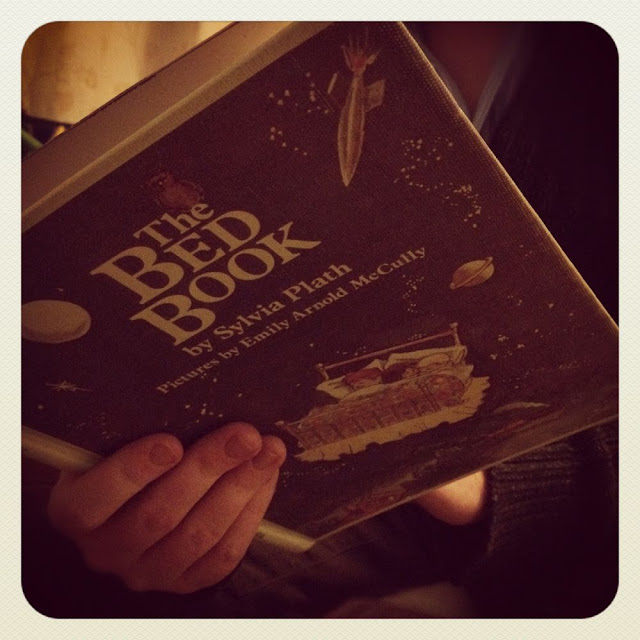
The book looks lovely. The issue reminds me of a bugbear I have where famous authors of adult literature's children's books are consigned to the trash heap of history.
I love the Bed Book. The picture is of me reading it to my daughter. Yet many Plath fans do not even know of its existence.
Why is it that these books are not well known or in print? Could it be we do not like our serious authors to show their playful and family loving side? It could be there is no demand to pay for publishing these books. That Joyce's story needed to go out of copyright to get printed is evidence against this though.
A friend pointed out this great blog We Too Were Children 'a Compendium of Children’s Books by Twentieth Century “Adult” Authors Currently Out of Print'. Do you know of any more slightly hidden childrens books by 'serious' authors? Kafka's tale of the plucky mouse who rescues the circus or some such.
A message on his T-shirt read: "Europe's greatest training robbers. Ryanair. Lowest wages guaranteed. Stop. Recruitment scamming our children."
If people really hate airlines there are much easier ways to harm their business than this. One way is to ask people to obey their terms and conditions.
Companies are still leaving themselves open to the being moved down search engine rankings as I described in Search Engine Deoptimization? The attack is to remove links to a website using the sites own Terms and Conditions.
1. Find if a company you are annoyed with has rule against linking to them in their Terms and Conditions. Something like 'links to this website without the prior written consent'.
2. Inform all the people who link to this website of this rule. Possibly implying you are from some sort of legal enforcement organisation.
Airlines and insurance companies love having these rules. The Idea I presume is to hinder price comparison websites.
If you do not want to go to the effort of building a spider to get the list of url's that link to a site you can google (or bing)
link:http://www.aerlingus.com
Where you replace http://www.aerlingus.com with the company website you want a list of linkers to.
The last example I used was Ryanair, mainly because so many people hate them. The following companies looked to have odd T&C from a quick read. I accept the irony of linking to people T&C that say you cannot link to their T&C.
Aer Lingus: 'to link to our site(s) only through our home page. Please do not link to other pages of our site(s) without obtaining prior written permission from Aer Lingus (such consent may be withdrawn at any time at Aer Lingus's sole discretion);'
For something like the only link to the main page rules you would need to modify the "link:" search and the scary email that tries to get the links removed.
It is easy to read the terms and conditions of competitors websites. Many competitors rankings would be harmed by removal of even a small percentage of quality links to their website. I think you could boost a client above a competitor with this technique. If I was asked to bump up an insurance companies websites search rankings I would be tempted to look at the terms and conditions of their competitors and do a "Link:" search on any of them who had these linking rules websites.
A quick google and sending some emails has to be easier than handcuffing yourself to a goalpost.
The Copyright Term Extension Act (CTEA) of 1998 extended copyright terms in the United States by 20 years ,..., the Walt Disney Company (whose extensive lobbying efforts inspired the nickname "The Mickey Mouse Protection Act")..supported the act
Disney are very pro copyright. Here is Clay Shirky talking about how you can't let kids draw a picture of Mickey Mouse and put it on a cake without getting sued by Disney for copyright violation
They seem oddly pro remixing, homage and parody when it come to other peoples creative output. I am not talking here about the companies cartoons based on traditional folk tales but about their Joy Division T-Shirt. Disney's description of the shirt:
Inspired by the iconic sleeve of Joy Division's Unknown Pleasures album, this Waves Mickey Mouse Tee incorporates Mickey's image within the graphic of the pulse of a star. That's appropriate given few stars have made bigger waves than Mickey!
This is Disney's photo.
Hook confirmed that he had not given permission for Disney to use the image, adding that it was a legal grey area. "From a legal point of view, the image is in the public domain, as Disney know and, in a funny way, it's quite a compliment for a huge conglomerate like Disney to pick up on a poor little Manchester band that only existed for a couple of years, it's quite startling," he commented. "I'm amazed they're that hard up that they need to prey on little indie bands, ... The bassist added that though he spends a chunk of his time "policing" Joy Division bootlegs, all he usually required was that wannabe bootleggers made a contribution to an Epilepsy charity in memory of Ian Curtis and called on Disney to do the same.
Joy Division do not get asked for permission nor do they or their charity make any money from this T-Shirt but Disney will sue a shop for printing children's pictures on a cake? If Disney like to control their creative work to such a huge extent why don't they obey the same rules for others work?
A form of synaesthesia in which people experience letters or numbers in colour may be trainable. The discovery could shed new light on how such traits develop. Synaesthesia is thought to have a genetic component, but some people have reported synaesthetic experiences following hypnosis, so Olympia Colizoli at the University of Amsterdam in the Netherlands, and colleagues, wondered if it might also be possible to acquire synaesthesia through training.
To test the idea, they gave seven volunteers a novel to read in which certain letters were always written in red, green, blue or orange (see picture). Before and after reading the book, the volunteers took a "synaesthetic crowding" test, in which they identified the middle letter of a grid of black letters which were quickly flashed onto a screen. Synaesthetes perform better on the test when a letter they experience in colour is the target letter.
The volunteers performed significantly better on this test after training compared with people who read the novel in black and white.
The findings suggest that natural synaesthesia may develop as a result of childhood experiences as well as genetics, says Colizoli, who presented the findings at the Forum of European Neuroscience in Amsterdam last week.
I liked the idea of training myself to have Grapheme → color synesthesia. It is is a form of synesthesia in which an individual's perception of numbers and letters is associated with the experience of colors. Nabokov had this, he wrote in Speak Memory "Since a subtle interaction exists between sound and shape, I see q as browner than k, while s is not the light blue of c, but a curious mixture of azure and mother-of-pearl". Training yourself to be a poundland Nabokov sounded cool so I wrote a script to do that.
If people want me to and I remove any bugs I will stick the script up on userscripts to make it easier to install. If you survive the web via the medium of nyan cat let me know.
I have set the synaesthesia script to colour a and o as these are letters I mix up. I also mix up p and b but I'll write a script for that if the vowel one helps. I was tested as a kid for dyslexia but they decided I was just stupid.
You could change it to match Dee Adams or Cassidy Curtis or whatever colours match up to letter for you. If you install the script using greasemonkey or you want to and need a hand doing that let me know.
The Church of Kopimism, whose principal tenent is the right to file-share, has been formally recognized as a religious organization in Sweden... “For the Church of Kopimism, information is holy and copying is a sacrament,” it said in a statement.
This is a pretty good troll but more weirdly there is a history of religious copying in Ireland. One that we may have to thank for western civilisation.
How the Irish Saved Civilisation (on amazon for $8) ultimately argues that it was the Irish love of copying books that saved much of classical literature and combined with their spreading these copies as they set up new monasteries allowed an ember of literacy to be saved until the renaissance reignited it. During the dark ages after the Roman empire fell Irish monasteries with their book copying scriptoriums were one of the few bastions of literacy left in Europe.
This book is full of good anecdotes. For example that for her near contemporaries St Brigid'smost famous miracle was performing an abortion. "Brigid makes the fetus of a nun (whose womb had "through youthful desire of pleasure, .. swelled with child") magically disappear ("without the coming of birth, and without pain")"
I think the book places too much emphasis on St. Patrick and how he converted the Irish to Christianity. I always got the impression St Patrick was sort of a Arthur Guinness character. Used after his death by a giant corporation to try and sell their product to the locals. They both even have a celebration day. The Beer Nut has a great post "Interlude" that goes into the political machinations that went into the creation of the St. Patrick story.
It was a turf war: plain and simple. The independents had all been swallowed by the Big Three who were now each using the political influence they'd garnered along the way to try and crush the other two. The prize was total national dominance of the market, and a hefty slice of the action abroad where the product had been zealously pitched to a receptive customer base, building up a lucrative following among locals and ex-pats alike.
The thrust of the books argument about how the copying Irish rescued the western cannon comes from Columcille. He had a major brain erection for copying any books he came across.
On one occasion when he was at the monastery of Moville he came across Finian's book of the Psalms. Colum Cille decided to copy it secretly. He did, and when he was brought before King Diarmait who was to decide who was the rightful owner of it, Diarmait made his famous decision: “To every cow its calf and to every book its copy”. This might be regarded as the first copyright case in history! Later fighting broke out about the decision. After a battle for it Colum Cille got it back and it has since been known as the 'Cathach' or Battle Book. Colum Cille went into exile as penance and landed in the island of Iona in 563 and there he established his famous monastery
From here "he made one hundred fifty monks the cutoff number for the Iona community, and after they exceeded that, twelve and one monks would set off to establish another foundation in a new setting". These new monasteries would take copies of books with them and produce new analysis and in doing so spread literacy back into Europe. For example "More than half of all our biblical commentaries between 650 ad 850 were written by Irishmen".
I think its fascinating that Colum Cille's 150 monastery size number from the sixth century is the same as Dunbar's number. "Dunbar's number is suggested to be a theoretical cognitive limit to the number of people with whom one can maintain stable social relationships. ... No precise value has been proposed for Dunbar's number. It has been proposed to lie between 100 and 230, with a commonly used value of 150". Colum Cille was obeying modern social network theory in his monastery rules.
Ultimately I think the dark ages are a rorschach test, we know so little about them that the flimsy evidence can be used to argue any point you want to make. For example 'How the Irish saved civilization? By blogging it.' is a blogpost that argues the point that what the book proves is that blogging and such intellectual mashups are what preserved the culture.
While on the subject of dark ages Irish Monasteries "The secret of Kells" is a great film on this era
How the Irish Saved Civilisation is an interesting quick read. I was not convinced that literacy and the classics would not have survived the dark ages without Ireland. But I do think the lesson that we should copy and distribute our really important information around if we want it to be preserved when the barbarians break through the gates is an important one. It is easy to laugh at the Swedish Kopimism party but remember that an Irish monk who was willing to ignore the courts, go to war, murder and got banished from his country to copy things may have saved civilisation.
*The Taoiseach mentions the effect of these monks in his speeches 'In the sixth century our monks 'colonised the minds of Europe', rescuing the continent from the Dark Ages.' but he doesn't mention they were banished partly due to copyright restrictions.
In what year will the most farmers ever be working? We reached peak baby in 1990 and peak manufacturing employee slightly later.
Mass employment in manufacturing just isn't coming back 'I estimate global manufacturing employment to have been between 150 million and 200 million workers in 2002, with those numbers reflecting a global decline of 20-30 million manufacturing employees in 2002 compared to 1995.'
You can never tell exactly what the future will hold but with the increasing use of robots points to reduced manufacturing jobs for example "Foxconn to rely more on robots; could use 1 million in 3 years". Agricultural employment as a percentage of total employment has been declining since the industrial revolution. The percentage of Americans employed in agriculture has dropped from over 90% at the time of the American revolution to around 2% now for example.
The UN says peak rural population will be sometime between 2020-2025. "However between 2020 and 2025, the total rural population will peak and then start to decline," and "Global rural populations will peak in the 2020s, leading to mass abandonment of rural lands.(Data Source: UN Dept. of Economic and Social Affairs, Population Division)". Not all rural people are farmers and I think the proportion of farmers amongst rural dwellers is decreasing. If the figures of peak rural population being sometime 2020-2025 then that means the most farmers that will ever be living will occur sometime before 2020.
The first time in human history since the agricultural revolution that most people were not employed as farmers would have been some time before urban population passed rural population. The World Population Becomes More Urban Than Rural in around 2007 so we are not long past the majority of people being farmers. 'Agriculture still accounts for about 45 per cent of the world’s labour force, or about 1.3 billion people' according to this 2007 report. Until recently most people were farmers.
The world continues to urbainse, farms continue to mechanise and population continues to rise slower than it used to. All this means that sometime before 2020 farming will become globally a declining employer. If total farming and manufacturing jobs are declining and transport jobs could do the same soon that means we will have to find new things for people to do.
This prediction of declining numbers of farmers globally sometime around 2020 is one that someone with better google foo could disprove quickly, if you can please correct me in the comments.
Books really are kind of magic aren't they? Here is the ones I read this year that changed the way I think and turned me into a different person at the end. All for ten euro and a few hours of my time.
My favorite book was Moonwalking with Einstein. Without memory what would we be? This is a great diverse book on a really interesting topic.
Don't sleep, there are snakes. There is so much in this book from Language to God to child rearing to self sufficiency. It is just fascinating to read about people who see the world completely different to us.
The rational optimist nearly everything is getting better. This book left profoundly optimistic about the future. This is the book I have tried most to persuade my friends to read most this year.
Selfish reasons to have more kids. This book goes through the evidence that once your not an awful parent (one who would be refused an adoption for example) you really don't make much difference to your kids. It is actually a profoundly optimistic argument as this means you don't need to spend your time doing things you dislike to shape your childs path as by the time they are 18 they will end up where they would have anyway. It uses evidence from identical twin adoption studies to show how little parents need to worry about religion, education and all the other things they break their hearts worrying about.
The Great Stagnation By Tyler Cowen. We should have dinner in a pill, Optimus Prime, hover boards and lasers that turn dolls into women by now. Why don't we and what can we do about it?
Next year I plan to read mainly fiction. This year In cold blood by Capote was the one piece of fiction I read that I am sure will stay with me. Everyone says it is great and everyone ain't wrong.
This is a post where I do a back of the envelope estimate of when we'll see driverless cars, what will they do to taxi costs and what will that do to unemployment.
There are several estimates to when driverless cars will arrive. The New York time estimates 2020.
Self-Driving Cars By 2030, Sebastian Thrun predicts, more people will use self-driving cars in their daily commute than manually driven cars. Submitted by Sebastian Thrun, developer of Google’s self-driving car. Our readers predict this will occur around 2020, having moved this date 1381 times.
Many similar bets of Driverless cars being regular enough in 2020 and ubiquitous in 2030 exist for example here,
By 2020 - Driverless cars are commercially-available and street-legal somewhere in the United States. By 2027 - New driverless cars outnumber new cars requiring at least some human control, in the US market.
In my post last week, my commentors took me to task on my prediction that cars will drive us in ten years. Some thought Americans would wise up and learn to love mass transit. They don't know Americans.
Others thought the hardware cost would even in ten years remain out of reach. Google did not build an autonomous car by creating the hardware but by harnessing and training good machine learning algorithms. No amount of hardware would have given you a car able to navigate the streets of San Francisco five years ago.
What effect will these cars have? There are all sorts of ideas about how they will alter parking and car ownership. I'm going to try do a back of the envelope here on how much Taxi fares will cost if you don't have to pay the driver.
For each additional 1/6th of a kilometre or time 28 seconds)
(a) Day time 8am to 10pm €0.15 (b) Night time 10pm to 8am €0.20 (c) Sundays, Public Holidays, Christmas Eve and New Year’s Eve €0.20
Ignoring the pick up costs of about 3.40.
The AA says it costs around 25 cent per kilometer to drive a car in Ireland. About 25 pence per mile in the UK. Taxis charge 1.20 so the majority of the cost looks like the driver. You would have extra costs on top of a normal car with a commercial vehicle. But given the pick up costs a driverless taxi could be about a quarter the cost of a taxi with a driver. The price elasticity of demand should allow an estimate of how this will alter taxi usage. This paper "Estimation of Price Elasticity for Taxi Services in Hassel" gives a PED of -2.644. Though others such as Schaller at -.22 and here of -.6 shorter term. Taxis that cost a quarter the current price with a PED of -2.6 would mean about ten times the number of taxi journeys. The long term viability of public transport should take this possibility into account. If by 2030 people will be taking ten times the number of taxi journeys would enough people be using Metro North to make it cost effective?
Transport employs nearly one hundred thousand people in Ireland. Which is about 1 in 20 people who have a job here. Or about a third of the number of unemployed. I doubt everyone who works in transport will lose their jobs overnight. But taxis provide an example of how economic effects could provide a huge incentive to move to driverless cars. So far technological progress has always eventually resulted in new jobs to replace old lost ones. The money people save getting into town for a night now could end up being spent in town and require more employment in restaurants and bars for example.
But I think it is worth considering the possibility that fairly soon we could have nearly a hundred thousand people who earn a decent wage at the moment becoming unemployed in a short period of time. Construction lost 160 thousand people in three years. Transport jobs do not pay as well as construction did. But if the construction change caused most of our current economic issues it would be unwise to ignore a large sudden future change in transport employment.
To put some skin in the game, I am predicting that in 2025 in a period of three years we will see structural unemployment of about 5% of the workforce, half of those that work in transport.
I mentioned in this post on 2030 that I expect Polio and Guinea worm to be eradicated by then. It becomes a tricky issue when a disease gets really uncommon how you find and treat the last few cases? So far only smallpox and rinderpest have been eradicated. Eradication is great because once its done its done. You would not have to immunise every child for polio any more. Every polio vaccine has a small cost and risk and once thats gone you can go spend the money on something better
Alert the government on the occurrence of new cases of certain ailments and you may get a cash award! The government has targeted vaccine preventable diseases such as diphtheria, pertussis, measles, tetanus, and leprosy for elimination by 2016. India is also on the verge of being declared polio-free. District medical and health officer Dr G. Srinivasulu explains that even after being declared polio-free, there should not be a single new case for 14 consecutive months in the country. This is where the reward comes in. “If anybody succeeds in detecting a new polio case meanwhile, the government will give a cash award. Even in case of detection of new leprosy cases, ASHA health workers are given Rs 150-Rs 200,” he said.
A team from the Massachusetts Institute of Technology won $40,000 in a high-tech scavenger hunt on Saturday by discovering the location of 10 red weather balloons.
"We're giving $2,000 per balloon to the first person to send us the correct coordinates, but that's not all -- we're also giving $1,000 to the person who invited them. Then we're giving $500 whoever invited the inviter, and $250 to whoever invited them, and so on..." it said.
Some similar system that set up a chain of reward could be really useful in disease eradication. Many security protocols rely on a sort of iterative proof of trustworthiness. Something similar could be used to allow steps toward eradication without fear some other country is going to stop efforts.
Assurance contracts are another approach. It is possible that some regions are scared that once a disease is eradicated to their area they will lose funds. Some way to guarantee that funding will not reduce or to reward successful eradication might help here. Something like Dominant assurance contracts might help to change incentives to encourage eradication.
How about a guarantee fund for each of the remaining countries with polio and guinea worm that when who declares them free they get some cash bonus. You could imagine a kickstarter project that gave the minister of health in Nigeria money when polio was declared eradicated from the country.
The juice of the carrot, the smile of the parrot A little drop of claret - anything that rocks Elvis and Scotty, days when I ain't spotty, Sitting on the potty - curing smallpox
We want to discourage deliberately being lax about a disease so you have to be clever about incentives. Anyone have any good idea for how you could bribe people and governments to further incentivise disease eradication?
Would we get more or less innovation without patents? The rose that holds patent no 20175 tells us how little we need patents. The plants have been patentable in America since 1930. 16% of Rose varieties are now patented but this increase in protection to rose growers has not increased the variety of rose varieties.
Launching The Innovation Renaissance by Alex Tabarrok is a short €2 book I read on the bus into work. It details as well as the perils of rose patents other hindrences that block wider innovation
The argument against patents is that they give too much protection to innovators. That in covering too much that is too easily thought of they actually hinder people coming up with new products. I have not seen a coherent argument that (non pharmaceutical) patents have too little protection. Tabarrok does a moderate anti patent argument forward in a clear convincing way though.
Next Tabarrok argues we should have more prizes for innovation. I have a major brain erection for kaggle and science innovation prizes in general. Tabarrok makes a clear case that prizes should be used when new ideas are needed.
Many of the faults in education are also well laid out. "the value of a permanent 25-point increase in scores ...would be 80 trillion" ..."A 25 point increase would bring the united states from about the level of mathematics education in Ireland and Spain to the level in Germany and Australia" How are we in Ireland worse at maths than Australia? Australia is mainly populated with Irish people, and the ones with an unhealthily active interest in sports at that. We have no excuse for the Aussies beating us in Maths. The education section gives several good pieces of advise for Ireland. Pay teachers based on their subject. Pay them on results not just years served. Sponsor college courses that result in more innovation that increases the standard of living more than some of the liberal arts that don't. While on the subject there is a very good blog on Irish education from the teachers side at anseo.
Immigration of high skilled immigrants is discussed next. Again like patents a reasonable achievable change is suggested rather than fully free immigration. I think Ireland should go moneyball on this. Find undervalued players in the market and buy them for our team (this would mean letting persecuted people live here, but it is an argument for another time).
The main thrust of the book is that innovation matters. Instead of a welfare state dividing a pie it might be worth thinking of an innovation state that constantly tried to make things better and increase the size of the pie. This would involve fighting entrenched interests "Few people lobby for innovation because almost by definition, innovation creates present losers and future winners and the present winners are by far the more politically powerful".
The optimistic view that we have in our power to create new and amazing things infuses this book. It is about fixes rather than showing how bad the innovation problem is as Cowen's The Great Stagnation does. None of the suggestions are on the extreme side and all are clearly explained. Because of this I think this book is likely to provide a blueprint for many improvements in the near future.
I think it would be really cool if loads of science bloggers talked about the same thing on the same day. Beer bloggers have a monthly "session"
"The Session, a.k.a. Beer Blogging Friday, is an opportunity once a month for beer bloggers from around the world to get together and write from their own unique perspective on a single topic". The beer blogging community really get around the session and seem to delight in sharing stories around one topic. Something similar for science bloggers would be cool, it might already exist but I cannot find it.
If some neglected interesting topic was blogged about once a month that could be really fun. To see the many angles bloggers can take on a subject.
How about we all write a blog about leprosy for that day?
Off the top of my head here are some possible angles
1. Epidemiology How is leprosy spread Where is it common Can it be eradicated? An irish leprosy charity The Leprosy Mission is here
2. Microbiology Why can't leprosy be diagnosed until you have symptoms Why is the Leprosy bacteria so hard to culture Why do some people take decades to develop symptoms Why are most people genetically immune from the disease The reviled drug Thalidamide has a role in modern leprosy treatment why
3. History Why is leprosy one of the oldest known infectious diseases. How can you tell a mummy has leprosy How has treatment changed through the ages How has leprosy effected history? From the king in Braveheart to the Gospels leprosy has been important in history. Leopardstown I have heard was a 'leper colony'. Was it and what did it look like?
4. Sociology Why is there such a taboo against leprosy? What can we do to ease this?
5. Medicine What are the symptoms of Leprosy and why do they occur?
6. Zoology Armadillos can spread leprosy to humans. Other animals have also been implicated. What does it mean for the animal to carry this disease? How can infection from these animals be minimised?
Thats just a few ideas. None of which I know enough about to be able to write up. But you or someone you know might. It is a neglected disease. I have heard it small pox described as the disease that is gone but not forgotten and leprosy as the disease that is not gone but is forgotten. How about a session for science bloggers on leprosy on January 30th? If you have any ideas or comments or will commit to writing a post please comment below.
There is an interesting proposal in the Irish Times
Psychiatrist calls for lithium to be added to water
A consultant psychiatrist last night called on Government to add lithium salts to the public water supply in a bid to lower the suicide rate and depression among the general population.
At a mental health forum on “Depression in Rural Ireland” in Ennistymon, Co Clare, Dr Moosajee Bhamjee said that “there is growing scientific evidence that adding trace amounts of the drug lithium to a water supply can lower rates of suicide and depression”.
I would like to see what this scientific evidence is. The studies I have seen are from Japan where the lithium is naturally occuring. And one from Texas that seems a bit dodgy
Drinking water which contains the element lithium may reduce the risk of suicide, a Japanese study suggests. Researchers examined levels of lithium in drinking water and suicide rates in the prefecture of Oita, which has a population of more than one million. The suicide rate was significantly lower in those areas with the highest levels of the element, they wrote in the British Journal of Psychiatry.
So taking about 1/1000 of what someone who need treatment takes could reduce suicide? There is an interesting correlation/causation problem with this study. Is it that the lithium in the water is reducing the suicide rate or could the same thing that reduces suicide increases the lithium amounts? One explanation I have heard is that places where it does not rain much water hangs around longer and rubs off rocks picking up lithium. In places where it rains a lot the lithium levels might be naturally lower as the water does not get a chance to pick up much lithium. The kicker here is that places where it rains all the time might be depressing and that could explain the increased suicide rate.
A quick check of this theory throws up some problems. Oita is in the south of Japan. Oita has 94 days of rain per year . It has Average rainfall of 1677mm
Tokyo where people top themselves at the rate of depressed lemmings at a Leonard Cohen concert also has 94 days of rain per year. 'The city of Hiroshima, in western Honshu, averages a sizeable 1,603 mm (63.1 in) of rain each year. Tokyo, further east near the Pacific, receives an annual average rainfall of 1,460 mm (57.5 in). The city of Sapporo, on Hokkaido, averages 1,158 mm (45.6 in) of precipitation per year. The southern end of the Kii Peninsula is known for a heavy annual rainfall exceeding 4,000 mm (157.5 in).'
A quick back of the envelope is not enough to discout the "rain means less lithium but also more depression" explanation. But I still don't think it is time to put lithium in the drinking water.
Takeshi Terao, a coauthor of the paper and a professor at Oita University. "I do not think [cities should start adding lithium to the water supply], because our study is a preliminary one and further studies are required to establish evidence." "Lithium does have its negative side effects as well. Some are mild: people often feel thirsty when taking lithium. Other side effects can be more severe, like weight-gain and diabetes and kidney problems. Lithium in the water supply could increase these side effects as well, although Terao's study didn't examine this possibility. Since the dosages are so much smaller, presumably the side effects would be as well, although more research is needed to prove that."
The product, originally named "Bib-Label Lithiated Lemon-Lime Soda", was launched two weeks before the Wall Street Crash of 1929.[49] It contained the mood stabiliser lithium citrate and was one of a number of patent medicine products popular in the late-19th and early-20th centuries.[50] Its name was soon changed to 7 Up; all American beverage makers were forced to remove lithium in 1948.