Say you drink 35 liters a year of alcohol. 14 liters is the rather high amount the average Irish person does. There is a podcast here where Saul Griffith describes how due to carbon rationing in the future you will have to decide between a shower and a glass of wine each day. So the question of how much effort goes into each brew is important for the future where the amount of land and energy we consume may be heavily taxed and rationed.
What area of land do you need of a crop of apples, barley, wheat, potatoes, grapes or sugar to keep someone in booze for a year? There is a table here of the yield in terms of (kcal/sq m/year) each crop produces
Cane sugar 3500
Beet sugar 1990
Potatoes 1600
Apples 1500
Wheat, cereal 810
Corn 250
Milk 420
Beef 130
So in terms of calories per square meter Cane sugar seems to win. You do have to calculate how efficiently the calories in the crop get into alcohol in the booze you drink.
This guy tries get the alcohol out of sugar beat. "so the theoretical yield of ethanol produced is around 50%alc per weight of sugar"
Each square meter is 2000 kcal according to the earlier table. A kilo of sugar is 4000 kcal. So for 14 liters of alcohol is 28 kilos of sugar. 14 liters is what the Irish person drinks annually. So that is 56 square meters of sugar beat to keep you in (bad) booze for the year.
Now for cider.Say scrumpy is 6.5% abv then one liter of scrumpy is 65 ml of alcohol. So 14 liters is 215 liters of cider. Is that right? Does the average Irish person really drink the equivalant of a pint of scrumpy every day?
Anyway I want about 200 liters of cider which is about 400 kilos of apples. How much area of orchard do I need to get that many apples?
cider and apple juice are both about 400 calories per liter . Growing apples is 1500 kcal per square meter. I estimate 1/2 of that makes it into the juice which is 750kcal. Each liter is 400kcal so 200 liters is 80000 kcal. If a meter is 750 kcal after pressing etc then that is 106 meters squared to keep you in good alcohol for the year.
So back of the envelope it would take about 100 square meters of orchard to keep you in booze for the year.
4.5% Beer seems about 400 kcal per liter. And all grain is to be generous 75% efficient at getting out the sugars from grain. So each liter requires 533 kcal of grain very roughly. Wheat, cereal 810 kcal per square meter per year that is 2/3 of a meter square per liter of beer.
So how many liters of 4.5% beer is 14 liters of alcohol? It is about 310 liters of beer (which is a huge amount!) or back of the envelope 250 square meters of land to keep you in beer if you include malting loses.
Now wine. Each square meter grows about a kilo of grapes. As 1 acre grows about 5 tonnes according to here.
So 112 liters of wine is about 14 liters of alcohol.
3 kilos of grapes produce about 2 liters of wine from looking at various recipes. So 112 liters is about 170 kilos of grapes. So 112 liters is about 170 sq meters of vineyard. So you need about 170 square meters of grapes to keep you in booze for the year.
So in Ireland you could keep you in booze for a year of square meters you would need 56 sugar beat, 100 orchard, 250 barley and in france 170 grapes, roughly.
Saturday, March 13, 2010

Wednesday, March 03, 2010
Drug Delivery Service
I got a pamphlet in the door today offering a drug delivery service. The drugs are advertised as bath salts and plant food. Head shops selling these legal highs have been burned down in Dublin recently so this could be a way to avoid such attacks.


Sunday, February 14, 2010
The Perplexus Rocks

The perplexus is a 3-d maze where the aim is to move a ball around a series of obstacles. Makezine last issue had a great story on it here. The article described the journey from a school project through decades of effort to a toy and even a giant art piece.
There is an interview here with the creator Michael McGinnis. Usually my wife finds puzzles and games really boring but I have to keep fighting her to get a go on the perplexus. There is a page here on the history of the design. It shows some of the dedication and inventiveness that you can feel went into the puzzle when you play it.

It is not perfect, there are annoying etchings on the top that sometimes hinder viewing. It is slightly off spherical which is not what the designer wanted. It is made out of plastic like all toys. I presume trying to get this level of precision in wood would be nearly impossible. Still this is the best designed toy since the rubik's cube. Similar to the rubik's cube it is mainly aimed at children but not just for them.
This is really pretentious but the puzzle is like moving meditation. I cannot play this without feeling like part of zen and the art of motorcycle maintenance. You never get products anymore that have such obvious dedication built into them. Every step feels like some sort of Japanese mindfullness exercise. Basically the perplexus rocks. I got bought mine in the UK from here. The shipment to Ireland was really quick. You can get it from America here

Wednesday, January 13, 2010
Analytics X Prize Outside Bets
Black swans are not predictable but are there fairly rare events that could coour this year in Philadelphia that would skew the homicide rate in an area?
I know of nothing that would cause a sudden drop in the number of homicides in one particular area. Except a mass evacuation. There are a few things that could show up as a sudden rise though.
Terrorist attack. Philadelphia is not a well known terrorist target so any attack there would have to be pretty unpredictable. Terrorist attacks are also very rare so I do not think worth considering in a model.
Going Postal: These seem common enough in America. They have their own list here. I doubt you can predict where they will occur though. Might be worth considering.
Religious nutjobs:The solar temples and the kool aid drinkers in general tend to head off into the sticks before topping each other. So I think there is not much chance of a mass homicide by a cult in
Philadelphia.
Riots:Cities kick off on a fairly regular basis, The LA riots in 1992 resulted in 53 deaths for example. Philadelphia has had riots in the past. Riots in America seem to be mainly caused by racial tension. It might be possible to if not predict them localise where they are most likely to occur. Then submit a higher homicide count for that area in one of the analytics x prize submissions as an outside bet.
Prisoneers: They love a good ruck. In general prison populations have a higher homicide rate. So looking at changes in prisoner ecosystem in Philadelphia might be worth a look
Natural Disasters:After natural disaster people generally think the world turns into something from a Romero film.
The evidence for this is not that strong for example tales of post Katrina anarchy seem to be overblown. Also natural disasters could reduce the homicide rate as people leave an area after one. Philadelphia is unlikely to undergo a natural disaster though.
There are rare events that still occur often enough to make some sort of prediction on. I do not think any of these is worth including in a model with the possible exception of a riot. But predicting that would need more information about riots and Philadelphia than I have at the moment.
Tuesday, January 12, 2010
Survey the people of Philadelphia
In order to tell if a zip code in Philadelphia is getting more dangerous maybe we should ask people who live there.
So I created a survey here to ask them here. If you are or know someone living in Philadelphia if you could fill that out it would be great.
The idea is to find areas people think are changing in safety and see this turns out to help predict homicides. If it does this could be used to focus police resource in future to help reduce homicides.

I will release any data that is input as I am not the best person to do analysis on them. People going to the effort to submit a survey deserve to get the most out they possible. I will anonymise any data that does contain personal info before releasing it. There shouldn't be any info like this but I will check through the data in case.
I think ideally such a survey would let user place pins in a map in areas they think are improving/disimproving. Any thoughts on the survey? Or the idea of asking people for their local predictions in general?
So I created a survey here to ask them here. If you are or know someone living in Philadelphia if you could fill that out it would be great.
The idea is to find areas people think are changing in safety and see this turns out to help predict homicides. If it does this could be used to focus police resource in future to help reduce homicides.
I will release any data that is input as I am not the best person to do analysis on them. People going to the effort to submit a survey deserve to get the most out they possible. I will anonymise any data that does contain personal info before releasing it. There shouldn't be any info like this but I will check through the data in case.
I think ideally such a survey would let user place pins in a map in areas they think are improving/disimproving. Any thoughts on the survey? Or the idea of asking people for their local predictions in general?
Monday, January 11, 2010
Analytics X Prize
There is a competition here to try and predict what proportion of murders in Philadelphia will occur in each of the cities 47 zip codes. Many people who are interested in these sorts of puzzles have started submitting predictions.
So how would you go about predicting the murder proportion in each zip code?
Well if nothing changes in Philadelphia you would expect each zip code to keep exactly the same proportion of murders, well with some random variation you could not predict. So my first guess is a repeat of exactly what happened last year.
But in the real world things do change. Say the population changes if every person had the same chance of being murdered then the proportion of murders in a zip code would change proportionate to the change in population. If this was the case the prediction problem would become to find out what changes in population will take place over the year.

The dataset I am using is here and some errors in it need to be removed. Each dot is a zip code. It looks like number of murders does roughly follow population but it is not nearly an exact match. So changes in population are important but they are far from the only thing we need to predict.
How expensive the house in an area are or the average income or the number of people per house might help indicate the murder rate. Here I am looking at number of (murders/population)*10000.

So it looks to me a bit like areas with crowded houses could be more likely to have murders.

House cost looks like it is not connected to murder rate. This could be because zip code is too rough grained for this to be a good judge. Maybe the average cost of a house in a block would be a better measure of risk. Philadelphia has even been broken down into 60ft squares here

Does household income look like it is related to murder rate?
So if the graph is a random scattering of dots then it looks like the independant variable on the x-axis has no relation to homicide rate the dependant variable on the y-axis. If the dots form a line (well not just a line but that is another story) then the homicide rate may be related to that independant variable. It really is not this simple but that's the basics.

As Siah pointed out here young black males seem to be murdered out of proportion. The graph above does seem to suggest that predicting changes in ethnicity of a zip code may improve predictions. Age is another important variable and I do not have data on that so that might be the next thing to get.
There are interesting posts already on this puzzle
"Evaluating Spatial Predictions" and "Second Pass at Analytics X Prize" and "Homicides as non homogeneous poisson processes" are very informative.
Thursday, December 10, 2009
Dublin pubs and the El Farol Bar problem
I was in town last night and i noticed how empty the superpubs were. these are the giant warehouse like pubs that need to be packed all the time to pay for the giant rents they have.
They also need to be full to make it look like they are not just giant warehouses. This is a version of the El Farol Bar problem. The game theory is this
* If less than X% of the population go to the bar, It will be too empty and they'll all have a worse time than if they stayed at home.
* If more than X% of the population go to the bar, they'll all have a better time than if they stayed at home.
People realise the pubs will be empty so no one goes. It is a positive feedback problem. Which means these big pubs are in big trouble.
Monday, November 30, 2009
Human Nutrient Needs
What nutrients does a person need per day?
I am not a dietician or indeed sober so don't take this as actual advice. But what does ten minutes googling give as a list of the needed nutrients?
This is item 1 of the list of things to do for a modern version of Stigler's diet. Wikipedia the universal source of all truth (TM) italic has an article on this here.
It gives the RDA for an average 25-year old male (for ones that use IU which appears to be nonsense so I have taken some figures from here and here)
all figures are in µg
And the upper limit as
The figures we are interested in are RDA's which must be met and Tolerable upper intake levels which cannot be exceded.
Macro nutrients are in grams
Also some nutrients must be minimised Cholesterol, Trans fatty acids, Saturated fatty acids. These will have to be aims of a optimiser for diets.
These are a bit more difficult to deal with so I will ignore them for the moment.
Cholesterol As low as possible
Trans fatty acids As low as possible
Saturated fatty acids As low as possible
Also two types of macro nutrients must be a % of calories.
Added sugar No more than 25% of calories
Fat 20–35% of calories
I am going to guess a 25 year old male needs 2500 calories until I am corrected.
So we have a first approximation of what nutrients people need.
So next up is getting a price and nutrient contents for loads of different foods.
I am not a dietician or indeed sober so don't take this as actual advice. But what does ten minutes googling give as a list of the needed nutrients?
This is item 1 of the list of things to do for a modern version of Stigler's diet. Wikipedia the universal source of all truth (TM) italic has an article on this here.
It gives the RDA for an average 25-year old male (for ones that use IU which appears to be nonsense so I have taken some figures from here and here)
all figures are in µg
param RDA:=
Vitamin_A 900
Vitamin_C  90000
Vitamin_D  5
Vitamin_K   120
Vitamin_B6   1300
Vitamin_E  15000
Biotin    30
Calcium    1000000
Chloride    2300000
Chromium    35
Choline   550000
Copper  900
Cyanocobalamin  2.4
Fluoride    4000
Folate  400
Iodine  150
Iron   8000
Magsium  400000
Mangase    2300
Molybdenum  45
Niacin 16000
Nickel 1000
Pantothenic_acid    5000
Phosphorus  700000
Potassium    4700000
Riboflavin   1300
Selenium  55
Sodium   1500000
Thiamin 1200
Zinc 11000
;
And the upper limit as
param UL:=
Vitamin_A 3000
Vitamin_C  2000000
Vitamin_D  50
Vitamin_B6   100000
Vitamin_E  1000000
Boron 20000
Calcium  2500000
Chloride 3600000
Choline 3500000
Copper  10000
Fluoride  10000
Folate 1000
Iodine   1100
Iron 45000
Magsium 350000
Mangase 11000
Molybdenum 2000
Niacin 35000
Nickel 1000
Phosphorus  4000000
Selenium  400
Sodium   2300000
Zinc 40000
;
The figures we are interested in are RDA's which must be met and Tolerable upper intake levels which cannot be exceded.
Macro nutrients are in grams
param Macro:
Waterb  3700
Carbohydrates  130
Proteinc  56
Fiber  38
Linoleic 17
alpha-Linolenic 1.6
end;
Also some nutrients must be minimised Cholesterol, Trans fatty acids, Saturated fatty acids. These will have to be aims of a optimiser for diets.
These are a bit more difficult to deal with so I will ignore them for the moment.
Cholesterol As low as possible
Trans fatty acids As low as possible
Saturated fatty acids As low as possible
Also two types of macro nutrients must be a % of calories.
Added sugar No more than 25% of calories
Fat 20–35% of calories
I am going to guess a 25 year old male needs 2500 calories until I am corrected.
So we have a first approximation of what nutrients people need.
So next up is getting a price and nutrient contents for loads of different foods.
Sunday, November 29, 2009
The Diet Problem
What is the cheapest way to feed yourself? This is not a minor issue our diets and health could be much better if they were optimised to provide the most needed nutrients at the smallest cost and also to provide the most palatable diet that is as healthy as possible.
Stigler in 1939 worked out a near optimal miminum price needed to supply a person with the nutrients they need for a year. The diet consists of five not very pleasant foods so is not intended to be realistic dietry advice.
Still given current knowledge of nutrition a list of prices from various supermarkets could you optimise you shopping basket to provide your family with groceries? Here we want to give people the nutrients they need in a form they will actually eat that is healthy and cheap.
We need a list of
1. What nutrients are needed by a person
2. Foods preferences of people.
3. A price list of foods
4. A Linear program to optimize a shopping basket based on these variables.
All of these requirements need some explanation. I think its best if each gets it's own post. So tomorrow I will have a post on what quantities of nutrients people require. If you have any suggestions please comment.
Sunday, November 15, 2009
215 is the first Wikipedia dull number
I have always wanted my own constant and now for a short period I have one. Imagine numbers were 'interesting' or 'dull'. The first dull number would be interesting because it was the first dull number so no dull number can exist. So all number are interesting.
Now you would think any interesting number would be notable enough to have its own wikipedia page. The first number without a wikipedia page is 215. This should be notable enough to deserve a wikipedia page. So as long as 215 has no wikipedia page it is dull and thus as the first non notable number it is notable. The paradoxes of wikipedia notability were brought up here.
Now you would think any interesting number would be notable enough to have its own wikipedia page. The first number without a wikipedia page is 215. This should be notable enough to deserve a wikipedia page. So as long as 215 has no wikipedia page it is dull and thus as the first non notable number it is notable. The paradoxes of wikipedia notability were brought up here.
Sunday, November 08, 2009
Counting money across cultures
One great bit in the execrable Inglorious Basterds was where someone noticed that Germans and British people make the sign for three in different ways. I love these cultural comparisons that show how arbitrary much of what we do is. I looked at information from laces here
This is a video showing how money is counted in different countries.
How People Count Cash? - Click here for more free videos
I have heard Japanese people ring out clothes differently to the rest of the world but can find no evidence of this in spite of asking a few of them. Do you know of any other cultural differences?
Thursday, October 29, 2009
Matchbox Maths Games
There is a great article here on Matches on India. No really read it.
The article then suggests using the matchboxes to spread public health messages
I would recommend selling the glamor of flushing toilets and chimneys and such rather than nagging in your images. But i do not know enough about rural Indians and their diseases to advise on what health images to provide them. There are some interesting studies on what does kill these people here.
However what if all you put on the boxes was games? Many people have a ludic philosophy of life. You see a love of games in maths nerds in particular. This love of games I believe adds a cognitive richness that aids intellectual development.
There is a great book called "everything bad is good for you". That claims the increase in IQ in recent decades is due to increased complexity in our culture. I have not studied the Flynn effect enough to be sure it is not caused by nutrition or even to be sure it is important. But I will assume it is and that intellectual challenges improve general cognitive abilities. I will go further out on a limb and claim that such improvements in cognitive abilities would aid rural Indians. Never having been a rural Indian this really is a big assumption.
So what intellectual challenges could fit on a matchbox and be read by an illiterate farmer? How about puzzles and games?
There are some face meltingly brilliant match puzzles here(pdf). Other then puzzles there are games like NIM, dots and boxes, chomp and loads of others you can play with matches. I would imagine if a brand of matches has a game on it that keeps the kids from bothering you this would be a popular feature.
So can you think of some way to explain a puzzle or the rules of a game on a matchbox without using text? Do you think it really could be useful to put mathematical games and puzzles on matchboxes?
In fact, 97% of rural households purchase matches on a monthly basis. Matches are a unique product because of their high, constant demand and low price point.Their ubiquitous presence provides fascinating insights into India's rural distribution networks, and offer potential ways to inform and interact with India's relatively untouched market.
The article then suggests using the matchboxes to spread public health messages
What if that space was used to relay information? Imagine the possibilities of spreading new health/educational information or advertising to 97% of rural families on a monthly basis. Simple pictorial designs would pique interest and accommodate India's vast differences in literacy rates and languages. Awareness of important topics such as the installation of chimneys to reduce smoke inhalation or cleaning and covering water containers to prevent stomach ailments could be spread to households across India, and potentially save lives
I would recommend selling the glamor of flushing toilets and chimneys and such rather than nagging in your images. But i do not know enough about rural Indians and their diseases to advise on what health images to provide them. There are some interesting studies on what does kill these people here.
However what if all you put on the boxes was games? Many people have a ludic philosophy of life. You see a love of games in maths nerds in particular. This love of games I believe adds a cognitive richness that aids intellectual development.
There is a great book called "everything bad is good for you". That claims the increase in IQ in recent decades is due to increased complexity in our culture. I have not studied the Flynn effect enough to be sure it is not caused by nutrition or even to be sure it is important. But I will assume it is and that intellectual challenges improve general cognitive abilities. I will go further out on a limb and claim that such improvements in cognitive abilities would aid rural Indians. Never having been a rural Indian this really is a big assumption.
So what intellectual challenges could fit on a matchbox and be read by an illiterate farmer? How about puzzles and games?
There are some face meltingly brilliant match puzzles here(pdf). Other then puzzles there are games like NIM, dots and boxes, chomp and loads of others you can play with matches. I would imagine if a brand of matches has a game on it that keeps the kids from bothering you this would be a popular feature.
So can you think of some way to explain a puzzle or the rules of a game on a matchbox without using text? Do you think it really could be useful to put mathematical games and puzzles on matchboxes?
Wednesday, October 28, 2009
A work sceduling problem
I saw this problem recently
A GLPK program to calculate this is
The answer is 19 and no one starts working at 8am.
This is a simplified version of the program described here. Not a major revelation or anything but always find these puzzle solving programs cool.
A city authority is considering placing a toll booth on its new bridge. The beginning
times for the shifts are 8am, noon, 4pm, 8pm, midnight and 4am. A collector
beginning a shift at one of the above times works for the next 8 hours.
The following staffing levels during each of the 24-hour periods have been estimated
Hour.................... Minimum Collectors Needed
8am - Noon.............. . 5
Noon – 4pm ................6
4pm – 8pm .................10
8pm - Midnight........... .7
Midnight – 4am ...........4
4am – 8am .................6
Find the minimum number of collectors that need to be hired to begin the 8 hour shifts
at each of the six times.
A GLPK program to calculate this is
var x1 >= 0, integer;
var x2 >= 0, integer;
var x3 >= 0, integer;
var x4 >= 0, integer;
var x5 >= 0, integer;
var x6 >= 0, integer;
/* objective function */
minimize z: x1+x2+x3+x4+x5+x6;

/* Constraints */
s.t. ctr1:x1 + x6 >= 5;
s.t. ctr2:x1+x2>= 6;
s.t. ctr3:x2+x3>= 10;
s.t. ctr4:x3+x4>= 7;
s.t. ctr5:x4+x5>= 4;
s.t. ctr6:x5+x6>= 6;
data;
end;
The answer is 19 and no one starts working at 8am.
This is a simplified version of the program described here. Not a major revelation or anything but always find these puzzle solving programs cool.
Sunday, October 18, 2009
Prediction with game theory
I am going to this talk on Thursday so I am reading the book Predictioneer by Bruce Bueno De Mesquita. He has a ted talk video on his prediction ideas.
The use of game theory in forecasting seems based on the axiom that people are rational. The problem is they are not, here is a list of the different ways they are not. If you know how they are going to be irrational you can alter your models to take this into account. However if you fail to do this you will end up with less accurate models.
In chapter 2 the book claims people are rational and particularly that we are transitive in our preferences. "to be rational.. their preferences must not go in circles. For instance if I like chocolate ice cream better then vanilla and vanilla better then strawberry i presumably like chocolate ice cream better than strawberry." So no rock paper scissors can exist in human preferences.
The problem is they do. There is loads of evidence that people can have intransitive preferences. For example May showed in 1952 that people can have intransitive preferences for wealth, looks and intelligence in a partner. So how can you have a mathematical system modeling the world where one of your axioms is false?
While on the subject of intransitive never play dice with Warren Buffet. There are loads of stories of how he tries to con people with a set of intransitive dice. Edward Thorpe for example. Or Bill Gates as described in Bill Gates Speaks: Insight from the World's Greatest Entrepreneur By Janet Lowe
Buffet once attempted to win a game of dice with Bill Gates using intransitive dice. "Buffet suggested each would choose one dice and discard the other two. They would bet on who would roll the highest number most often. Buffet offered to let Gates pick first. This suggestion instantly aroused Gates curiosity. He asked to examine the dice after which he demanded buffet choose first."
Friday, October 16, 2009
Boy in Balloon, did the balloon have enough lift?
I love this story, it reminds me of the time myself and my dad nearly burned down the house. We made a tinfoil hot air balloon with a gas camping cooker to power it. The cooker was tipped onto the lino and the melting began. It was my mums fault for leaving us alone in the house together. In general I love these homemade balloon stories, like Larry Walters across California.
Could we have told in advance it was a haox? "Few had raised the issue of whether such a balloon could even lift off with a 50-pound kid inside, and then float the way it did"
So how big was the balloon? "Authorities said the silver balloon, 20-feet long and 5-feet high, at times reached 7,000 feet above the ground while adrift. It was found more than 90 minutes later in a field near Colorado Springs."
Then it would have a diameter of 6 meters and a height of 1.5m high. Taking the balloon as a cylinder then according to here would give it a volume of 42.5 cubic meters.

Gross Lift (Helium) = Volume (cubic meters)*1.05kg
So 42.5 * 1.05=44.625 kg lift.
Now that seems just within the bounds of possibility as the kid weights about 20 kilos and the balloon itself should be light. But could the balloon have gotten to a height of 2000 meters? There are all sorts of tables for these I might work it out later
Another site gives "Helium provides about 9.8 newtons of lift per cubic meter, at sea level and room temperature. That's enough to lift 1kg". So 20 kilos would require 20 meters squared to lift it. Same result as before.
Thanks to the best program on Television we know how many balloons it takes to lift a small child.
"It would require such a large number of balloons (3,500) to lift an average four-year-old girl of 44 pounds (20 kg) just a few feet off the ground that there is no way the myth could have happened unintentionally."
Update: Wired have an article here about how people should have realised the balloon was empty. Their estimation of the carrying capacity of the balloon is similar to mine. they point out that the balloon does not move like it has a heavy weight hanging from the bottom of it.
Could we have told in advance it was a haox? "Few had raised the issue of whether such a balloon could even lift off with a 50-pound kid inside, and then float the way it did"
So how big was the balloon? "Authorities said the silver balloon, 20-feet long and 5-feet high, at times reached 7,000 feet above the ground while adrift. It was found more than 90 minutes later in a field near Colorado Springs."
Then it would have a diameter of 6 meters and a height of 1.5m high. Taking the balloon as a cylinder then according to here would give it a volume of 42.5 cubic meters.
Gross Lift (Helium) = Volume (cubic meters)*1.05kg
So 42.5 * 1.05=44.625 kg lift.
Now that seems just within the bounds of possibility as the kid weights about 20 kilos and the balloon itself should be light. But could the balloon have gotten to a height of 2000 meters? There are all sorts of tables for these I might work it out later
Another site gives "Helium provides about 9.8 newtons of lift per cubic meter, at sea level and room temperature. That's enough to lift 1kg". So 20 kilos would require 20 meters squared to lift it. Same result as before.
Thanks to the best program on Television we know how many balloons it takes to lift a small child.
"It would require such a large number of balloons (3,500) to lift an average four-year-old girl of 44 pounds (20 kg) just a few feet off the ground that there is no way the myth could have happened unintentionally."
Update: Wired have an article here about how people should have realised the balloon was empty. Their estimation of the carrying capacity of the balloon is similar to mine. they point out that the balloon does not move like it has a heavy weight hanging from the bottom of it.
Wednesday, September 16, 2009
NAMA, how much is 54 billion euro?
Nama, the Irish governemts agency to take on bad loans, is paying 54 billion euro to buy property. How much money is that? There is a great visualisation here about how much is a trillion.
So lets picture Croke Park. Its pitch is 144.5 m x 88m. That is much bigger then a soccer or rugby pitch. A 20 euro note is 133 × 72 milimiters. So to pave Croke Park pitch with 20 euro notes requires. So that is 1087 notes long 1223 wide or 1,329,401 notes are needed to pave croke park pitch in 20 euro notes. So that is roughly 2 layers of 20 euro notes being 54 million and paving it two notes deep. A billion is a thousand million so 54 billion is 1000 times this. So 54 billion is paving Croke Park in 20 euro notes 2000 deep.
So if your looking at the game on Sunday imagine there is a 20,000 euro pile of cash on the pitch that you now owe. That is 54 billion divided among the people who pay tax. So you and the person sitting next to you owe a 2000 deep 20 euro sized chunk of the Croke Park pitch.
A comment vaguely asked how much euro coin is this? "Did you know its also enough Euros placed end to end to reach the moon". According to here a 2 euro coin has
Thickness (mm): 2.20
Weight (g): 8.50
So 27 billion 2 euro coins are needed. So in weight that is 229.5 million kilos.
"The maximum gross mass for a 20 ft (6.1 m) dry cargo container is 30,480 kg" so that is 7540 containers full of 2 euro coins.
How long would the stack be? 2.2 * 27 billion millimeters = 59 400 kilometers. Or enough to go around the earth one and a half times. But less than a fifth the distance to the moon.
Tuesday, September 15, 2009
Ask the waiter
If you want to know what someone is like ask their waiter. Because as a waiter you are far down the social rung anyone who is just a poseur treats you like dirt. Keith Floyd who died yesterday used to come into an Indian restaurant I worked in. He was much quieter then his media image and a complete gent. As was Liam Neeson BTW. I am not claiming to have known him just that he always treated the waiters well, which I believe is a good sign about someone.
Belinda Carlisle owes me a set of cutlery, she may think I have forgotten but I haven't. She promised she would bring them back and didn't. Try saying "if you cannot trust the singer of the Go-Go's, who can you trust?" to a middle aged Bangladeshi and see if your wages don't get docked.
Apart from an unfortunately forgetful singer I have a long list of who is a complete wanker. I'll post that again.
Wednesday, September 09, 2009
Prediction Market In Adwords?
Can we predict how much an adword word will cost in the future? I find prediction markets fascinating but have not talked about them for a while. Here is an interesting game for predicting the popularity of words.
If this prediction market can accurately predict what words people will in the future find interesting and will discuss then you could buy up these adwords in advance and watch their market value (well cost in google) rise. So anyone want to buy a futures contract in the word "Cromulent"?
If this prediction market can accurately predict what words people will in the future find interesting and will discuss then you could buy up these adwords in advance and watch their market value (well cost in google) rise. So anyone want to buy a futures contract in the word "Cromulent"?
Wednesday, September 02, 2009
Fair division in googledocs using Ruby
I figured out how to access google docs spreadsheets using Ruby's roo library.
So for the spreadsheet
https://spreadsheets.google.co/ccc?key=0AifEYKk1FmScdDUwcTE1c2c4aFF6Wl93cENkWVF1Smc&hl=en
#you can create a object for this document by
where user and password are the username and its password for the account that has the document. 0AoBJp9mMcWUrdDZUY1diRm5KOTd4ZWtKWUpib2V3ZHc is the key
no http, no google.com, no key= and no &hl=en at the end. Good thing I am not an idiot who would take hours to figure this last one out...
Then this data is sent off to the GLPK program described ad nauseum previously.
Then using ruby's standard regular expression methods the solution file fair.sol can be easily parsed. This can be easily written to the googles doc using roo.
Next thing is to get a web interface for people to add their own fair division problems. There are some guides for doing that here and here. So automated processing is the next task.
By the way if you do have a fair division problem you can mail it to stuffsplitter[at]gmail.com and I will run the processing for you.
So for the spreadsheet
https://spreadsheets.google.co/ccc?key=0AifEYKk1FmScdDUwcTE1c2c4aFF6Wl93cENkWVF1Smc&hl=en
#you can create a object for this document by
oo=Google.new("0AoBJp9mMcWUrdDZUY1diRm5KOTd4ZWtKWUpib2V3ZHc"
,user="stuffsplitter",password="thepassword")
where user and password are the username and its password for the account that has the document. 0AoBJp9mMcWUrdDZUY1diRm5KOTd4ZWtKWUpib2V3ZHc is the key
no http, no google.com, no key= and no &hl=en at the end. Good thing I am not an idiot who would take hours to figure this last one out...
Then this data is sent off to the GLPK program described ad nauseum previously.
Then using ruby's standard regular expression methods the solution file fair.sol can be easily parsed. This can be easily written to the googles doc using roo.
o2.default_sheet ='Sheet3'
#match fair.sol output file of glpk.
  if line=~/^\s+\d+ y\[(\d+).(\d+)\]\s+\*\s+(\d+)/
#   2 x[1,1]       *              0             0             1
   if $3=='1'
   o2.set_value(row, col, $1)
   o2.set_value(row, col+1, $2)
   o2.set_value(row, col+2, $3)
Next thing is to get a web interface for people to add their own fair division problems. There are some guides for doing that here and here. So automated processing is the next task.
By the way if you do have a fair division problem you can mail it to stuffsplitter[at]gmail.com and I will run the processing for you.
Sunday, August 30, 2009
Fair division using a spreadsheet and Ruby
It has taken me a month to get over the idea that someone expected this blog not to be the ranting of an inane balding drunk but actually good. Still it is time to get back to the drunken inane rambling.
There is no point having all these cool algorithms unless people can actually use them. So what is a good way to actually get the data into the program? We'll spreadsheets are used for this sort of thing all the time. Unfortunately I cannot figure out how to get openoffice, excel or gnumeric's solver to carry out this minimax fair division program.
Ruby has a cool library called roo for interacting with spreadsheets. So heres a program to get the data out of a spreadsheet and send it off to GLPK
The input spreadsheets are openoffice and excelin the first row is the list of items.
Every other row is each persons valuation for each item. The first sheet is the indivisible items and the second sheet are the divisible ones. Unfortunately roo does not allow you write to these spreadsheets so I cannot print out the answer to a spreadsheet.
The roo interface to the google docs spreadsheet does allow cells to be written to. So getting that version up and running is the next task.
There is no point having all these cool algorithms unless people can actually use them. So what is a good way to actually get the data into the program? We'll spreadsheets are used for this sort of thing all the time. Unfortunately I cannot figure out how to get openoffice, excel or gnumeric's solver to carry out this minimax fair division program.
Ruby has a cool library called roo for interacting with spreadsheets. So heres a program to get the data out of a spreadsheet and send it off to GLPK
  require 'rubygems'
  require 'roo'

  #open office version
 # oo = Openoffice.new("spreadsheetOO.ods")
 #  o2 = Openoffice.new("spreadsheetOO.ods")

 #excell version
   oo = Excel.new("spreadsheetOO.xls")
   o2 = Excel.new("spreadsheetOO.xls")
  oo.default_sheet = oo.sheets.first

 o2.default_sheet ="Sheet2"
st="" #data being written toa file
div= o2.last_column


#start writing data to model file
st<< "data;\n"
st<< "param m := #{oo.last_row-1};\n"

   st<< "param n := #{div};\n"
 #the non divisible is whatever is left
    st<< "param o := #{oo.last_column};\n"

st<< "param c :"
 i=1
 (oo.last_column).times{st<< "#{i} "
 i=i+1}
 st<< ":=\n"

# number of people
  i=1

 2.upto(oo.last_row) do |line|
 st<< "#{i} "
 1.upto(oo.last_column) do |col|
    st<< "#{Integer oo.cell(line,col)} "#Integer

   end
   st<< "\n";
   i=i+1
 end
 st<< ";\n"
  st<< "param d :"
 i=1
 (o2.last_column).times{st<< "#{i} "
 i=i+1}
  i=1
 st<< ":=\n"
  2.upto(o2.last_row) do |line|
 st<< "#{i} "
 1.upto(o2.last_column) do |col|
    st<<"#{Integer o2.cell(line,col)} "
 end
   st<< "\n";
   i=i+1
 end


 st<< ";\nend;"

#write data to a file
File.open("data","w")do |file|
file.write(st)
end

#call glpk program on the data
system('./glpsol -m fair.mod -d data -o fair.sol');
The input spreadsheets are openoffice and excelin the first row is the list of items.
Every other row is each persons valuation for each item. The first sheet is the indivisible items and the second sheet are the divisible ones. Unfortunately roo does not allow you write to these spreadsheets so I cannot print out the answer to a spreadsheet.
The roo interface to the google docs spreadsheet does allow cells to be written to. So getting that version up and running is the next task.
Monday, July 06, 2009
Filling knapsacks with candies
This paper by Marco Dall’Aglio and Raffaele Mosca on using linear programming (and dynamic programming)
it gives two examples of dividing non divisible goods between two people. The paper uses hard candies as a metaphor for any indivisible item.
The valuations are not based out of 100% but just plain numerical values.
Which as data for glpk looks like this
the worst person got 102 of what they wanted
Person alice gets item number 1 3 and 4
Person bob gets item number 2 5 6 7 8
This is the same allocation as the paper come up with.
The next example given is
which is the data file
Alice gets item 1 and 2
Bob gets item 3,4
The worst performing person gets 50.
To use these data files with the fair divider for two people (the code of which is here)
./glpsol -m fair2.mod -d data -o fair.sol
As pointed out in the comments this isn't earth shaking or anything it just shows another use of fair division which can be used when items cannot be divided.
it gives two examples of dividing non divisible goods between two people. The paper uses hard candies as a metaphor for any indivisible item.
The valuations are not based out of 100% but just plain numerical values.
candy 1 2 3 4 5 6 7 8
Alice 12 18 50 40 20 20 10 5
Bob 5 10 35 30 15 22 30 28
Which as data for glpk looks like this
data;
param m := 2;
param n := 0;
param o := 8;

param d : :=
1
2
;
param c : 1 2 3 4 5 6 7 8 :=
1 12 18 50 40 20 20 10 5
2 5 10 35 30 15 22 30 28
;end;
the worst person got 102 of what they wanted
Person alice gets item number 1 3 and 4
Person bob gets item number 2 5 6 7 8
This is the same allocation as the paper come up with.
The next example given is
candy 1 2 3 4
Alice 32 28 22 18
Bob 25 25 25 25
which is the data file
data;
param m := 2;
param n := 0;
param o := 4;

param d : :=
1
2
;

param c : 1 2 3 4 :=
1 32 28 22 18
2 25 25 25 25
;end;
Alice gets item 1 and 2
Bob gets item 3,4
The worst performing person gets 50.
To use these data files with the fair divider for two people (the code of which is here)
./glpsol -m fair2.mod -d data -o fair.sol
As pointed out in the comments this isn't earth shaking or anything it just shows another use of fair division which can be used when items cannot be divided.
Monday, June 29, 2009
Fair Division of an estate
This page describes a fair division of an estate between 5 people. The process is described in the "method of Sealed Bids" section. It that requires each participant has money they can use to pay off the others. I think this is a fairly serious drawback as not everyone has loads of money. Also in the case of an estate division it seems slightly galling that the person with more money gets more things, possibly of only sentimental value, then others.
The division works by
"# Step 1. Bidding. Each player produces a sealed bid in which he or she attaches a dollar value to each item in S. A player's fair share is 1/N of his total assessment.
# Step 2. Allocation. Each item in S goes to the highest bidder for that item. If her/his assessed value of the items received exceeds her/his fair share, she/he must pay the difference. If the assessed value of the items received falls short of a fair share, then she/he is paid out of money that others have had to pay.
# Step 3. Dividing the Surplus There is almost always a surplus of cash that is divided equally among the players. "
given results in people getting
And the minimum receive is $62,500 + $52,100+$18,340=132 940 out of a possible $679,000 or 19% of their desire.
If instead of assuming each player has money to buy stuff off the others I assumed each layer had equal claim to happiness. So I give each persons 100% desire is worth $679000 and those who claimed less then that use the remainder of their allocation as cash.
So this gives a table of desire of this
Running this on the linear programming fair division calculator program(you need to add s.t. wor5{i in I}: ((sum{j in J} c[5,j] * x[5,j])+(sum{k in K} d[5,k] * y[5,k])) >= worst;). gives a the person who gets least 20.5388%
which is an slight improvement of over on the initial allocation. Everyone gets the same items as in the initial allocation but the money is divided amongst those who receive the least rather then everyone.
The division works by
"# Step 1. Bidding. Each player produces a sealed bid in which he or she attaches a dollar value to each item in S. A player's fair share is 1/N of his total assessment.
# Step 2. Allocation. Each item in S goes to the highest bidder for that item. If her/his assessed value of the items received exceeds her/his fair share, she/he must pay the difference. If the assessed value of the items received falls short of a fair share, then she/he is paid out of money that others have had to pay.
# Step 3. Dividing the Surplus There is almost always a surplus of cash that is divided equally among the players. "
given results in people getting
Al  BMW, Saab, Miro
Ben  House
Cal  Cottage
Don  Klee
Ed  Yacht
And the minimum receive is $62,500 + $52,100+$18,340=132 940 out of a possible $679,000 or 19% of their desire.
If instead of assuming each player has money to buy stuff off the others I assumed each layer had equal claim to happiness. So I give each persons 100% desire is worth $679000 and those who claimed less then that use the remainder of their allocation as cash.
So this gives a table of desire of this
data;
param m := 5;
param n := 1;
 param o := 7;

 /* n divisible items, o non divisible items*/

/*Divorce between Donald and Ivana Trump described in Win-Win solution.
Items to be divided are
4 divisible items:cash
2 non divisible items: House cottage, bmw,saab,yacht,miro, klee
Item   Al   Ben   Cal   Don   Ed
House  29.46 31.66 28.71 25.77 30.19
Cottage  8.84 7.22 9.2 8.76 8.1
BMW  4.27 3.6 3.68 4.06 4.06
Saab  3.68 2.8 3.33 3.6 2.87
Yacht  17.67 18.4 17.53 19 19.51
Miro  13.99 13.13 7.36 11.05 9.57
Klee  22.09 19.88 14.58 26.36 21.94
cash 0 3.31 15.61 1.4 3.76
*/

param d :  1  2  3  4 5 6 7 :=
      1   29.46 8.84 4.27 3.68 17.67 13.99 22.09
      2   31.66 7.22 3.6 2.8 18.4 13.13 19.88
      3   28.71 9.2 3.68 3.33 17.53 7.36 14.58
      4  25.77 8.76 4.06 3.6 19 11.05 26.36
      5   30.19 8.1 4.06 2.87 19.51 9.57 21.94;

param c :  1 :=
      1   0
      2   3.31
      3   15.61
      4   1.4
      5   3.76;

end;
Running this on the linear programming fair division calculator program(you need to add s.t. wor5{i in I}: ((sum{j in J} c[5,j] * x[5,j])+(sum{k in K} d[5,k] * y[5,k])) >= worst;). gives a the person who gets least 20.5388%
Al BMW Saab Miro
Ben House
Cal  0.726381 of the cash  Cottage
Don Klee
Ed Yacht 0.273619 of the cash
which is an slight improvement of over on the initial allocation. Everyone gets the same items as in the initial allocation but the money is divided amongst those who receive the least rather then everyone.
Sunday, June 28, 2009
Fair Division in Treaty Negotiations
Raiffa in "the art and science of negotiation" describes the Panama Canal treaty negotiations in 1974. He got the value each country attached to each issue from the US negotiating team. In the fair division book chapter 5 describes this negotiation using their Adjusted winner algorithm. One weakness with this algorithm is that all items must be divisible.
There is no way to fix issues as non divisible as there is in my program (you will need to remove s.t. wor3 and s.t. wor4).
So if you take the data as
where expansion routes is not divisible.
US gets item number us defense rights, use rights, expansion rights,expansion routes
Panama gets duration, expansion routes, compensation, jurisdiction and us military rights. For Land and water the US gets .1333 of this and Panama get 0.86667 which is ok as land and water are the sorts of things that can be divided up. Each country got 66% of what they wanted, In this case my program gets the same results as the Adjusted winner program.
There is no way to fix issues as non divisible as there is in my program (you will need to remove s.t. wor3 and s.t. wor4).
So if you take the data as
data;
param m := 2;
param n := 9;
param o := 1;

 /*m people,  n divisible items, o non divisible items*/
/*
1 non divisible items expansion routes
                  US Panama
US defense rights  22 9
use rights        22 15
Land and water   15 15
expansion rights  14 3
duration         11 15
expansion routes  6 5
compensation     4 11
jurisdiction      2 7
US military rights  2 7
defense role of Panama   2 13
*/

param c :  1  2  3  4 5 6 7 8 9 :=
      1  22 22 15 14 11 4 2 2 2
      2  9 15 15 3 15 11 7 7 13;

param d :  1 :=
      1   6
      2   5;
end;
where expansion routes is not divisible.
US gets item number us defense rights, use rights, expansion rights,expansion routes
Panama gets duration, expansion routes, compensation, jurisdiction and us military rights. For Land and water the US gets .1333 of this and Panama get 0.86667 which is ok as land and water are the sorts of things that can be divided up. Each country got 66% of what they wanted, In this case my program gets the same results as the Adjusted winner program.
Thursday, June 25, 2009
A better fair division program
One problem with the wildly unpopular fair division programs discussed previously is that they assume either everything can be cut into pieces or nothing can.
In the real world as Solomon noticed some items cannot be divided up. But some items are easily splittable . So I have improved the fair division program to deal with combined divisible and indivisible items.
Another problem is that the code only dealt with the two person case. I have fixed this by adding a new constraint for each extra person.
The code for this Mathprog program fair.mod is here. I am providing the source code in case anyone can suggest improvements. Also the world is full of decisions that get made for us that we have no way to challenge or understand. So I would like people to be able to see why the reasoning in and results of an arbitration,
The program (glpk) is run by
Put this data in a data file. Call glpk on it.
./glpsol -m fair.mod -d data -o fair.sol
So the data file could be
data;
param m := 4;
param n := 4;
param o := 2;
/*m people, n divisible items, o non divisible items*/
/*
Items to be divided are
4 divisible items: cash, land, cake, gold
2 non divisible items: dog, table
*/
param c : 1 2 3 4 :=
1 20 30 0 20
2 30 20 0 20
3 20 30 0 20
4 0 10 40 40;
param d : 1 2 :=
1 10 20
2 20 10
3 20 10
4 10 0;
end;
Which means person 1 thinks 20% of the value to them in the estate is in the cash, 10% is in the dog etc.
So now you can divide up goods fairly between m people. I have never seen a program that does this before. Using this program the that parties in a will, divorce, international dispute, merger and all sorts of other areas can achieve optimal solutions. The solutions will be proportional, envy-free (in the two person case) and Pareto optimal.
Now to make the dispute resolution program more usable.
Tuesday, May 26, 2009
Fair Division of Advertising
Wired today had a really interesting article on how Google uses auctions to sell advertisements here.
But what other mechanisms are there to distribute out advertisements? One way is to use voting which I will describe again. Another method is the algorithmic fair division explained in my last post.
The glpk program given can be used to divide desired ad words between two bidders. You can add more bidders by adding constraints and people. There is an advantage to using this linear programming system of adword selling. It is not designed to maximise earnings but fairness. The procedure guarantees certain criteria described here. One advantage of these criteria is that the least unhappy buyer will be as happy as possible. As Amarillo Slim said "You can shear a sheep many times, but you can skin him only once." If you can keep each party as happy as possible you might maximise revenue over time rather then just for each particular auction. In the given program each party is assumed to have the same resources, 100, a fair division linear program for most applications would give each party a different level of resources.
Dinosaurs are interested in fair division

The book on fair division is this one
So using the previous code but with different data.
it has spawned—dozens of millionaire geeks, billions of auctions, and new ground rules for businesses in a data-driven society.There is a great paper here(pdf) on the game theory of these online auctions.
But what other mechanisms are there to distribute out advertisements? One way is to use voting which I will describe again. Another method is the algorithmic fair division explained in my last post.
The glpk program given can be used to divide desired ad words between two bidders. You can add more bidders by adding constraints and people. There is an advantage to using this linear programming system of adword selling. It is not designed to maximise earnings but fairness. The procedure guarantees certain criteria described here. One advantage of these criteria is that the least unhappy buyer will be as happy as possible. As Amarillo Slim said "You can shear a sheep many times, but you can skin him only once." If you can keep each party as happy as possible you might maximise revenue over time rather then just for each particular auction. In the given program each party is assumed to have the same resources, 100, a fair division linear program for most applications would give each party a different level of resources.
Dinosaurs are interested in fair division
The book on fair division is this one
So using the previous code but with different data.
/*
Coke and Pepsi want to buy advertisements. They each have 100 dollars to spend.
The adwords they desire are
1. Refreshing drink 2. Black Fizzy water
3. cola 4. pop
param c gives how much each company desires an ad on
each  of these words. Minimax guarantees that
 the company that does worst gets
the most ads on the topics they want possible.
*/
param c :  1  2  3  4 :=
      1   10 40 10 40
      2   40 20 30 10 ;
end;
Tuesday, May 19, 2009
Fair Division
"The only way to rectify our reasonings is to make them as tangible as those of the Mathematicians, so that we can find our error at a glance, and when there are disputes among persons, we can simply say: Let us calculate [calculemus], without further ado, to see who is right" Leibniz
If you want to divide items between two people you want to make sure that the person who gets least gets as much as possible.
This Maximin algorithm where you maximise what the person who gets least gets. To do this each person should put a valuation on each item. You can then use linear programming to divide items fairly between people. This program is written for the GLPK(there is a tutorial on it here)
This program is a modified version of this one
This last data part param c is important. The first line the columns are the items to be divided. The rows are the valuations placed on them. So c[i,j] is the value person i places on item j.
With splitting items allowed this results in
With splitting items not allowed the answer comes out as
This algorithm can be used to divide up items in a divorce, resources between countries and loads of other areas.
I will try make this easier for people to use. Any suggestions/comments are welcome.
If you want to divide items between two people you want to make sure that the person who gets least gets as much as possible.
This Maximin algorithm where you maximise what the person who gets least gets. To do this each person should put a valuation on each item. You can then use linear programming to divide items fairly between people. This program is written for the GLPK(there is a tutorial on it here)
This program is a modified version of this one
param m, integer,:= 2;
/* number of people dividing stuff */

param n, integer, > 0;
/* number of items to be divided */

set I := 1..m;
/* set of people */

set J := 1..n;
/* set of items */

param b{i in I},:= 100;
/* resource capacity of person i.
How much each person can want */

param c{i in I, j in J}, >= 0;
/* amount received if item j
is given to agent i */

var worst;
/*how is the worst person doing?*/

var x{i in I, j in J},>=0;
/*
here ,>=0;
   means that the items can be subdivided.
here , binary;
  means that items cannot be subdivided
x[i,j] = 1 means job j is assigned to agent i */

s.t. one{j in J}: sum{i in I} x[i,j] = 1;
/* item j must be assigned.
An item can be split due to >=0
 being used instead of binary;*/

s.t. lim{i in I}: sum{j in J} c[i,j] * x[i,j] <= b[i];
/* total amount received by all items
 to person i must not exceed the person's capacity */

s.t. wor{i in I}: sum{j in J} c[1,j] * x[1,j] >= worst;
s.t. wor2{i in I}: sum{j in J} c[2,j] * x[2,j] >= worst;
/*constraint on who gets worst deal*/
maximize obj: worst;

data;

param n := 4;

/*Divorce between Donald and Ivana Trump
described in Win-Win solution.
Items to be divided are Conneticut estate, Palm beach mansion,
 Trump plaza apartment, Trump Tower Triplex
param n := 4;
*/
param c :  1  2  3  4 :=
      1   10 40 10 40
      2   40 20 30 10 ;
end;
This last data part param c is important. The first line the columns are the items to be divided. The rows are the valuations placed on them. So c[i,j] is the value person i places on item j.
With splitting items allowed this results in
        No. Column name  St   Activity
------ ------------ -- -------------
     1 worst        B        73.3333
     2 x[1,1]       NL             0
     3 x[2,1]       B              1
     4 x[1,2]       B       0.833333
     5 x[2,2]       B       0.166667
     6 x[1,3]       NL             0
     7 x[2,3]       B              1
     8 x[1,4]       B              1
     9 x[2,4]       NL             0
With splitting items not allowed the answer comes out as
  No. Column name       Activity
------ ------------    -------------
     1 worst                      70
     2 x[1,1]       *              0
     3 x[2,1]       *              1
     4 x[1,2]       *              1
     5 x[2,2]       *              0
     6 x[1,3]       *              0
     7 x[2,3]       *              1
     8 x[1,4]       *              1
This algorithm can be used to divide up items in a divorce, resources between countries and loads of other areas.
I will try make this easier for people to use. Any suggestions/comments are welcome.
Tuesday, April 28, 2009
Blind Rubik's Cube 2

I decided after getting slagged for my incredibly girly last cube to do something a bit less pink. So I went to the craft shop. Where I did not look in anyway out of place amongst all the girls buying glitter and sparkles.
The materials I had to choose from were clockwise from top left
Tire Rubber, paper, foam, felt,velcro hooks, velcro, canvas, ribbon and mesh. I also got black sandpaper later.

I removed the stickers. I then washed off the residual stickiness with glue. I sandpapered 5 of the faces. After some thought I went for foam, velcro hooks, canvas, sandpaper, mesh and clear.
Sunday, April 26, 2009
Swine Flu

There has been a worrying outbreak of swine flu. there is a good description of it here. The new scientist has another article on the issue here.
The pandemic ventilator project here says
So what do we know? First the people that are dying are not the typical elderly and very young. They are mainly healthy young and middle aged adults. The death rate seems fairly high, perhaps as great as 10%. Death rates early on in a pandemic however are very difficult to pin down, as we really do not know how many people were infected but in fact had very mild symptoms and were not counted. The virus is spreading to many geographical locations quickly. The WHO has already stated that it’s first line defense against pandemic outbreaks, which is containment, is no longer possible. The reason that there are no major travel restrictions imposed by governments is not that they think the threat is too minor, but that it is past the point where travel restrictions will help. What is still unknown is how severe it will eventually be, and how readily it will spread.
There is not much information in this post. All I am trying to do is point out some sources of useful information on this new flu outbreak.
Sunday, April 19, 2009
Blind Rubik's Cube

I saw this and thought a tactile rubik's cube was a good idea.
So I made one. Anyone need a cube they won't look at? Id love to send one to Bernard Morin the blind topologist.
1. Peel off the stickers
2. Get rid of crud left using white spirit
3. Scour the cube and the buttons with a stanley knife
4. Glue buttons onto cube
5. Wait

The result looks a bit like the Borg assimilated hello kitty.
I am going to do up another but this time with different textures instead of shapes. This gets over the symmetry problems. What substances should I use? I want to use felt and thinking of it reminded me of fuzzy felt

I dont want to get all Angela's Ashes here but really was fuzzy felt the best toy ever?
Friday, April 10, 2009
Shannon limit progress

Shannon was the guy who came up with much of the theory of digital computers but is mostly famous for creating information theory. I found out today invented the worlds first wearable computer to cheat at roullette in Vegas here. This is pretty similar to finding out Einstein invented a time machine to grift rubes in three card monte.
He also developed a motorised pogo-stick and flame throwing trumpet. A picture of Shannon using these or even just juggling on his unicycle would finally prove the internet was useful.
So how has attempts to get a code that approaches the Shannon limit progressed? "The Shannon limit or Shannon capacity of a communications channel is the theoretical maximum information transfer rate of the channel, for a particular noise level."
It is really important because it controls how much information a device can transmit. Which is important if you make phone calls or communicate with a satellite.
So in 1948 Shannon put a limit on how much information can be transferred. Mathematicians (and engineers) devise ways to encode information to make communications close to this limit. As maths progresses you would expect the codes to get closer to this limit.
I have taken this first picture from this very good article. You can see how codes improve over time

In this picture you can see new codes moving closer to 0 on the y-axis showing improvements in the coding schemes. I'm having trouble getting the world record closeness to the Shannon limit for particular dates. When I do I'll add them.
What I have so far is
Year Power Who
1977 2.1 dB Reed–Solomon code(now 1–1.5db)
1997 .27 db hamming code
2009 0.0045 dB LDPC codes
Sometimes codes have been invented before they were practical, but even then people tend not to have known how good they were.
"LDPC codes were invented by Robert Gallager in 1962! However, LDPC codes were largely forgotten until their rediscovery by David Mackay in 1998, who not only rediscovered them but used powerful modern computers (which were not available to
Gallager) to simulate their performance and thereby demonstrate their astonishing power"
The importance of this progress has been summed up by suggesting future historians will write
"Claude Shannon formulated the notion of channel capacity in 1948 A.D. Within several decades, mathematicians and engineers had devised practical ways to communicate reliably at data rates within 1 percent of the Shannon limit...."
Coding theory is one where we can see practical applied progress in mathematics over the last 60 years.
Thursday, April 09, 2009
Rubik's Progress
How quickly is maths improving? Say you look at how good your best solution to certain problems is over time. You can estimate how much improvement there is in maths over this time. Most of maths is based around proofs which are pretty hard to measure the quality of. But by looking at applied results you might get evidence to how much the pure maths knowledge has improved also.
So take the example of optimal algorithms for Rubik's cubes (most of this data taken from here).

Start 1974 until now how many face turns are needed to solve the Rubik's cube in the worst case?
52 moves 1981 using Thistlethwaite's Algorithm
42 moves 1990 Kloosterman (doc)
39 moves Mike Reid (i'm trying to get a date for this)
29 moves 1995."In 1995 Michael Reid proved that using these two groups every position can be solved in at most 29 face turns"
27 moves 2006, Silviu Radu
26 moves August 2007, Daniel Kunkle and Gene Cooperman
25 Moves Mar 2008 Tomas Rokicki
23 moves Jun 2008 Tomas Rokicki
22 moves August 2008 Tomas Rokicki
This implies 20 moves are enough using the given algorithm but it has not been proved
Now the best possible solution is at least 20 moves (known as gods algorithm). This number used to be 18 but was improved in 1995 by Michael Reid. The bounds on solutions to the Rubik's cube is improving from two sides. The ability to solve a Rubiks cube going from 52 to 22 moves does not seem earth shattering. There are probably more important maths calculations that have improved over time though. Can you think of any? As usual if you have any more information or corrections I will add them.
So take the example of optimal algorithms for Rubik's cubes (most of this data taken from here).
Start 1974 until now how many face turns are needed to solve the Rubik's cube in the worst case?
52 moves 1981 using Thistlethwaite's Algorithm
42 moves 1990 Kloosterman (doc)
39 moves Mike Reid (i'm trying to get a date for this)
29 moves 1995."In 1995 Michael Reid proved that using these two groups every position can be solved in at most 29 face turns"
27 moves 2006, Silviu Radu
26 moves August 2007, Daniel Kunkle and Gene Cooperman
25 Moves Mar 2008 Tomas Rokicki
23 moves Jun 2008 Tomas Rokicki
22 moves August 2008 Tomas Rokicki
This implies 20 moves are enough using the given algorithm but it has not been proved
Now the best possible solution is at least 20 moves (known as gods algorithm). This number used to be 18 but was improved in 1995 by Michael Reid. The bounds on solutions to the Rubik's cube is improving from two sides. The ability to solve a Rubiks cube going from 52 to 22 moves does not seem earth shattering. There are probably more important maths calculations that have improved over time though. Can you think of any? As usual if you have any more information or corrections I will add them.
Wednesday, April 08, 2009
Timing Accuracy
As technological improves you would expect that our ability to measure things would improve. So if we take the accuracy of measurements as a crude gauge of technological progress can we graph how quickly we are progressing?
So take time. How quickly is our ability to measure time accurately improving?
I'm going to have a look at how accurately people have been able to measure time since the start of the modern world (about the time Newton got hit by an apple) till now. I take accuracy to mean how many seconds you could count before you would be out by one on average.
1656, Dutch astronomer Christian Huygens. It had an error of less than one minute a day according to here
1721, George Graham improved the pendulum clock’s accuracy to within a second a day
1761 John Harrison, half a second a day
1889 to Siegmund Riefler's clock with a nearly free pendulum, which attained an accuracy of a hundredth of a second a day
1952 Quartz clock at accuracy of 1 in 10^8 seconds.
Modern times are graphed here
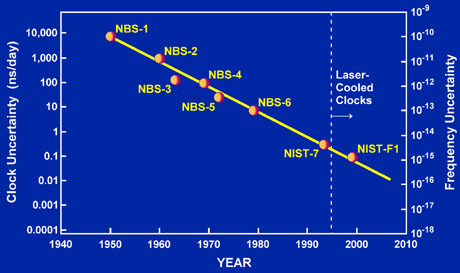
For the atomic age I got the figures from here
So that gives the data
year accuracy
1650 10E+03
1721 10E+05
1889 10E+07
1952 10E+08
1955 10E+10
1970 10E+13
1989 10E+16
2008 10E+17
One problem with this line of thought is that exponential increases tend to stop. Otherwise we would be up to our ears in Fibonacci's rabbits. The problem with this exponential reasoning is described here
There are all sorts of other things whose accuracy have improved over time. Has temperature and mass measurement accuracy increased at the same rate?
So take time. How quickly is our ability to measure time accurately improving?
I'm going to have a look at how accurately people have been able to measure time since the start of the modern world (about the time Newton got hit by an apple) till now. I take accuracy to mean how many seconds you could count before you would be out by one on average.
1656, Dutch astronomer Christian Huygens. It had an error of less than one minute a day according to here
1721, George Graham improved the pendulum clock’s accuracy to within a second a day
1761 John Harrison, half a second a day
1889 to Siegmund Riefler's clock with a nearly free pendulum, which attained an accuracy of a hundredth of a second a day
1952 Quartz clock at accuracy of 1 in 10^8 seconds.
Modern times are graphed here
For the atomic age I got the figures from here
So that gives the data
year accuracy
1650 10E+03
1721 10E+05
1889 10E+07
1952 10E+08
1955 10E+10
1970 10E+13
1989 10E+16
2008 10E+17
One problem with this line of thought is that exponential increases tend to stop. Otherwise we would be up to our ears in Fibonacci's rabbits. The problem with this exponential reasoning is described here
There are all sorts of other things whose accuracy have improved over time. Has temperature and mass measurement accuracy increased at the same rate?
Monday, April 06, 2009
Turkeys Voting for Christmas
Surely this expression should mean that things should not engage in acts they don't have the cognitive capacity needed to do. A bit like saying dogs should not do quantum theory. Taleb has a theory of turkey philosophy here.
But that is not the excepted meaning which is
Other then the obvious practical difficulties of running meleagrine elections Christmas has to be the best thing that has ever happened to turkeys. I remember a talk on the long now that the best way to ensure your species survival is to be really tasty.
Without Christmas we would have no reason to have such large numbers of turkeys. People don't keep skunks because they serve no useful purpose. Numbers would be vastly reduced. If only wild turkeys survived and they were not farmed for food their numbers would be orders of magnitude less.
Of course there is the question of whether it is a good idea for turkeys to put all their eggs in one basket Christmas wise. They have intelligently diversified in the American market into thanksgiving. Some sort of Summer festival in Asia would be where they should concentrate their marketing on next I would think.
But that is not the excepted meaning which is
like turkeys voting for (an early) Christmas (British & Australian humorous)
if people are like turkeys voting for Christmas, they choose to accept a situation which will have very bad results for them
Usage notes: Turkeys are large birds which are often eaten on Christmas Day.
Other then the obvious practical difficulties of running meleagrine elections Christmas has to be the best thing that has ever happened to turkeys. I remember a talk on the long now that the best way to ensure your species survival is to be really tasty.
Without Christmas we would have no reason to have such large numbers of turkeys. People don't keep skunks because they serve no useful purpose. Numbers would be vastly reduced. If only wild turkeys survived and they were not farmed for food their numbers would be orders of magnitude less.
Of course there is the question of whether it is a good idea for turkeys to put all their eggs in one basket Christmas wise. They have intelligently diversified in the American market into thanksgiving. Some sort of Summer festival in Asia would be where they should concentrate their marketing on next I would think.
Friday, March 27, 2009
What have a panzer tank and a Dublin taxi got in common?

You can use statistical methods to estimate their numbers boom boom
How many taxis are there in Dublin? I'm going to try guess without looking it up then see if I'm right. And I'm going to use Panzers to do it.
During WW2 the allies had to try guess how many tanks the germans had. From the Guardian
"The statisticians had one key piece of information, which was the serial numbers on captured mark V tanks. The statisticians believed that the Germans, being Germans, had logically numbered their tanks in the order in which they were produced"
People are always trying to guess how many of something there is. Iphones, kindles, computer worms, all sorts of man made objects. Mainly though it is important for military reasons.
Lancasters square law says that the power of a modern military force is proportional not to the number of units it has, but to the square of the number of units. This means that relatively small changes in the number of units an enemy has can have big changes in their effectiveness. Play around with the graph of x^2-x; here if you want to see for yourself. This is also important in computer game simulations of military operations.
Anyway I'll get some data on the Dublin Taxi driver licence numbers and get back with the calculation. The estimation problem should make more sense with an example.
Tuesday, March 24, 2009
The Lottery of Penalties
Croatia boss Slaven Bilic: "Penalties are a lottery and the players felt confident enough to take the spot kicks."
Redknapp's post-match attitude was that penalties are a "lottery"
Max Tonetto: “We played a great game, and unfortunately we were punished by the lottery of penalties.”
There is not much research on this area. This paper implies
“The research shows that the individual goal-scoring skills do play a role in scoring goals from penalties and that the result is not exclusively a matter of luck… The belief that a penalty shootout is a lottery made players more receptive to the negative consequences of anxiety-caused stress.”
So according to Geir Jordet and Esther Hartman's research not only is a penalty kick not a lottery but saying it is hurts your team.
Sunday, March 15, 2009
Submarine Collision Probability 3
Ok last time on the how often should two nuclear submarines smack into each other question. This particular sum managed to get me and Luke into the Wall Street Journal print edition here and their blog here. Which was nice.
So the sum is a mean free path calculation. Where the particles are submarines and the box they are in is the submarine patrol zone or the whole Atlantic depending.
The size of a submarines patrol area is generally set by the requirement to have a surface support vessel within 24 hours. If one of these could travel at 20 knots an hour it could cover an circle with radius of 900 kilometers. The maximum operating depth is not much more than 600m and the submarine has to operate about 100m below the seasonal thermocline. A stealth mode speed is about two meters per second. The size of a nuclear submarine is about 150m length by 12m diameter plus a conning tower of about 8m high by 12 meters long. We modeled this cylinder as a sphere, which on these scales should not be too bad.
A support ship can support up to 14 subs. So we took it that there were 14 in its particular area in the small sum. If there were 14 gas particles wandering around a box the size of the Atlantic (big) or a ships support area (small). from a depth of 100m to 600m. At a speed of 2 meters a second. How often would you expect one to hit another is what we worked out.
Nuclear submarines have to stay 100 meters below the seasonal thermocline. We took the thermocline to be zero based on this
The model "mean free path" used is derived here
Now these are big ifs, thinking of things as being random gas particles is a big IF. People thought derivatives acted like random particles (the Black–Scholes model) and they just lost a lot of money. So I think this is more "fun application" of physics rather than "rigorous analysis". Thanks to Luke and Carl who crunched the numbers and got the data (i.e who did all the work).
Thursday, March 05, 2009
Malware News 2012
Turing Bots Are Coming
Autonomous IM bots with near human appearance have become an increasing source of malware infection in the last few months. Early attempt at such IM "Turing bots" first occurred in 2007. However recent improvements in the technology have lead to increased success in these infection methods. The bots attempt to appear human in instant messenger communications. This is generally to attempt to learn bank account information.
Eliezer Yedkawsky who has for years pointed out the security threat of artificial intelligence warned yesterday "Why does a dog wag its tail? Because the dog is smarter than the tail. If the tail was smarter, it would wag the dog."
A security expert dismissed as preposterous the idea that smarter then human AI coming from IM bots represents an existential threat to humanity.
NamScan closes
In related news a Vietnamese Anti Virus company NamScan closed yesterday. The Buddhist workers at the company refused to create software that would destroy intelligent AI bots. A company spokesman said "this is a strange cult that has grown up in our company. The engineers believed that if a program a collection of bits could pass the Turing test then it was in some way "human" and destroying it would be immoral".
The ruling on the court case between the antivirus industry and PETAI (people for the ethical treatment of AI) is due next week. A spokesman for the antivirus industry said "without the ability to stop these programs the whole internet will collapse".
Wednesday, March 04, 2009
Satellite Collisions
If something is worth doing its worth overdoing. So rather then continue to explore the massive conspiracy against life that is nuclear weapons I want to look at satellites.
"In an unprecedented space collision, a commercial Iridium communications satellite and a defunct Russian satellite ran into each other Tuesday above northern Siberia, creating a cloud of wreckage, officials said today."
There are all sorts of worries here about the effects of shards of satellite debris hurtling round the earth. Mainly though there are incredibly cool graphics of stuff smashing together.
Now I believe thinking about nuclear submarines as wandering particles (as i did here) makes sense on the grounds they are supposed to act in a random manner. Satellites however are deliberately put into set orbits to exclude collisions. They do change path occasionally though based on fuel leaks, gravity effects or being moved for operational reasons but they do not change path often enough for this model to be anything like a good fit. But if we did think of satellites as particles in a box how often would there be hits? If you are interested in a better back of the envelope there is one here.
"The Iridium satellite spanned about 5 meters across its solar arrays. Strela-2M used gravity gradient stabilization, and probably spanned 17 meters including the gravity boom. When calculating collision probabilities, it's important to remember that booms and antennae mean that many satellites have much larger cross-sections than the size of their main body would imply."
Number of particles=300 satellites
Size of particles= 2 meterish sphere
speed: 8000 mps
size of box= 0.06370550904E+12 cubic kilometers
as in earth Mean radius is 6,371.0 km. So sphere of size (6,371.0 km + 800) - sphere of size (6,371.0 km + 700) is the total area.
total volume of satellite = 600 cubic meters
satellite per unit area= 600/0.06370550904E+12 cubic kilometers
A java program to calculate this is below
Satellites should hit every 1.42E7 years. Which makes me fairly sure I've gotten my zeroes wrong somewhere.
"In an unprecedented space collision, a commercial Iridium communications satellite and a defunct Russian satellite ran into each other Tuesday above northern Siberia, creating a cloud of wreckage, officials said today."
There are all sorts of worries here about the effects of shards of satellite debris hurtling round the earth. Mainly though there are incredibly cool graphics of stuff smashing together.
Now I believe thinking about nuclear submarines as wandering particles (as i did here) makes sense on the grounds they are supposed to act in a random manner. Satellites however are deliberately put into set orbits to exclude collisions. They do change path occasionally though based on fuel leaks, gravity effects or being moved for operational reasons but they do not change path often enough for this model to be anything like a good fit. But if we did think of satellites as particles in a box how often would there be hits? If you are interested in a better back of the envelope there is one here.
"The Iridium satellite spanned about 5 meters across its solar arrays. Strela-2M used gravity gradient stabilization, and probably spanned 17 meters including the gravity boom. When calculating collision probabilities, it's important to remember that booms and antennae mean that many satellites have much larger cross-sections than the size of their main body would imply."
Number of particles=300 satellites
Size of particles= 2 meterish sphere
speed: 8000 mps
size of box= 0.06370550904E+12 cubic kilometers
as in earth Mean radius is 6,371.0 km. So sphere of size (6,371.0 km + 800) - sphere of size (6,371.0 km + 700) is the total area.
total volume of satellite = 600 cubic meters
satellite per unit area= 600/0.06370550904E+12 cubic kilometers
A java program to calculate this is below
class Sat {
   public static void main(String[] args) {
   int numPart=300;//sat number
       int sizePart=2; // sat sizeg.
       int speed=8000;//sat speed
       Double below=new Double (1d);
       below=1.41421356*3.14159265*2;//sqrt(2)*pr*r is part of mean free path sum
       Double sizeBox =new Double(63705509040000000000d);//areas sats are in
       double totalSat= numPart*sizePart;//total volume of sats
       double SatPerUnit=totalSat/sizeBox;//how many sats per unit area?
       Double meanFreePath=new Double(1d);
       meanFreePath=1/(below*(1/sizeBox));//mean free path calculation
       Double often= new Double(1d);
       often=meanFreePath/speed;
       often=often/(365*24*3600);
       System.out.println("Satelites should hit every
"+often+" years");
   }
}
Satellites should hit every 1.42E7 years. Which makes me fairly sure I've gotten my zeroes wrong somewhere.
Subscribe to:
Posts (Atom)